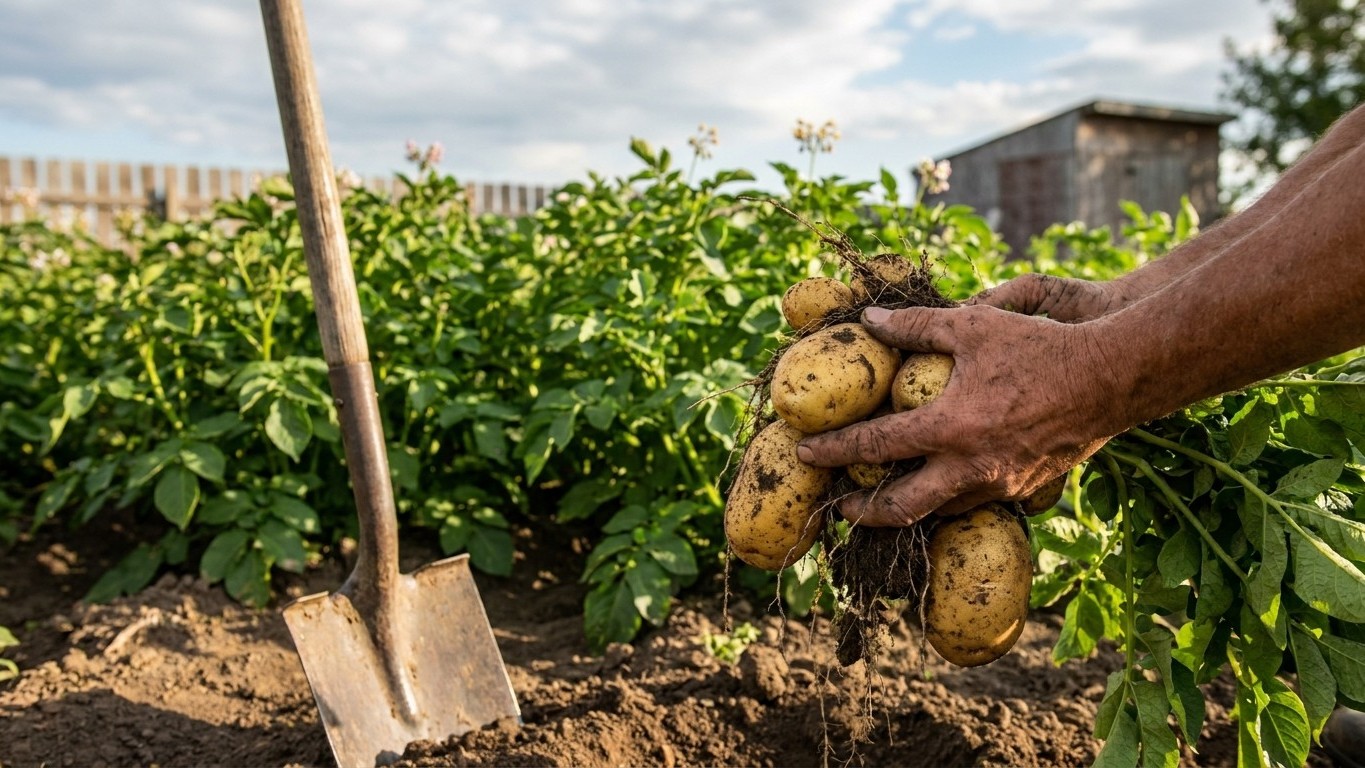

North Dakota gardeners get a rare break: summer heat almost never threatens the crop. The state’s reference city, Fargo, logs only 11.7 days a year at 90 F or hotter, according to NOAA NCEI Climate Normals. With the last spring frost window running May 4 to May 15, the growing season here supports a full-season crop dug in late summer, not a rushed spring-only harvest like in hotter states, and Harvesting and Storing Potatoes in North Dakota covers how to time and manage that later dig.
The short answer

Two numbers decide how this crop behaves in any state, and both point the same direction in North Dakota. The first is the mean count of days a year hitting 90 F or above, measured at the reference station in Fargo: 11.7 days, per NOAA NCEI Climate Normals covering 1991-2020. The second is the last spring frost window for that same station, May 4 to May 15, also from NOAA NCEI records.
Compare that 11.7-day figure to what actually stops a potato crop from producing. Utah State University Extension identifies the mechanism plainly: tuber set and fill is inhibited once soil temperatures climb above 90 F. That’s not air temperature, it’s soil temperature at the depth where tubers are forming, and it’s a hard biological ceiling, not a suggestion. In states where 90-degree days stack up by the dozens through July and August, that ceiling gets hit early and stays hit, which is why gardeners there dig a spring crop before the heat arrives and skip trying for a second one.
North Dakota doesn’t have that problem. Fewer than a dozen days a year cross the 90-degree threshold, and they’re scattered rather than sustained. Soil temperature under a hilled potato row rarely tracks air temperature exactly, either. It runs cooler, buffered by the soil mass and by mulch or hilling. That means a North Dakota gardener planting in May is very unlikely to watch tuber development stall from heat in July. The bottleneck here isn’t summer heat. It’s the length of the cool part of the season on either end, bookended by that May frost window in spring and the first fall freeze later on.
What that means practically: choose a planting date driven by soil temperature and frost risk, not by fear of midsummer heat, and When to Plant Potatoes in North Dakota lays out exactly how that timing works. Full-season and late-season varieties, which need more time on the vine to bulk up their tubers, are a realistic choice in a state where heat rarely intervenes, and it’s worth reviewing Potato Varieties That Suit North Dakota before deciding what to plant. That’s a different calculus from a hot-summer state, where a late variety might not finish sizing before soil temperatures cross that 90-degree line. Here, the growing window itself, not heat stress, is what a gardener plans around.
When to plant here
Planting date isn’t picked from a calendar page. It’s calculated backward from two things: the local frost window and a soil temperature threshold. Here’s the sequence, worked out for the Fargo reference window of May 4 to May 15.
- Start from the last frost date. NOAA NCEI puts Fargo’s last spring frost window at May 4 to May 15. That’s the point after which frost risk drops sharply, based on the station’s freeze-probability records.
- Subtract 14 to 21 days. Utah State University Extension and University of Maine Cooperative Extension both give the same rule: potatoes go in the ground as soon as soil reaches 50 F, and that point typically falls 14 to 21 days before the last frost date. For a May 4 frost date, that lands in mid-to-late April. For a May 15 frost date, it lands in late April to early May.
- Confirm with a soil thermometer, not a guess. Air temperature and soil temperature diverge, especially in early spring when the ground is still cold from winter. A $10 soil thermometer pushed 4 inches deep tells the actual number that matters: 50 F, sustained, not a single warm afternoon reading.
- Adjust for your own ground. Heavy clay soil warms slower than sandy loam. A north-facing garden warms slower than a south-facing one. Raised beds and black plastic mulch can push that 50-degree mark a week earlier.
The arithmetic is portable to any North Dakota county: take the local last-frost date, subtract two to three weeks, then verify with a thermometer instead of trusting the calendar math alone. That sequence matters more than any fixed date, because frost timing shifts county to county even within a state with a fairly uniform climate like this one.
What the heat does to the crop
The mechanism is the same everywhere, even though its consequences differ by state. Utah State University Extension is direct about it: once soil temperature rises above 90 F, tuber set and fill shut down. The plant doesn’t die, and the foliage may look fine, but the underground process of forming and enlarging tubers stalls out. University of Maine Cooperative Extension Bulletin #2077 describes the same cool-season biology behind the crop, which is why potatoes are planted early relative to the frost date rather than after the ground has fully warmed.
Here’s the detail that trips people up in hotter states, and it’s worth stating plainly: watering more does not fix this. Soil moisture and soil temperature are separate variables. A gardener can keep the root zone perfectly damp and still watch tuber sizing stop cold once soil temperature crosses that 90-degree line, because the inhibition is a temperature response, not a drought response.
North Dakota’s 11.7 average days a year at 90 F or above (Fargo, NOAA NCEI) means that ceiling gets brushed against occasionally, not lived under for weeks at a stretch. A crop planted according to the frost-window math above spends most of its development period well under that threshold. That supports carrying a crop through a full season rather than racing to dig everything before summer arrives, which is the standard advice in states where 90-degree days number in the dozens or more.
Mulch and hilling still help here, even with a low heat-day count, because they buffer soil temperature swings on the handful of hot days that do occur and they keep developing tubers shaded so they don’t green up. But the core takeaway for this state is that heat stress on tuber set is the exception, not the rule, across a typical North Dakota season.
What goes wrong here
- Uncertified seed potatoes. Seed saved from a grocery-store potato or an uninspected source often carries viral disease that won’t show up until the plant is already struggling mid-season. Certified seed potatoes, sold as such and traceable to an inspection program, is the one input worth not cutting corners on.
- Planting into cold, wet soil before it reaches 50 F. Seed pieces sitting in cold, saturated ground are prone to rot before they ever sprout. Waiting for the soil thermometer to confirm 50 F, rather than planting on a fixed date, avoids losing the seed piece entirely.
- Skipping the hilling and ending up with green tubers. Tubers that push up near the surface and get exposed to sunlight turn green and develop solanine, a compound that makes them unsafe to eat. Hilling soil up around the base of the plant as it grows keeps developing tubers covered and prevents this.
- Digging too early. Pulling potatoes before the vines have died back naturally, or before the skins have had a chance to set, produces thin-skinned tubers that bruise easily and don’t store well. Letting the foliage die down on its own before harvest gives the skins time to toughen for storage.
Checking this against your own county
The Fargo figures anchor this article, but they’re a starting point, not a rule for every North Dakota garden. Elevation, and the state’s own north-south stretch, shift both the last frost date and the count of hot summer days by a meaningful margin. A garden in a low-lying river valley can see a different frost pattern than one on higher, more exposed ground even a short drive away. Suburban and rural gardens also tend to see their last spring frost later, and their first fall frost earlier, than an airport weather station reading, sometimes by one to two weeks.
The fix is straightforward: check the numbers for your own county rather than assuming the statewide figures apply exactly. NDSU Extension maintains local growing guidance and frost data by region, and it’s the resource to consult before locking in a planting date. The math from this article, the frost-window backward count and the 90-degree ceiling, still applies. Only the specific dates need adjusting for where you actually garden.
Common questions
Can I plant a second potato crop after the first harvest in North Dakota?
The frost window and season length here favor a single full-season crop rather than a spring-and-fall double planting common in warmer states. With a last frost around May 4 to May 15 and heat rarely a limiting factor, growers typically use the full season for one crop rather than splitting it.
Does mulching help even though North Dakota rarely hits 90 F?
Yes. Mulch and hilling still buffer soil temperature swings on the occasional hot day and, more importantly, keep developing tubers covered so they don’t green up from sun exposure.
Should I choose an early or late-season variety here?
Because summer heat rarely interrupts tuber development in this state, later-season varieties, which need more time on the vine, are a realistic option alongside early ones. The choice comes down to how you plan to use the crop: some varieties are suited to baking, others to boiling, and that published use, not a maturity-day count, is the detail worth checking on the seed label.
What if my soil hits 50 F earlier than the statewide estimate suggests?
Trust the thermometer over the calendar. The 14-to-21-day-before-last-frost rule is a guideline for estimating timing, but a soil thermometer reading of a sustained 50 F is the actual trigger for planting, regardless of what date that falls on in a given year.