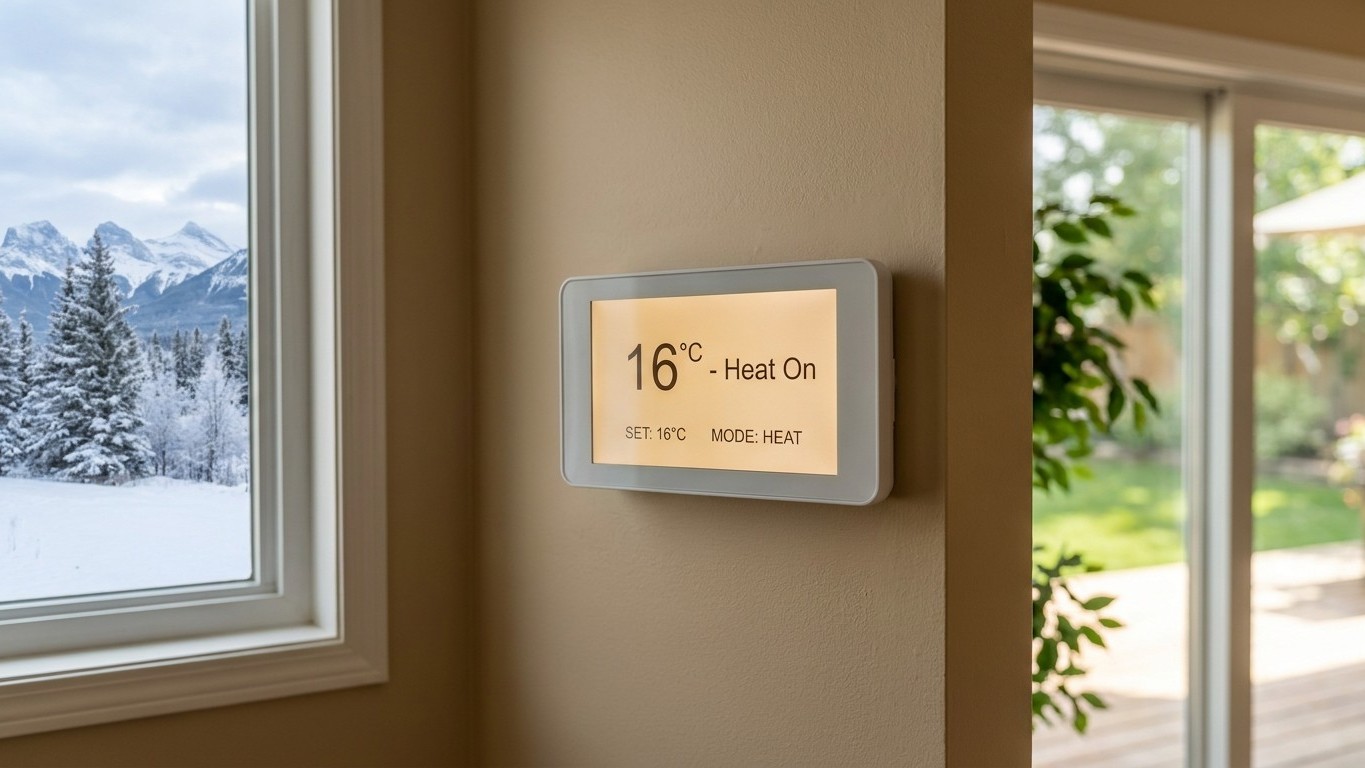

In Calgary and across Alberta, there’s no single month when the furnace gets its seasonal wake-up call, because the season never really ends. Every month of the year, including July, the average daily temperature stays cold enough to call for indoor heat. What changes isn’t whether you need heat, but how much. January brings the heaviest demand; the shoulder months of June through September bring the lightest.
When the heating season starts in Alberta

Ask a homeowner in most of the country when heating season starts, and you’ll get a month. Ask in Alberta, and the honest answer is that it doesn’t start, because it doesn’t stop. At the Calgary International Airport weather station, the 1981-2010 climate normals show the mean daily temperature falling below 18 degrees Celsius, the standard threshold used to calculate heating demand, in every single month of the year. Even July, the warmest month on the books, averages 16.5 degrees Celsius, still under that line. There’s no calendar gap wide enough to call a true “off season.”
That doesn’t mean the furnace runs the same way in July as it does in January. Demand swings hard across the year, and the shape of that swing matters more than any single start date. January is the peak, with 778 heating degree-days recorded for the month, more than any American northern city typically posts even at its own coldest point. The table below breaks down the monthly totals, and it’s worth sitting with for a second, because it shows just how compressed the “light” season really is here.
| Month | Heating degree-days (base 18°C) |
|---|---|
| January | 778 |
| February | 659 |
| March | 607 |
| April | 403 |
| May | 254 |
| June | 134 |
| July | 67 |
| August | 84 |
| September | 213 |
| October | 398 |
| November | 612 |
| December | 769 |
Notice the pattern: even August, deep in what most of the country calls summer, still logs 84 degree-days. That’s the thing about Alberta’s climate, the dip is real but it’s shallow, and it’s short. Practically speaking, most households treat late spring through early fall as the stretch where the furnace can idle, and treat everything from October through April as full working season. But that’s a habit built from experience, not a rule written anywhere.
One caveat worth keeping in mind: these are thirty-year averages from a single station, Calgary International Airport. A monthly normal describes the typical shape of a season, not the exact morning your particular house gets cold. The first hard frost of the year has a way of arriving before the calendar, or the averages, suggest it should.
How hard the winter works here
Add up all twelve months and Alberta lands at roughly 4,979 heating degree-days a year, measured against that 18-degree-Celsius base. Degree-days are essentially a stand-in for fuel use: a house that sees twice the degree-days of another, similar house, will burn roughly twice the fuel to stay comfortable, all else being equal. That’s the number that actually predicts your winter, more than any single cold snap does.
What the annual total doesn’t tell you is the shape of the load, and that’s exactly why the monthly table above matters. Two places can post similar yearly totals for very different reasons, one with a long, mild, grinding season and another with a short, brutal one. Alberta’s pattern leans toward the former: the cold arrives early, stays late, and never fully lets go, rather than delivering one ferocious month and calling it done. That has real consequences for equipment. A furnace here isn’t sprinting through a short crisis, it’s pacing itself through a long haul, which is one more reason the pre-season check covered further down matters as much as it does.
It’s worth resisting the urge to stack this number against a heating degree-day figure from south of the border. Canadian normals use an 18°C base measured from 1981-2010; American figures typically use a 65°F base from 1991-2020. Different starting point, different measuring period, different math entirely. The comparison that actually means something is Alberta against another Canadian province or another Environment and Climate Change Canada station, not Alberta against a U.S. city.
What most homes in Alberta actually heat with
Statistics Canada’s most recent survey on primary heating systems gives a clear picture of what’s actually installed in Alberta homes, even if it doesn’t tell you what should be installed.
| System | Share of homes |
|---|---|
| Forced-air furnace | 78% |
| Boiler with hot-water or steam radiators | 7% |
| Heat pump | not reported |
| Electric baseboard heaters | not reported |
| Heating stove | not reported |
That “not reported” designation isn’t a way of saying zero. It means the sample size for that category was too small in this survey to publish a reliable estimate, not that nobody in the province uses heat pumps or baseboard heat. Statistics Canada is simply declining to guess.
The forced-air furnace’s dominance at 78 percent isn’t an endorsement, it’s a fossil record. It tells you what fuel was affordable and what technology was standard when a large share of Alberta’s housing stock went up, nothing more. A share of installed systems describes the past, not what fits your house today.
Living with a forced-air furnace day to day means a system that heats a house quickly and evenly through a duct network, and that recovers fast after a cold snap, both real advantages given how long Alberta’s heating season runs. The tradeoff shows up in the ductwork itself: a forced-air system is only as good as the path the air travels, and leaky, poorly sealed ducts can bleed away a meaningful share of the heat before it ever reaches a room. The one maintenance item that gets skipped most often, and punishes homeowners hardest for skipping it, is the air filter. A clogged filter restricts airflow, forces the blower motor to work harder, and can shorten the life of the whole system, all for the cost of a filter change most people put off for one season too many.
Run it once before you need it
Every heating system in Alberta seems to fail on the same night: the first genuinely cold one, when every HVAC technician in the region is already booked solid. The fix is to test the system weeks earlier, sometime before the demand curve climbs through October and November on its way toward the January peak. Here’s the order that matters, cheapest and fastest steps first, the ones a reader should do even if they stop partway through.
- Turn the thermostat up and run the system through a short cycle, just a few minutes, while you stay nearby and listen. Rattling, grinding, or a burning-dust smell on that first firing is normal, it’s just dust burning off elements that sat cold all summer. It should clear within a few minutes; if it doesn’t, or if the smell is stronger than dust, shut it off.
- Check and replace the air filter if it’s dirty. This is the cheapest, fastest step on the list, and the one most likely to prevent a mid-winter breakdown.
- Clear the space around every vent, radiator, or outdoor unit. Furniture pushed against a vent, boxes stacked near a radiator, or debris around an outdoor heat pump unit all choke airflow the system needs.
- Test the carbon monoxide alarm. A forced-air furnace burning fuel indoors carries a real risk if it’s malfunctioning, and a working alarm is the cheapest insurance available. Test it, replace the batteries if needed, and move on.
- Walk the ductwork you can access, in the basement or attic, looking for disconnected joints, crushed sections, or obvious gaps. The U.S. Department of Energy notes that in a typical house, about 20%-30% of the air moving through the duct system is lost to leaks, holes, and poorly connected ducts, meaning a furnace can be running perfectly and a room can still stay cold simply because the air never gets there.
- If the system doesn’t respond normally, if it won’t hold a cycle, trips a breaker, or the smell doesn’t clear, stop and call a technician before the cold weather arrives and the schedule books up.
What turning it down is actually worth
The U.S. Department of Energy states it plainly: “You can save as much as 10% a year on heating and cooling by simply turning your thermostat back 7-10°F for 8 hours a day from its normal setting.” That figure covers heating and cooling combined, over a full year, for that specific setback held for that specific stretch of hours, nothing looser than that.
For a house in a place where the heating season runs essentially year-round, that setback has more hours to work with than it would somewhere with a short winter. A nightly setback during sleeping hours, or a daytime setback while the house sits empty, applies against a heating load that barely lets up from October through April, and even lingers into the shoulder months on either side. The math the Department of Energy quotes doesn’t change with climate, but the number of days it gets applied does.