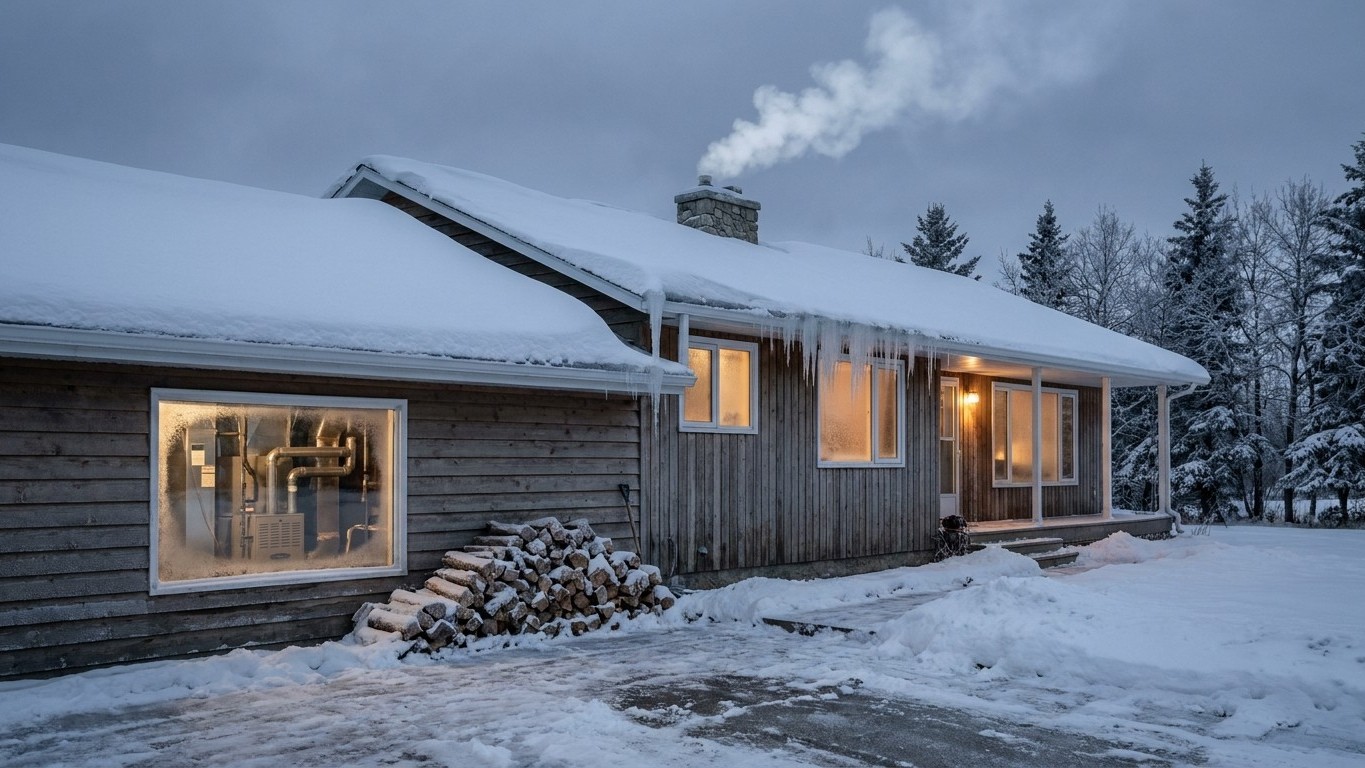

Alberta winters don’t just dip below freezing, they camp out there for months at a stretch. That reshapes everything about heating a home here: how hard a furnace runs, how much wood a wood-burning household needs stacked by October, and how long that wood has to sit before it’s actually worth burning.
How cold it gets, and for how long

The mean daily minimum for the coldest month in Calgary sits at 8.2°F, according to Environment and Climate Change Canada’s 1981-2010 Climate Normals. That’s not the record low, and it’s not some average that flatters the season by mixing in mild afternoons. It’s the number that tells you what a typical night looks like in the depth of winter, and 8.2°F is genuinely cold: cold enough that a furnace isn’t cycling on and off so much as running long, steady stretches to keep up.
What matters just as much as the low itself is how long it lingers. A place that spends four months hovering near the freezing mark asks a different question of a heating system than one that drops much lower but only for six or eight weeks. Alberta leans toward the first kind of winter: sustained cold, not just occasional brutal snaps. That means equipment sized for endurance, not just for surviving a cold snap in January, and it raises a practical question worth answering directly: When Does the Heating Season Start in Alberta?
For a furnace, that translates into more total runtime across the season, which shows up on the gas or electric bill as much as it shows up in comfort. For a wood stove, it means the difference between needing a few cords to bridge occasional cold nights and needing enough wood to carry a household through a genuinely long heating season, often five or six months once you count the shoulder periods in October and April when a house still needs a fire in the evening even if the days feel milder.
None of this is exotic weather. It’s the baseline. And that baseline is exactly why sizing decisions, whether for a furnace or a wood-burning setup, get made around the coldest-month minimum rather than around some warmer statewide average that doesn’t describe what actually happens on a February night.
What a cord of wood is worth here
A cord is a volume, not a weight, and that distinction is where a lot of firewood buyers get shorted. The standard definition is a stack measuring 4 feet by 4 feet by 8 feet, which works out to 128 cubic feet total. Nothing in that definition says what kind of wood fills the stack, and that’s the whole trick: a cord of dense hardwood packs a lot more actual wood mass into those 128 cubic feet than a cord of a lighter species, because the pieces themselves are heavier per unit of volume.
According to Michigan State University Extension, a cord of well-seasoned hardwood delivers roughly 20 million BTU. MSU frames that figure in terms a homeowner can actually use: one cord is roughly equivalent to the heat you’d get from 145 gallons of #2 fuel oil, or from 215 gallons of LP gas. That’s a useful anchor for planning how many cords a given winter is going to eat through, especially in a place where the heating season stretches as long as it does across most of Alberta.
But that 20 million BTU number comes with a condition attached: it assumes well-seasoned wood, meaning the moisture has already been driven out. Green wood, fresh off the tree, doesn’t deliver anywhere near that heat output, because a chunk of the energy in that fire goes toward boiling off water still trapped inside the wood before any of it reaches the room as usable heat. That’s the seasoning question, and it’s the difference between a cord that actually earns its price and one that mostly produces smoke and disappointment.
The species matters too, and it’s worth remembering that not every stack labeled a “cord” is stacked to the same standard, so a buyer checking dimensions before paying is doing basic due diligence, not being difficult.
How long wood takes to dry in Alberta
Seasoning time isn’t a fixed number stamped on every species everywhere. It depends on local humidity and how much summer heat a region gets to pull moisture out of split wood over the warm months, which means the same species can season faster in a dry, hot climate than in a damp one. MSU Extension puts the target at 20 percent moisture or less for wood that’s ready to burn efficiently, and notes that green wood coming straight off a fresh cut can run over 60 percent moisture. That’s a massive gap to close, and it doesn’t close on its own just by letting logs sit in a pile.
Splitting and stacking the wood so air actually moves through it is what gets green wood down to that 20 percent mark, typically after one full summer of proper seasoning. Rounds left whole, or wood piled in a heap with no airflow, dry far slower and sometimes never really get there before winter arrives. Red oak is the notable exception MSU flags: its cell structure makes it dry more slowly than other hardwoods, so it needs extra time beyond what a typical species requires.
Burning before that moisture threshold is reached costs a household on two fronts. First, less usable heat reaches the room, because energy that should be warming the house is instead spent evaporating water trapped in the wood. Second, and this is the part that causes real problems down the line, unseasoned wood produces more creosote buildup in the flue. That means a chimney needing to be swept sooner than it otherwise would, and a higher risk profile for anyone burning wood regularly through a long Alberta winter. Neither of those outcomes shows up the first time someone burns a green log, which is exactly why the mistake is so common: the cost shows up later, in a duller fire and a dirtier flue.
Where to check before you buy
Everything above describes conditions around Calgary, the reference station behind the coldest-month figure. Alberta covers a wide range of elevation and exposure, from foothills communities to prairie towns to areas further north, and species availability along with local drying conditions can shift noticeably across that range. A number that fits Calgary won’t necessarily match a property up against the Rockies or out on the open plains.
That’s where Alberta’s provincial agriculture and irrigation office becomes the more useful reference than any general climate figure. The site, run by the province, is the place to check for guidance specific to a given area, including which species are commonly available locally and what seasonal burn restrictions might be in effect. Burn rules are set locally and they change from year to year depending on air quality conditions, wildfire risk, and local bylaws, so a restriction that applied last winter isn’t a safe assumption for this one.
Anyone planning to heat with wood this season, or supplementing a furnace with a wood stove for the coldest stretches, is better off checking current rules before stacking a winter’s worth of cords rather than after.
What each heat source costs to run in Alberta
At Alberta’s average residential prices, this is what one million Btu of heat delivered into the house costs with each system (Canadian dollars). It compares fuels on the same unit: it is not a yearly bill, and it leaves out the price of the equipment.
| System | Cost per million Btu delivered |
|---|---|
| Electric resistance (baseboard, 100% efficient) | C$67.12 |
| Heat pump at 8.1 HSPF2 (seasonal COP about 2.4) | C$28.27 |
Cheapest to run in Alberta: heat pump, C$38.85 less per million Btu than the electric resistance.
Prices: Hydro-Québec, 2025 Comparison of Electricity Prices in Major North American Cities. Efficiencies: ENERGY STAR criteria. A heat pump’s figure is a seasonal average; in the coldest weather its efficiency drops.