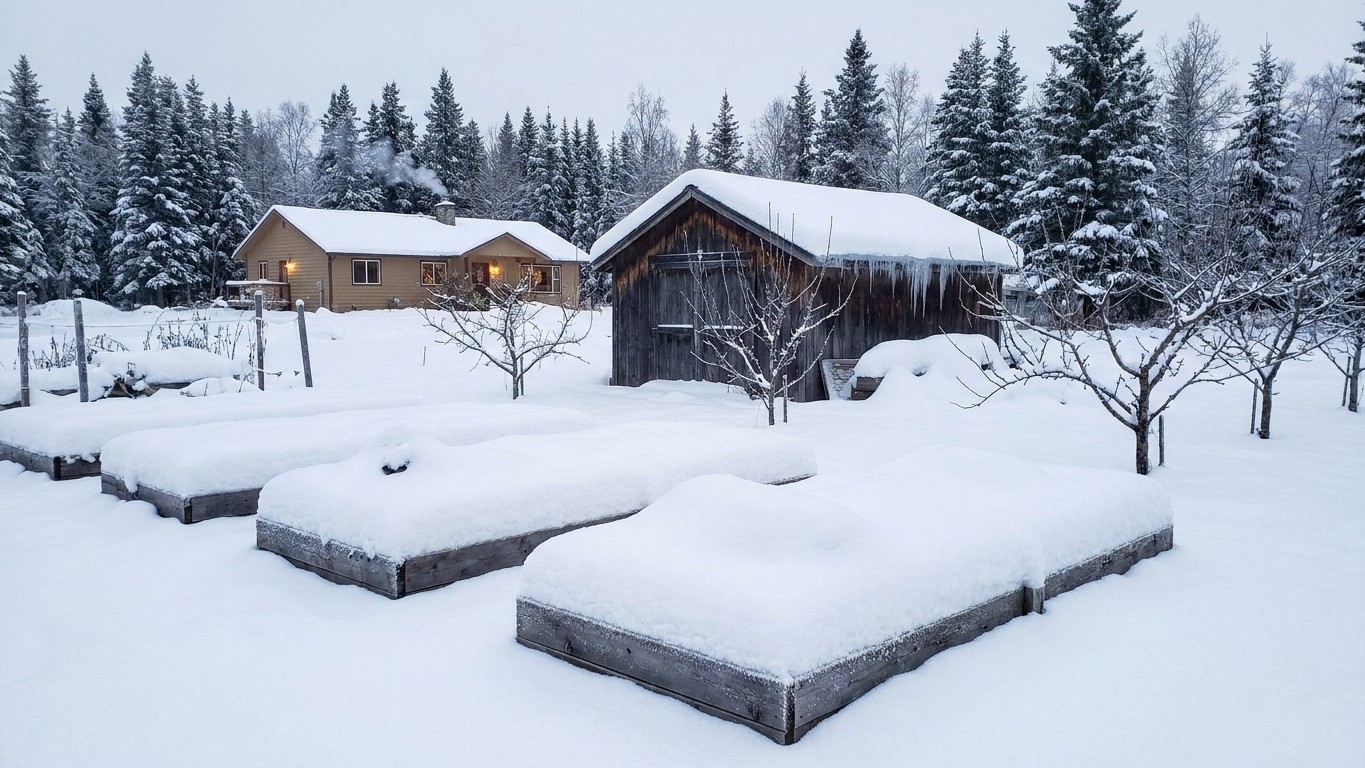

In Anchorage, the ground in December sits frozen solid under months of snow, and the answer to what goes outside is nothing. That’s not a gap in the calendar, it’s the whole point of this stretch: the garden work now is dormant pruning, seed ordering, tool care, and keeping stored crops from rotting before spring.
What goes in the ground in December

Nothing goes into open ground in Alaska this month, and the reason isn’t just cold air, it’s frozen soil. Anchorage’s last spring frost window runs May 3 to May 12 (NOAA NCEI 1991-2020 Climate Normals, station USW00026451), which puts December roughly five months out from that window on one side and about two and a half months past the first fall frost (September 22 to October 1) on the other. That’s deep dormancy, not a planting gap you can shortcut.
Garlic and shallots, which normally go into Alaska ground in fall so roots establish before freeze-up, are already past that window by December. If cloves never made it into the ground in fall, the outdoor option is closed until the thaw; the better move is potting them in a container of soil kept in an unheated but frost-protected space, or simply holding them for spring planting once soil is workable again.
Cold frames offer little in December across most of Alaska. Between the extreme cold and the short daylight hours, even a well-built frame can’t warm soil enough to matter, and in the far north there may be only a few hours of usable light in a day. Low tunnels face the same limits.
What does work indoors this month is forcing. Rhubarb crowns dug and brought into a dark, cool space (roughly 50 to 60 F) will push tender stalks in a matter of weeks without any light needed. Belgian endive (chicory) roots can be forced the same way, packed in soil or sand in complete darkness to produce pale, tight heads. Both give a fresh harvest from material that’s otherwise sitting dormant outside. Beyond that, honestly, December is a month for prep rather than planting.
What to start under cover
Counting backward from Anchorage’s last frost window of May 3 to May 12 is the only reliable way to time indoor starts, and December is still too early for nearly everything. Onions, one of the slowest crops to reach transplant size, typically need 10 to 12 weeks under lights before they go out. Counting back from early May puts that start in mid-February to early March, not December. Start onions now and by transplant time they’ll be rootbound, yellowing, and stressed well before the ground is even ready.
Celery and leeks run on a similarly long clock, usually 10 to 12 weeks as well, and land in the same February window. Anything with a shorter run, peppers or slow tomato varieties among them, needs even less lead time and would sit far too long indoors if started in December.
That leaves two honest failure modes to watch for. Start too early, as December would be for almost every seed on the list, and the payoff is leggy, light-starved seedlings that stall out before the garden is ready for them. Start too late, which is the opposite risk come February and March, and Alaska’s short frost-free stretch of roughly 143 days won’t leave enough time for crops to mature. December’s real job on this front is prep: setting up grow lights, testing germination rates on saved seed, and building a start schedule keyed to that May frost window so nothing goes into a tray before its time.
What is ready to pick
Outdoors in Alaska in December, there’s little to nothing coming out of the garden. Snow cover and frozen ground close that door across nearly the whole state, including Anchorage. In the mildest coastal pockets, like parts of Southeast Alaska where the USDA hardiness range climbs toward its warmer end, a well-mulched planting of hardy kale might still be findable under snow, but that’s a narrow exception, not a general rule for the state.
Indoors is where December harvests actually happen. Sprouts, ready in three to five days from seed, and microgreens, cut in one to three weeks, need only a windowsill or a shelf under lights and no soil temperature to worry about. Forced rhubarb and chicory, covered above, add to that short list.
The bigger job this month is checking what’s already in storage. Squash should feel firm with no soft spots; any give at the stem end or a sour smell means it’s turning and needs to be used immediately or discarded. Potatoes stored in the dark should be checked for sprouting eyes and green-tinged skin, both signs they’ve been exposed to light or warmth. Onions and garlic in mesh bags need a squeeze test; any softness at the neck spreads to the whole bag if left unsorted. Going through storage crates now, rather than waiting until a batch is visibly rotting, saves the rest of the pile.
The jobs that matter this month
December carries real deadlines even with nothing in the ground, and skipping them costs the next season, not this one.
Pruning, ordering, and planning
Dormant pruning of fruit trees and berry canes is often better held until late winter in Alaska’s colder zones, since fresh cuts made during a deep cold snap can suffer dieback around the wound. December is the month to plan the cuts, not necessarily make every one of them, especially in the Interior where extreme lows are common. Seed ordering, on the other hand, has a real December deadline: short-season varieties bred for Alaska’s compressed summer sell out from seed companies well before spring, and waiting until February often means settling for whatever’s left.
Planning next season’s rotation on paper now, while last year’s layout is still fresh, prevents the same bed from growing the same family of crops two years running, a mistake that builds up soil-borne problems over time.
Soil, tools, and storage checks
Soil testing can’t happen in frozen ground, but a sample bagged before freeze-up (or planned for as soon as the ground softens) can go to a lab over winter so amendment decisions are ready by spring. Compost piles are mostly dormant under snow and cold; the useful move is checking that any indoor worm bin or kitchen scrap system is still active rather than trying to turn a frozen outdoor pile. Cleaning and sharpening pruners, shovels, and hoes now means no scramble once the ground opens. Fencing and raised bed frames damaged by snow load or freeze-thaw are easier to spot and repair while the garden is otherwise idle. And storage crops, covered above, need that same weekly check right through the month.
What not to do in December
The most common mistake this month is judging planting readiness by how the air feels rather than what the soil is doing. A stretch of unusually mild days doesn’t thaw ground that’s frozen several inches or feet down, and any seed or bulb tucked into it will simply sit and rot rather than sprout.
A related error is uncovering mulch or protective straw after a warm spell, assuming winter has broken. Alaska’s cold routinely returns hard after a thaw, and perennials or overwintering crops that lose their insulation too soon can suffer damage they wouldn’t have taken under full cover.
Feeding nitrogen at the wrong point is another one worth flagging, particularly for houseplants and any forced crops indoors. Fertilizing during low light triggers weak, stretched growth that a plant can’t support once light stays scarce, whether that’s a rhubarb crown being forced in the dark or a houseplant sitting through the short days. Hold off on feeding until light levels and active growth pick back up, and instead put December’s energy into the pruning plans, seed orders, and storage checks that actually move the needle before spring.
Checking this against your own county
A statewide month is a starting point, not an instruction, and nowhere is that truer than Alaska. The USDA Plant Hardiness Zone Map places the state anywhere from zone 1a to zone 8a, a range wide enough to cover both the coldest Interior valleys and the mildest parts of the Southeast panhandle. Elevation, coastal influence, and simple latitude shift frost windows by weeks between one part of the state and another. Anchorage’s May 3 to May 12 last-frost window won’t hold for Fairbanks, Juneau, or the North Slope. Check local conditions and planting timing against the University of Alaska Fairbanks Cooperative Extension Service before locking in a schedule.
Common questions
Can I plant garlic in Alaska in December?
No. Garlic normally goes into Alaska soil in fall, before freeze-up, so it can root before winter. By December the ground is frozen and closed to planting; cloves that missed the fall window should be held in a container or saved for spring.
What USDA hardiness zone is Anchorage in?
Alaska as a whole spans USDA Plant Hardiness Zones 1a through 8a, an extreme range for one state. Anchorage sits toward the milder end of that range, but exact zone assignment depends on the specific location and should be checked against the current USDA map rather than assumed from a statewide figure.
When is the last spring frost in Alaska?
For Anchorage, NOAA NCEI 1991-2020 Climate Normals put the last spring frost window at May 3 to May 12, based on station USW00026451. Other parts of the state, especially the Interior and the north, run later, sometimes considerably so.
What can I start indoors in December in Alaska?
Very little in the way of transplants, since even the slowest crops like onions and leeks only need about 10 to 12 weeks before the May frost window, putting their start date in February or March. December is better used for forcing rhubarb or chicory, growing sprouts and microgreens, and testing germination on saved seed ahead of the real start dates.