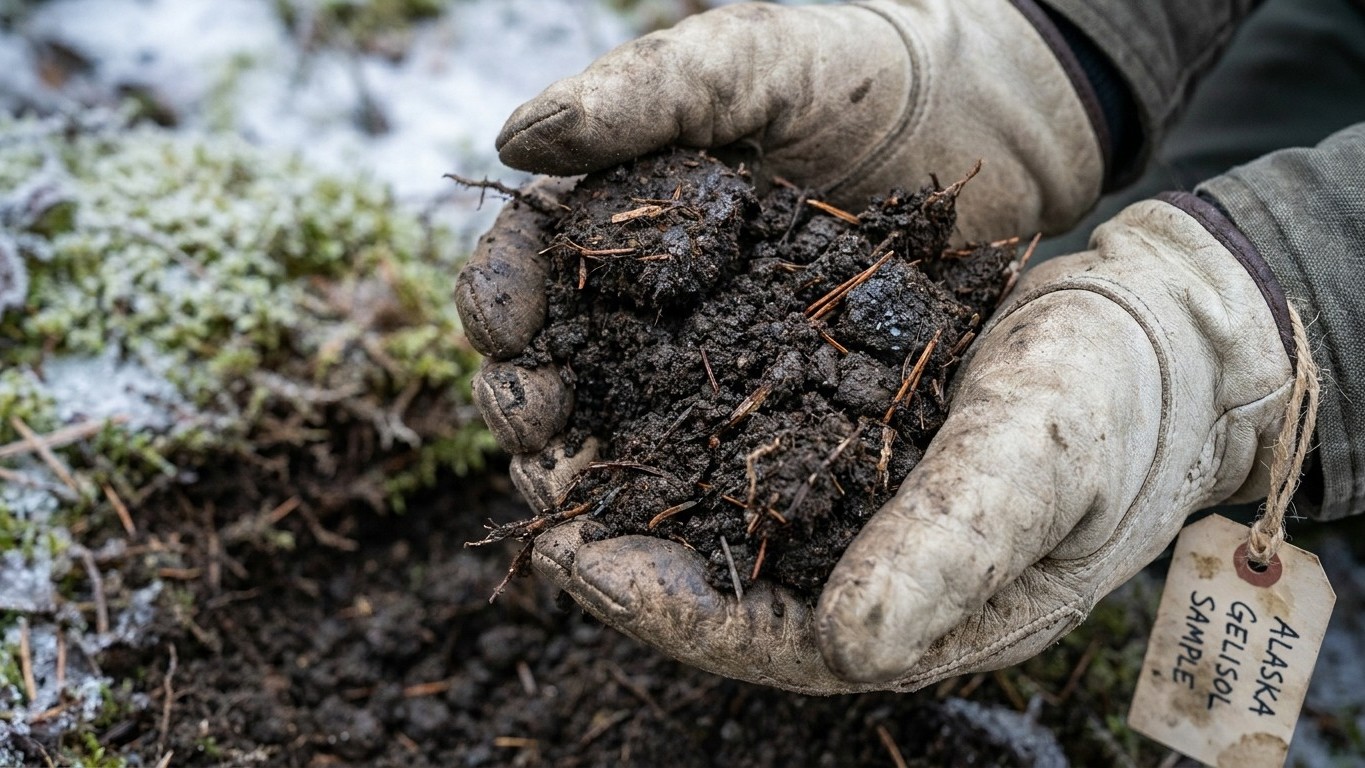

Under much of Alaska, the ground itself works against you before you ever pick up a trowel: cold, acid, and often sitting on frozen soil that won’t let water leave. The state’s representative soil, the Tanana series, spells out exactly what that means in measurable terms, and what to do about it in your own bed.
What is under your garden

The USDA lists the Tanana series as the soil representative of Alaska. It’s a Gelisol, which is the technical way of saying this is soil with permafrost within reach of the profile, frozen ground sitting close enough to the surface that it shapes everything happening above it. The surface horizon runs strongly acid, with a pH around 4.7. Texture-wise, the major components average 30 percent sand, 7 percent clay, and 63 percent silt, which puts it in silt loam territory rather than the heavy clay or sandy extremes gardeners in other states complain about. Organic matter sits around 90.0 percent, and the series is classed as poorly drained.
That organic-matter figure deserves a second look before you get excited. A number that high on a surface horizon usually means the mapped layer is a natural accumulation of peat, muck, or undecomposed forest litter, not a cultivated bed built up over years of compost. If you’ve been digging into worked garden soil, your organic-matter percentage will look nothing like 90 percent, and that’s normal, not a failure.
None of this is a prediction about your specific yard. Tanana is the soil USDA uses to represent the state on paper, the way a single family photo represents an entire family reunion. Alaska covers an enormous range of ground, from river-bottom silt to rocky hillside to whatever a builder scraped, graded, and refilled before pouring your foundation. Fill dirt trucked in during construction has no relationship to any native series, no matter what county you’re in. Read this section as a description of regional tendencies, not a stand-in for a soil test on your own property.
Reading your own dirt in five minutes
Grab a handful of moist soil from six inches down and try the ribbon test: squeeze it between thumb and forefinger and push it upward. Soil high in clay forms a long, slick ribbon before breaking. Silt-heavy soil, like the Tanana series describes, feels smooth and a little soapy but the ribbon snaps short. Sandy soil won’t ribbon at all, it just falls apart, gritty against your skin.
For a clearer picture, fill a straight-sided jar about a third full of soil, top it off with water, shake it hard, and let it sit overnight. Sand drops out within a minute or two and settles on the bottom. Silt follows over the next few hours, forming a middle layer. Clay stays suspended longest and settles as a thin cap on top, sometimes taking a full day. Measure the layers and you’ve got a rough texture reading for the exact dirt you’ll be planting into, not a statewide average.
Testing before you amend
Eyeballing soil tells you texture and maybe drainage. It tells you nothing about pH, phosphorus, potassium, or the nutrients that actually determine whether your tomatoes stall out in July. Guessing and dumping in lime or fertilizer based on a hunch is how gardeners waste money two ways: buying amendments they didn’t need, and skipping the one they did.
A proper sample takes a few minutes longer than scooping a single shovelful, and it’s worth it. Pull five or six small cores from different spots in the bed, all at the depth where roots actually live, generally the top six to eight inches for vegetables and annuals. Mix those cores together in a clean bucket, remove rocks and roots, and pull about a pint of the blended soil for the lab. One sample from one corner of the yard tells you about that corner and nowhere else, mixing cores gives you a number that represents the whole bed.
The state’s land-grant extension service typically runs these tests through its own lab or a partner lab, and the price is modest compared to what a season of guessing costs in wasted seed and fertilizer. When results come back, you’ll get a pH reading, an estimate of organic matter, and levels for major nutrients, sometimes with specific recommendations attached.
Given the pH the Tanana series carries at 4.7, it’s reasonable to expect strongly acid ground almost anywhere permafrost sits close to the surface in Alaska. But expecting isn’t knowing. Local variation in parent material, drainage, and years of amendment can shift a garden’s actual pH well away from the regional figure, and the only way to find out is to send in a sample and get a number back with your name on it.
Amending it
A surface pH of 4.7 points in one direction only: this ground needs lime, not sulfur. Adding elemental sulfur to soil already this acid would be a real mistake, pushing pH further from where most vegetables and ornamentals want to sit. At this level of acidity, phosphorus becomes chemically locked up and unavailable to roots no matter how much you apply, and brassicas in particular struggle, since clubroot disease thrives in acid soil and cabbage-family crops prefer conditions closer to neutral. Lime is the correction, applied according to your soil test’s recommendation, and it works over seasons rather than weeks. Expect a full year or more before a lime application fully shifts the pH of a bed this acid, which is why fall application ahead of spring planting makes more sense than a last-minute fix.
If your own soil test comes back on the alkaline side instead, above roughly 7.3, the rule flips completely: lime should never go anywhere near that ground. Elemental sulfur worked in gradually, paired with steady additions of organic matter, is the slow and honest route to bringing pH down. High pH locks up iron the same way low pH locks up phosphorus, and yellow leaves with green veins, especially on newer growth, are the plant’s way of telling you iron is present in the soil but unreachable at that pH.
Working with a silt loam, not a heavy clay
The Tanana figures, 30 percent sand, 7 percent clay, 63 percent silt, describe a silt loam, not the sticky heavy clay that cracks in summer and turns to concrete when worked wet. Still, silt-dominant soils have their own habit: they compact easily and can crust over after rain, sealing the surface and shedding water instead of absorbing it. Organic matter worked in every season loosens that crust and improves structure without the risk that comes from mixing sand into a silty or clay-heavy bed, which tends to create something closer to concrete than the fluffy soil gardeners picture. If your own test reveals a sandier profile than Tanana suggests, organic matter still does the heavy lifting, but paired with shorter, more frequent watering, since sandy ground won’t hold moisture no matter how much you add at once.
Texture problems and structure problems fix on different timelines. A pH correction with lime or sulfur takes a full season or more to show results throughout the root zone. Organic matter improves structure and water-holding capacity faster, often visible within one growing season, though the full benefit builds over two or three years of consistent additions.
Drainage and compaction
The Tanana series is classed as poorly drained, and permafrost is the reason. Frozen ground sitting within the profile acts like a lid, water that would normally percolate downward simply has nowhere to go, and it backs up into the root zone instead. Standing in a garden built on ground like this after a hard rain, you’ll likely find puddles that sit for hours or days rather than sinking away within minutes.
You can check your own drainage with a simple percolation test. Dig a hole about a foot deep and a foot across, fill it with water, and let it drain completely once to saturate the surrounding soil. Fill it a second time and time how fast the water level drops. A drop of one to two inches per hour is generally workable for most vegetables and ornamentals. Anything slower than half an inch an hour signals the kind of poor drainage the Tanana series describes, and anything faster than three inches an hour suggests sandy, fast-draining ground at the other extreme.
Compaction compounds the problem, whether it comes from foot traffic packing down a bed edge or from machinery driving across a yard during construction. Double digging, once the standard fix, has fallen out of favor because it disturbs soil structure and microbial life more than it helps, and the compaction often returns within a season or two anyway. On ground that’s both poorly drained by nature and compacted from use, a raised bed is usually the more honest answer than years of amendment. Building up six to twelve inches of good soil above grade sidesteps the permafrost and compaction problem entirely rather than fighting it, and for anyone gardening on Tanana-type ground or anything similarly poorly drained, that’s often the faster route to a productive bed.
Local help
Soil testing in Alaska runs through the University of Alaska Fairbanks Cooperative Extension Service. Send in a properly mixed sample from your own garden, and the results come back with pH, nutrient levels, and organic matter specific to your soil, not a statewide average. County extension offices typically walk through the results with the gardener directly, which matters when a report full of numbers needs translating into an actual plan for lime, sulfur, or compost.
Common questions
Is all Alaska soil acidic like the Tanana series?
No. Tanana represents the state on USDA maps, but pH varies with parent material, drainage, and local geology. Coastal areas, old floodplains, and disturbed or filled ground can all read very differently. A soil test is the only way to know your own number.
Why would organic matter be listed at 90 percent when compost-heavy beds rarely get close to that?
That figure describes the natural surface horizon of the mapped series, which is often a peat or muck layer built up over centuries. A cultivated bed, even one amended heavily for years, won’t resemble that number, and it isn’t a target to aim for.
Should I add sand to break up silty or compacted soil?
Generally no. Mixing sand into silt- or clay-dominant soil often creates a dense, poorly structured mix rather than loosening it. Organic matter, worked in gradually, is the safer and more effective fix.
How long does permafrost affect a garden bed once it’s built up?
If the frozen layer sits close to the surface, it continues to limit drainage and root depth no matter how much soil you add on top, unless the bed is built up enough to keep roots and standing water above that frozen layer entirely, which is the main reason raised beds work so well on this kind of ground.