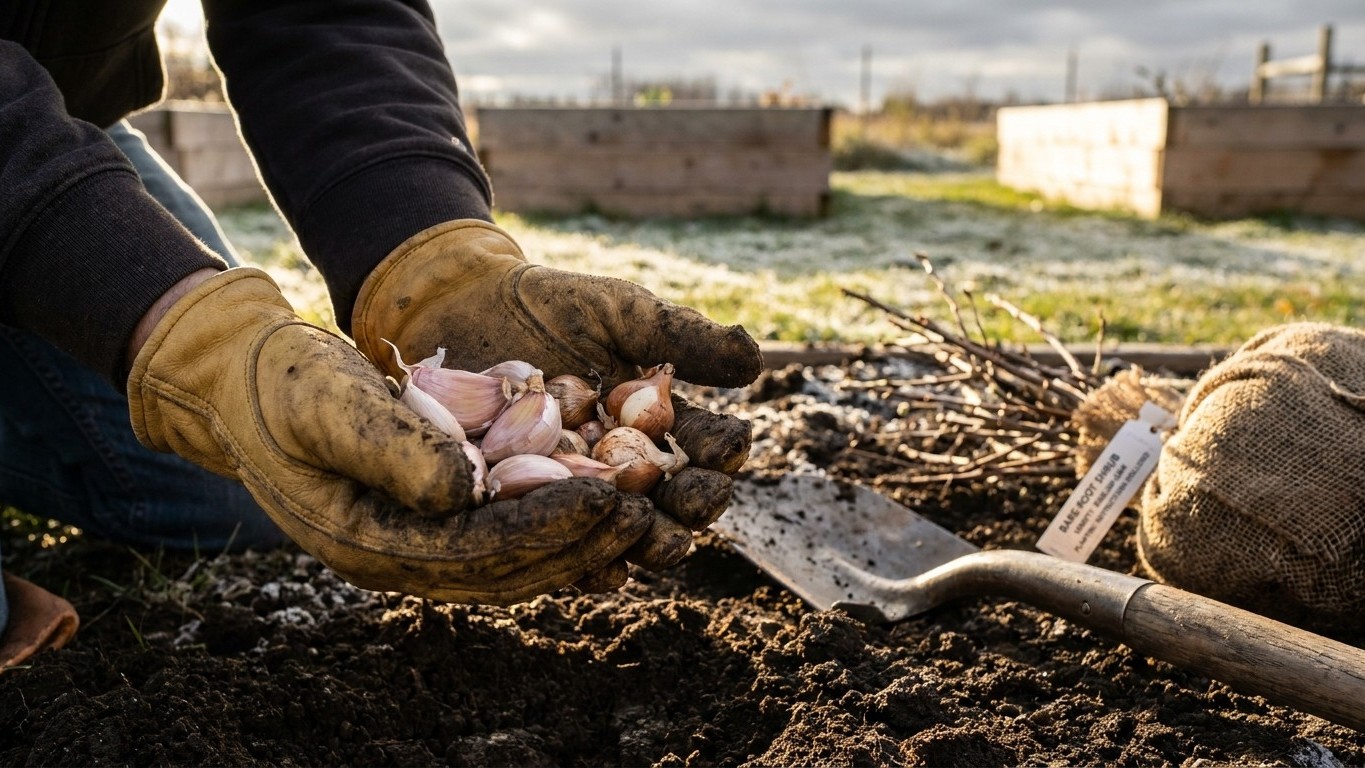

October in Alberta means garlic goes in the ground, spring bulbs get tucked in before the soil locks up, and bare-root trees and shrubs can still be planted while the roots have time to settle. Everything green and tender is already finished for the year. The work now is about protecting what’s stored, planting what overwinters, and getting ahead of a freeze-up that can arrive with little warning.
What goes in the ground in October

The decision this month isn’t the calendar, it’s whether the soil is still workable. Alberta’s average first fall frost lands around September 16, so by the time October opens, most gardens have already taken a hit. That date is a mean, not a guarantee: in roughly half of all years the first frost comes later, which is exactly why some gardeners still have green tomatoes on the vine into early October while others lost their squash weeks earlier. Once a hard freeze sets in, the ground itself becomes the real deadline, not the thermometer.
What’s safe to plant right now is anything that wants a cold winter to break dormancy or that can shrug off a light freeze. Garlic and shallots top the list. Cloves and bulbs go in four to six weeks before the ground freezes solid, giving roots time to establish before winter without pushing top growth that would just get burned back. Spring-flowering bulbs, tulips, daffodils, crocus, follow the same logic: plant while soil is still diggable, water once, then let winter do the vernalizing.
Bare-root and dormant stock is the other safe bet. Fruit trees, shrubs, roses, and perennials sold bare-root or as dormant potted stock can go into the ground now, as long as you can still get a spade in without fighting frozen clay. Mulch heavily after planting to buffer the root zone against temperature swings before snow cover arrives.
What’s a gamble: anything green. New seedlings of lettuce or spinach sown outdoors this late won’t have enough daylight or soil warmth left to establish before freeze-up. A cold frame or low tunnel can stretch the life of greens that were already growing from a late-summer sowing, buying a few extra weeks of harvest, but starting new direct-sown crops in open ground in October is generally wasted seed. Alberta sits in Canadian hardiness zone 4a (measured at Calgary, using Canada’s seven-variable system, which is not the same scale as the USDA zones used elsewhere on this site), and that zone rating is exactly why fall planting here leans so heavily on things built to survive a hard freeze underground.
What to start under cover
Working backward from Alberta’s average last spring frost of May 21 is the right way to plan seed-starting, and it’s also why October isn’t the month to start much for outdoor transplanting. A typical vegetable transplant wants six to eight weeks indoors before it goes out, which puts the real seed-starting window in late March or early April, not now. Sow tomatoes or peppers indoors in October and you’ll be nursing leggy, rootbound plants under grow lights for five months before they can go anywhere near the garden. That’s the classic mismatch: starting too early doesn’t gain you a head start, it just burns out the plant before its season even opens.
What does make sense under cover this month is short-cycle and decorative growing. Microgreens and sprouts on a windowsill or under a light give a fast harvest with no season-length math involved at all, since they’re cut in one to three weeks regardless of what’s happening outside. Forcing bulbs indoors, amaryllis, paperwhites, hyacinths in water or shallow gravel, is another legitimate October task: pot them now and they’ll bloom indoors over the following weeks, giving color and scent through the darkest stretch of the year.
Cold frames and unheated tunnels still have a job, too, but it’s protection rather than propagation. Greens sown back in August or early September can keep producing under a frame well past the average frost date, since the covering buys several degrees of frost protection. Just don’t confuse that with sowing new seed under the same cover in October; by the time it germinates, daylight and soil heat are both working against it.
What is ready to pick
October is the month storage crops come out of the ground for good. Potatoes, carrots, beets, cabbage, and winter squash all need to be lifted before the soil freezes hard, since a frozen root crop left underground is difficult to dig and prone to rot once it thaws. Onions and garlic from the summer crop should already be cured and in storage by now; if they’re still sitting in the garden, get them in before a heavy frost softens the necks.
Not everything comes out, though. Kale and leeks are two crops built to stay put: both tolerate hard freezes and actually sweeten with cold exposure, so leaving them in the ground under a layer of straw mulch extends the harvest well into the colder months. A cold frame full of spinach or mâche sown earlier in the season can keep supplying salads on the mild days between cold snaps.
Indoors, sprouts and microgreens fill the gap when the outdoor garden has little left to offer. And this is the month to go through the root cellar or storage shelves crop by crop: a soft spot on a squash, a sprouting potato, or an onion gone soft at the neck spreads faster than most people expect once the whole bin is packed together for winter. Pulling the bad ones now saves the rest.
The jobs that matter this month
Protecting what’s already planted
Mulch is the single highest-value job on the list right now. A thick layer over garlic beds, strawberry crowns, and newly planted bulbs insulates the root zone against the freeze-thaw cycling that heaves plants out of the ground over winter. Wrapping the trunks of young fruit trees guards against both sunscald on bright winter days and rodent damage once snow cover hides the bark from view. Roses that aren’t reliably hardy in zone 4a benefit from a mounded collar of soil or mulch at the base before the ground locks up.
Closing down the growing season
Draining and disconnecting hoses and irrigation lines before a hard freeze prevents cracked fittings and split pipe come spring. Turning the compost pile one more time while it’s still workable keeps decomposition going a few extra weeks and gives you a head start on finished compost for next season. Cleaning and sharpening tools before they go into winter storage, rather than next spring in a rush, means they’re ready the moment the ground thaws.
Planning ahead
This is also the window to order seed for varieties that tend to sell out, since popular open-pollinated and heirloom seed lines often run short by midwinter. A soil test taken now, while beds are cleared but the ground isn’t frozen, gives results in time to plan amendments before spring planting. And a few notes on what worked and what didn’t this season, written down while it’s still fresh, make next year’s crop rotation plan far easier to put together than trying to remember it from scratch in March.
What not to do in October
The most common mistake is trusting a warm afternoon over the calendar. A stretch of mild weather in early October can feel like an invitation to leave covers off or hold back on mulching, but Alberta’s average first frost has usually already passed by the time October opens, and a hard freeze can follow a warm spell within days. Uncovering a cold frame “just for the afternoon” and forgetting to close it back up is a common way to lose a whole bed of greens overnight.
Feeding nitrogen this late is another classic error. Nitrogen pushes soft, leafy growth, and any plant that responds to a late feeding with new growth is sending out tissue that has no time to harden off before winter. That soft growth is what gets killed outright by the first hard freeze, sometimes taking damage back into older, previously hardy wood. If a plant needs feeding at all this time of year, a low-nitrogen or phosphorus-and-potassium-leaning amendment supports root and bulb development instead.
Leaving root crops in the ground too long is a third trap. Waiting for “just one more week” of growth on carrots or beets can mean digging them out of soil that’s already partially frozen, which damages the roots and makes storage life much shorter. Once the soil starts crusting hard in the morning, it’s time to lift what’s left rather than gamble on another mild stretch.
Checking this against your own county
A province-wide October guide is a starting point, not an instruction sheet. Alberta’s elevation changes, the Peace Region’s shorter season compared to the south, and the moderating effect near the foothills can all shift these windows by two to three weeks in either direction. A garden outside Grande Prairie is working with a very different freeze-up timeline than one in the Lethbridge area, even in the same calendar month. For local frost data, soil conditions, and crop advice tuned to your specific region, the Alberta Agriculture and Irrigation department is the reliable next stop.
Common questions
Is it too late to plant garlic in October in Alberta?
No, October is generally the right window, as long as the soil is still workable. Garlic wants four to six weeks in the ground before hard freeze-up to root in before winter dormancy.
Can I still start vegetable seeds indoors in October?
Not for garden transplants. Working back from the average last spring frost of May 21, indoor seed-starting for outdoor crops belongs in late March or early April, not October. Microgreens and sprouts are the exception, since they’re harvested within weeks regardless of the outdoor season.
What vegetables can survive a light frost in the garden in October?
Kale and leeks handle hard freezes well and often improve in flavor after cold exposure. Cold-frame greens like spinach or mâche can also keep producing on milder days between frosts.
Why does Alberta’s plant hardiness zone matter for October planting decisions?
Zone 4a, measured at Calgary under Canada’s own seven-variable system, signals how much cold a plant needs to survive winter dormancy. It’s a different scale than the USDA zones used in the US, so it should never be compared directly, but it’s the reason fall planting in Alberta leans so heavily on garlic, bulbs, and dormant bare-root stock rather than anything still actively growing.