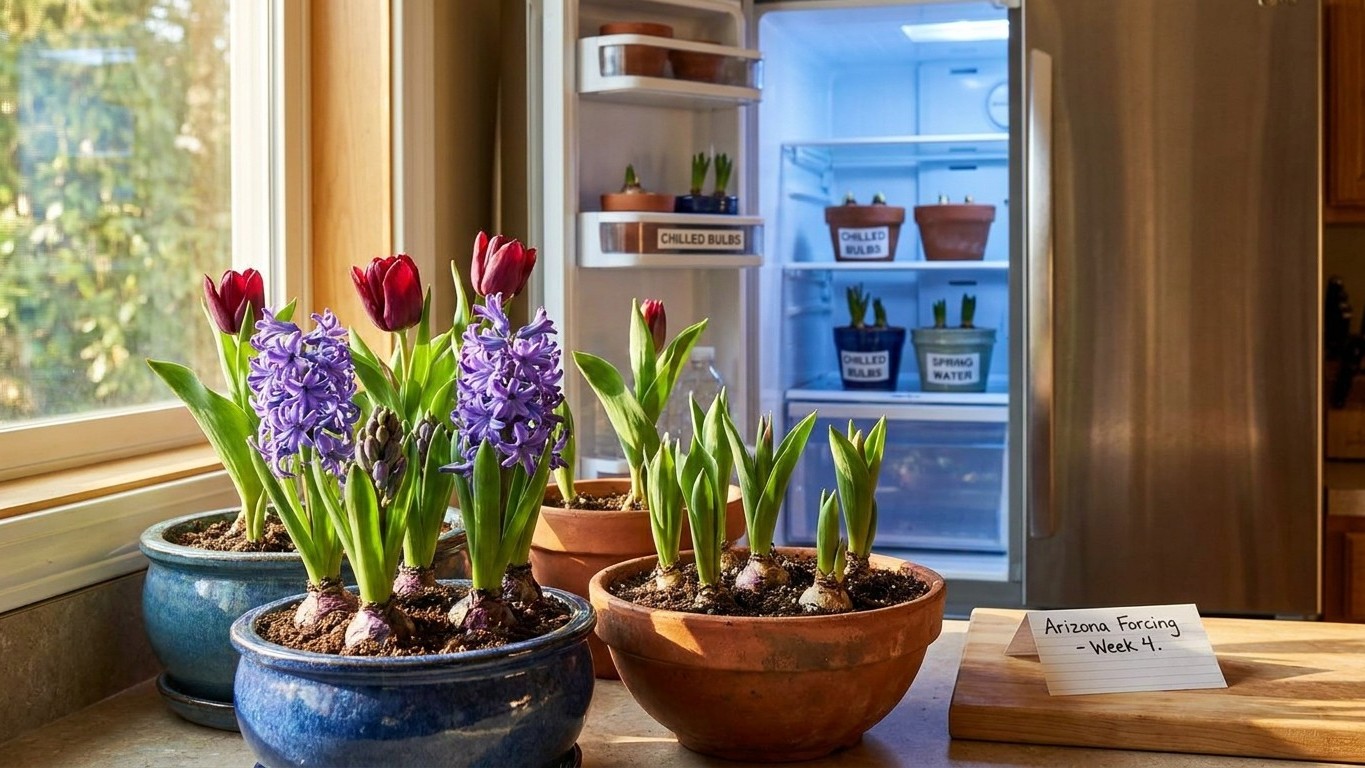

Phoenix winters average a coldest-month low of 45.3°F, according to NOAA climate normals covering 1991-2020. That number is too warm, for too short a stretch, to trick a tulip or hyacinth into blooming on its own. In this territory, growing spring bulbs in containers means forcing them yourself, refrigerator or garage standing in for the winter Arizona doesn’t provide.
Why this matters in Arizona

A spring bulb like a tulip or hyacinth needs 12 to 14 weeks of temperatures below 45°F before it will send up a flower stalk. That’s the trigger buried in its biology: without enough sustained cold, the bud inside the bulb never finishes forming, no matter how much sun or water follows. At 45.3°F, the average low for Phoenix’s coldest month sits right at that threshold, not comfortably below it, and it only touches that mark for a matter of weeks, not the twelve-to-fourteen stretch the bulb needs. Left in the ground or in an outdoor pot through a typical Phoenix winter, most classic spring bulbs simply won’t get cold enough, long enough, to bloom.
That single fact settles which of two common bulb problems applies here. Some U.S. gardeners fight the opposite issue: a container that freezes clean through, roots and all, in a climate cold enough to kill a bulb in a pot that would have survived the same winter tucked into garden soil. Arizona isn’t that place, at least not at the reference station in Phoenix. The USDA Plant Hardiness Zone Map puts the state anywhere from zone 4b to zone 10b, which is a stretch wide enough to cover both true high-desert winters and the mild low-desert ones Phoenix represents. For the low-desert reference city, the operative problem is a shortage of cold, not an excess of it. Containers there rarely freeze through, so the freeze-through risk that shapes bulb advice in colder states mostly doesn’t apply.
Gardeners in the state’s higher, cooler pockets, the ones closer to zone 6 or 7 on that same USDA range, face a different reality: real freezes, and a container that can chill faster and harder than a garden bed. If that’s your elevation, the freeze-through caution matters and gets addressed below. But for anyone gardening at or near Phoenix’s climate, the fix is forcing, not frost protection.
How to do it here
Forcing is a sequence, and skipping a step, or shortening the cold period, is the single most common reason it fails. Here’s the order that works against Phoenix’s climate numbers.
- Choose bulbs that actually need the cold you’re about to supply. Tulips, hyacinths, and crocus require the full chill; some narcissus types don’t (more on that below).
- Buy dormant, firm bulbs in early fall and refrigerate them immediately rather than waiting, since the chill clock only starts once they’re cold.
- Store them in a paper bag in a refrigerator’s crisper drawer, away from apples, pears, or bananas. Ripening fruit releases ethylene gas, and ethylene aborts the flower bud inside a chilling bulb even while the leaves develop normally.
- Hold them at that cold temperature for 12 to 14 weeks, tracked from a fixed start date. An unheated garage that reliably stays above freezing can substitute for a refrigerator if you can confirm it holds under 45°F for the full stretch; if you can’t check the temperature, use the fridge instead.
- Pot the bulbs up in a well-draining container with drainage holes about two weeks before you want blooms, since forced bulbs move fast once the cold period ends.
- Set the freshly potted container somewhere bright but still cool, a covered patio or that same unheated garage, so roots establish before top growth takes off.
- Move the pot into full sun once shoots appear above the soil line.
- If you garden in one of Arizona’s genuinely cold, higher-elevation zones where containers can freeze through in a way Phoenix’s climate doesn’t, size that pot at least two USDA zones hardier than the bulb’s rating, or plan to move it into an unheated garage overnight and mulch it heavily. In the low-desert reference climate, this step is rarely the one that decides success; the chilling period is.
Which bulbs are worth it
Not every spring bulb repays the fridge space and the twelve-plus weeks of patience. The ones with a short chill requirement and a short, sturdy stem force cleanly in a container; tall bulbs with long chill demands tend to either fail outright or produce a flower stalk that flops before it opens. And because almost no classic spring bulb reliably rebounds after a Phoenix summer bakes it in the ground, treating any of them as a one-season purchase costs nothing extra, they were never going to come back regardless of whether you forced them.
- Crocus, short-stemmed and quick to respond once the chill period ends
- Hyacinth, sturdy stems that hold up well in a pot
- Standard tulip varieties, provided the full 12-14 week chill is met
- Paperwhite narcissus, which skip the cold requirement entirely and bloom within weeks of potting, making them the simplest option for this climate
- Fritillaria imperialis, tall and top-heavy enough to topple most containers once it flowers
- Tall daffodil varieties (the classic King Alfred type and similar), whose long stems flop without garden-bed support
- Giant ornamental alliums, which need a chill period long enough that container timing rarely lines up with a reasonable bloom window
What goes wrong, and when you can still fix it
Leaves come up, but no flower ever forms
This is a chilling shortfall. The bulb had enough stored energy to push leaves, but the flower bud never finished differentiating because it spent fewer than 12 to 14 weeks below 45°F. There’s no fix for the bulb already in the pot this season; the leaves are the extent of the show. The bulb itself may still be viable, so if you want another attempt, start over next fall and track the full chill period against a calendar rather than a guess.
A flower opens, but the stem is too short to see it above the foliage
This points to a bulb warmed up too fast, or moved into heat before the cool transition period finished. The stem simply didn’t have time to elongate before the flower forced its way open. This bloom won’t improve; there’s nothing to do but let it finish. Next time, give the potted bulb more days in that cool, bright spot before moving it into full sun.
The bulb turns soft or rots in the pot
Rot almost always traces back to drainage, water sitting against the basal plate long enough for fungus or bacteria to take hold. If you catch it early and the bulb is still mostly firm, you can sometimes save it by repotting immediately in fresh, well-draining mix and cutting back on watering. Once the bulb has gone fully soft, it’s finished for this season, and the fix going forward is a container with real drainage holes and a mix that doesn’t stay soggy.