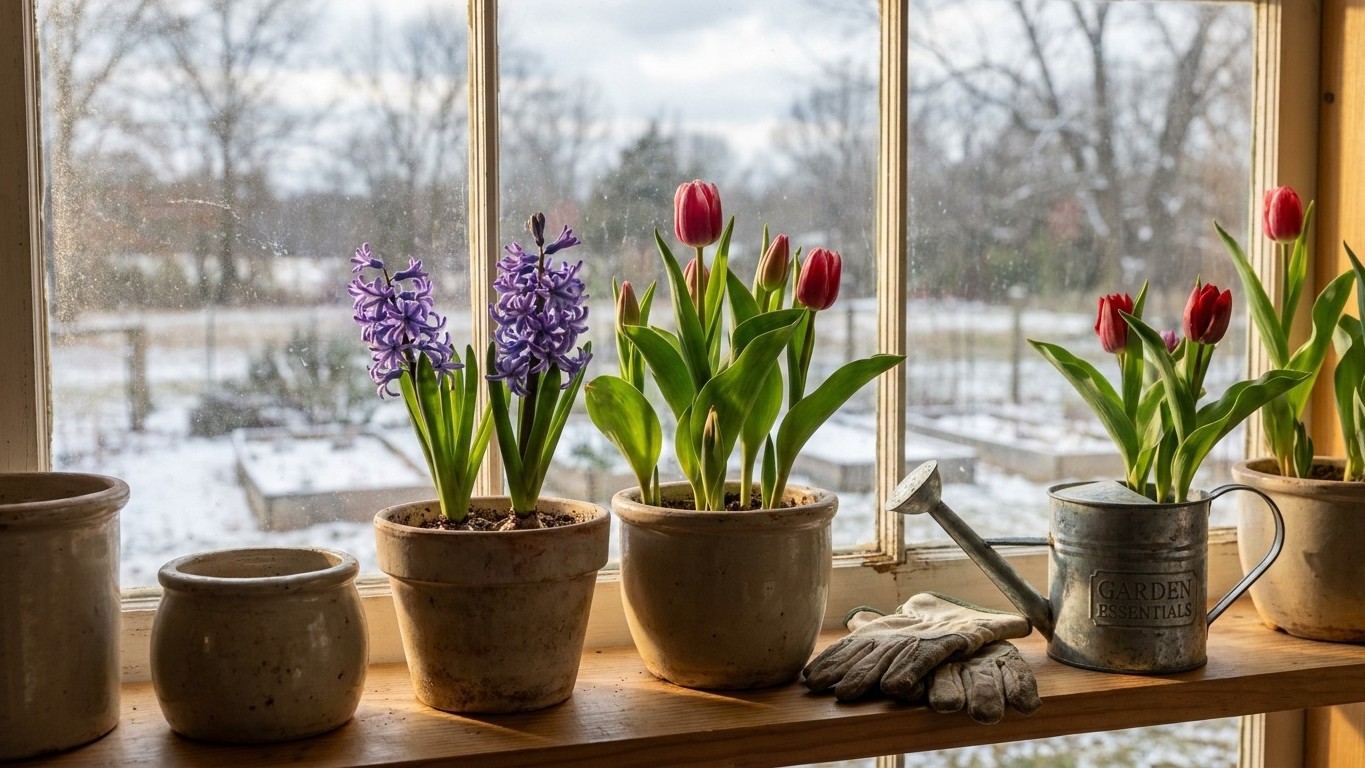

Arkansas winters aren’t the reason to force bulbs indoors here. The coldest month averages a nightly low of just 30.9°F, cold enough that most spring bulbs get their chilling requirement right where they’re planted. Forcing changes the equation only when the container does the freezing, or when a gardener wants blooms on a specific timeline rather than whenever the yard decides.
Why this matters in Arkansas

Little Rock’s coldest month sits at a mean daily minimum of 30.9°F, according to NOAA’s 1991-2020 Climate Normals. That’s the number that decides whether a bulb survives winter here, not the occasional hard freeze that makes the evening news. A spring bulb like a tulip or hyacinth needs roughly twelve to fourteen weeks with soil temperatures below 45°F to complete the biochemical process that turns a bud into a flower. With a coldest-month average that far under freezing, in-ground soil across most of the state clears that bar without any help.
That puts Arkansas in a specific spot among the two situations forcing is meant to solve. In territories where winters barely dip below 45°F at all, gardeners force bulbs indoors because the ground itself can’t deliver enough chill, full stop. Arkansas isn’t that place. The USDA Plant Hardiness Zone Map puts the state at 6b-8a based on 1991-2020 averages, a range that runs from genuinely cold in the northern counties to mild in the southern ones, but even the 8a end still routes through a real winter with sustained stretches below 45°F.
The second situation is where Arkansas actually lives: containers. A pot sitting on a porch or patio doesn’t have the earth’s mass around it. When the air hits that same 30.9°F average, the soil inside a container follows it almost in lockstep, freezing through to the bottom, roots and all, in a way that in-ground soil at the same depth never does. A bulb rated hardy for zone 7 in the ground can die in a zone 7 pot for exactly this reason. So the forcing question here isn’t “does my yard get cold enough” (it does) but “does my container survive what my yard survives without complaint” (often, it doesn’t).
That reframes what forcing indoors is actually for in this state. It’s less a rescue technique and more a tool: for gardeners growing bulbs in pots that need protection, and for anyone who wants a hyacinth blooming on the kitchen windowsill in February instead of waiting for the flower bed to catch up in March.
How to do it here
The mechanics don’t change because you’re in Arkansas, but where you find the cold does. An unheated garage that stays above freezing but below 45°F through the winter works as well as any refrigerator, and it’s free. A refrigerator drawer works too, provided it stays clear of apples, pears, or any ripening fruit, since the ethylene gas they give off will damage the flower bud forming inside the bulb before it ever gets planted. Given the zone range across the state, an unheated but attached garage in the 6b counties up north will run colder and more reliably than one in the 8a stretch near the Louisiana line, where a cold snap can still push it too close to freezing solid.
- Pot the bulbs in a well-draining mix, pointed end up, with the tips just at or slightly below the soil surface, and water once thoroughly.
- Move the pot to a spot holding steady between roughly 35°F and 45°F, either an unheated garage or a refrigerator drawer kept away from fruit.
- Leave it there for twelve to fourteen weeks, checking every couple of weeks that the soil hasn’t dried out completely.
- Watch for pale shoots pushing up an inch or two; that’s the signal the chilling period has done its job.
- Bring the pot into a cool room (60-65°F) out of direct sun for about a week to let the stem start elongating before it sees stronger light.
- Move it to a brighter spot once the bud is visible, and expect bloom within another one to two weeks.
For anything staying outdoors in a container through the winter rather than coming inside, the rule of thumb is to treat the bulb as if it needs two zones more cold-hardiness than it actually has, since the pot strips away the ground’s insulation. A bulb hardy to zone 6 should be planted as though it needs to survive zone 4 conditions in a pot, unless you’re willing to move it into an unheated garage or bury the pot to its rim in mulch once temperatures start dropping.
Which bulbs are worth it
Forcing pays off fastest with bulbs that either need little chilling to begin with or stay short and sturdy enough to hold themselves up in a pot without staking. It costs almost nothing to try with bulbs that were never going to survive as long-term perennials in Arkansas soil anyway, since there’s no perennial performance being sacrificed.
- Paperwhite narcissus: needs no cold period at all, blooms in three to four weeks from potting, and isn’t reliably hardy through Arkansas winters anyway, so forcing loses nothing.
- Hyacinths: a full but manageable twelve-to-fourteen-week chill produces a compact, heavy-scented bloom on a stem that doesn’t flop.
- Crocus: one of the shortest chilling requirements among true spring bulbs, and the stem is too short to ever topple.
- Grape hyacinth (muscari): forces reliably and stays low enough for any windowsill pot.
- Dwarf and species tulips: the shorter cultivars force well; the standard tall Darwin types do not, for reasons below.
- Standard trumpet daffodils (King Alfred type): tall, top-heavy stems that lean or fold once the flower opens indoors, away from the wind resistance that keeps them upright outside.
- Tall Darwin hybrid tulips: the same top-heavy problem, worse in a small pot without garden soil’s weight to anchor the roots.
- Alliums: a chilling requirement long enough to make the process impractical, paired with flower stalks too tall for most indoor containers.
- Fritillaria: finicky about chilling duration and prone to skipping bloom entirely if the timing is off by even a couple of weeks.
What goes wrong, and when you can still fix it
Leaves but no flower
This means the chilling period ran short, whether it was a week or three cut off the twelve-to-fourteen-week window. The bulb has enough stored energy to push leaves but never formed a flower bud in the first place. There’s no way to add missing cold back into a bulb that’s already in active growth. The bulb itself isn’t dead, though; if you’re growing it in a container, it can go back into a longer chill next winter and try again.
A flower on a stem too short to see
The flower bud formed correctly, but the stem was warmed too fast after the cold period, so it never got the week or so of cool, low-light transition that lets it stretch upward before opening. If you catch this while the bud is still tight and just visible, moving the pot back to a cool, dim spot for another week can sometimes let the stem catch up before the flower fully opens. Once it’s already open on a short stem, that particular bloom is finished for the season.
Rot in a pot
Soft, dark, mushy bulbs almost always trace back to a container that never drained, whether from a mix that stayed waterlogged or a pot without a real drainage hole. There’s no saving a bulb once it’s rotted. The fix applies to the next attempt only: a mix that drains freely, a pot with an actual hole in the bottom, and watering enough to keep the soil barely moist through the chilling period rather than wet.