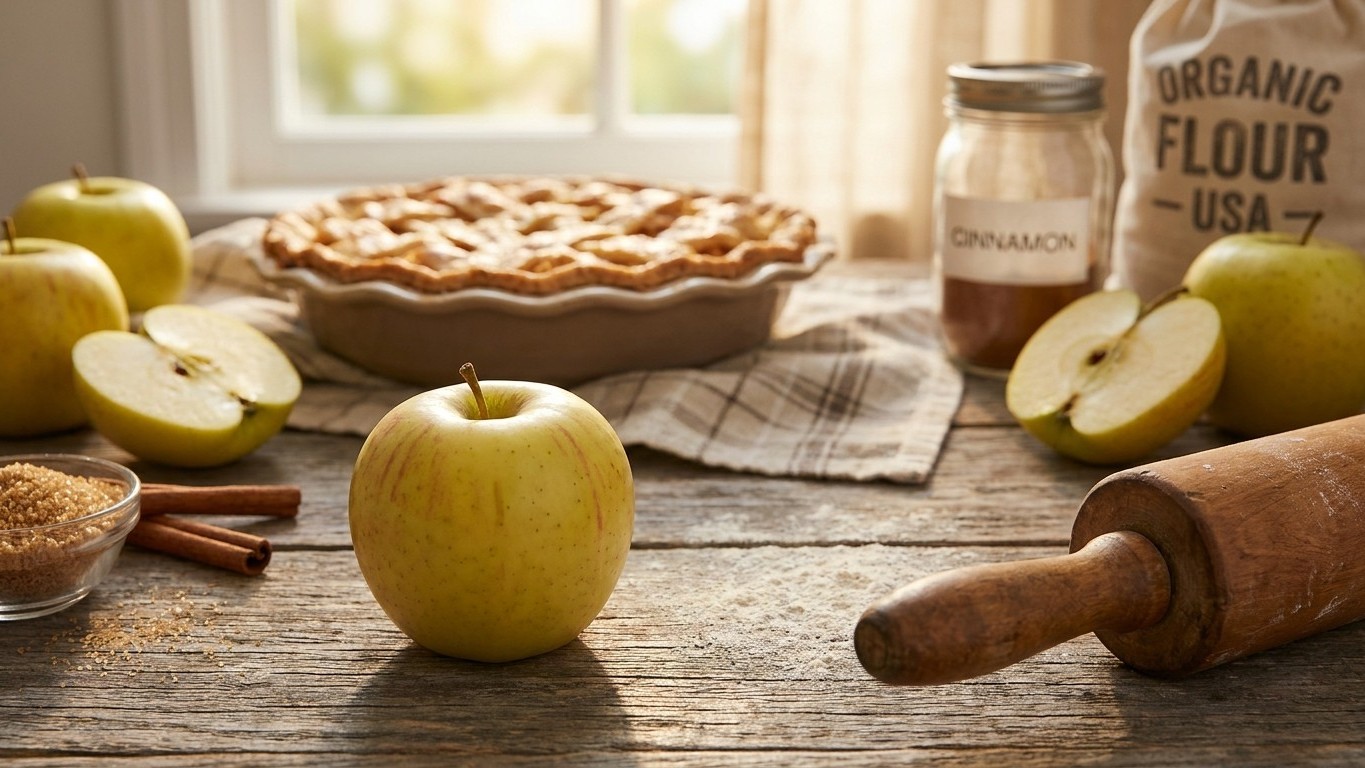

Mutsu is a mid-season, all-purpose apple hardy in zones 5 through 9, prized for a crisp, juicy bite with a tart edge. Sold under a second name in some markets, and carrying a pollen quirk that trips up a lot of backyard orchards, it rewards a grower who plans ahead rather than one who plants it alone and hopes.
What Mutsu actually is

Grocery shoppers sometimes know this apple as Crispin, the name it’s sold under in parts of the produce aisle, according to Utah State University Extension. Same apple, different label. If you’ve bought Crispin at the store, you’ve bought Mutsu.
- Ripens in late October to early November
- Tastes crisp and juicy, with a tart edge
- Suits both fresh eating and cooking, an all-purpose apple
- Keeps well into the storage season under the right conditions
The flavor profile is what pulls people in. Clemson Cooperative Extension’s variety table rates the eating quality as crisp and juicy with a noticeable tartness, not a sugar bomb like some newer club varieties. That tartness is doing real work in the kitchen. An apple that’s mostly sweet turns to mush in a pie because the acid that normally helps the flesh hold its shape under heat just isn’t there. Mutsu’s acidity survives baking, and its flesh stays firm enough to slice cleanly in a tart or a crisp, which is exactly why Clemson lists it as all-purpose rather than dessert-only or baking-only.
Mid-season bloom puts it in the same general flowering window as many popular varieties, useful to know before you start planning a mixed planting, which the next two sections cover in more detail. For now, the short version: this is a large, aromatic apple that home bakers like for pies and sauce and that fresh-eating fans like for the tang. It’s not a one-trick apple, and that versatility is a big part of its reputation.
Will it grow where you are
Hardiness zones
Mutsu is rated for USDA hardiness zones 5 through 9, according to Utah State University Extension. That’s a wide band, stretching from parts of the upper Midwest and New England down through the mid-South and into warmer pockets of the Southeast and Southwest. If your winter lows regularly dip well below zone 5 territory, or if your summers run hotter than zone 9 typically allows, this isn’t the variety to bet a whole orchard on.
Winter chill
Hardiness zone is only half the equation. The other half is winter chill, the number of cold hours a tree needs during dormancy before it can break bud and flower properly the following spring. A tree that doesn’t get enough chill hours can leaf out late, unevenly, or barely bloom at all, even if it survives the winter fine.
No specific chill-hour figure for Mutsu turned up in the sourced extension material for this page, so none is given here rather than guessed at. What can be said with confidence: apples as a category generally need a moderate-to-high number of chill hours compared to stone fruit, which is why they’re a staple in cooler climates and a gamble in the Deep South or low-desert Southwest, even when the USDA zone number looks technically compatible. Gardeners in the warmer end of that 5-9 range, coastal California or the Gulf Coast, for instance, should check with a local extension office before committing, since local microclimate and chill accumulation vary a lot even within the same zone.
What to plant beside it
Here’s the part that catches people off guard. Mutsu’s pollen is sterile, according to Clemson HGIC 1350 and University of Georgia Extension bulletin C740. It can accept pollen from another apple and set a full crop, but it cannot return the favor. Plant Mutsu next to a single other variety, and that neighbor may never get pollinated by it, no matter how heavily Mutsu blooms.
That means a Mutsu tree needs at least one compatible pollen donor to fruit itself, and if you also want that donor variety to fruit, you need a third tree in the mix that can pollinate the donor. Two trees isn’t enough in a garden built around Mutsu. Nearly all apple varieties crop better with a compatible partner nearby regardless, since very few set a full harvest on their own pollen, but Mutsu raises the stakes because it can’t be that partner for anyone else.
The varieties known to pollinate Mutsu, per Clemson and UGA extension sources, are:
- Fuji
- Gala
- Ginger Gold
- Granny Smith
- Jerseymac
- Mollie’s Delicious
- Red Delicious
- Yates
All of these fall within a bloom window that overlaps with Mutsu’s mid-season timing, which the bloom group data classifies as group B. That group is a relative ranking of flowering order rather than a fixed calendar date, so the exact bloom dates will shift depending on your local spring, but the sequence between varieties tends to hold from one climate to the next.
One caution worth repeating: overlapping bloom time alone doesn’t guarantee good pollination between any two trees. Some parent-and-offspring pairs won’t cross-pollinate each other even when they flower together, because a seedling variety often can’t be pollinated by its own parent. No such exclusion is listed for Mutsu in the sourced material, but the general rule is worth knowing before you assume any two blooming trees will do the job. For a fuller breakdown of how apple pollination groups work and how to build a mixed planting from scratch, see our apple pollination guide.
Growing it well
Fire blight susceptibility
Mutsu is rated susceptible to fire blight, according to USU Extension. In practice, that means watching for the telltale signs each spring: blackened, wilted shoot tips that curl into a shape often described as a shepherd’s crook, and a scorched look to blossom clusters after a wet, warm bloom period. Growers in humid climates or areas with a history of fire blight pressure should prune out infected wood promptly, well below the visible damage, and disinfect tools between cuts. Avoid heavy nitrogen fertilization too, since vigorous, soft new growth is more vulnerable to infection.
Growth habit and vigor
Mutsu is known for producing a large, vigorous tree with big, aromatic fruit. That size is a product of both the variety’s natural tendency and whatever rootstock it’s grafted onto, since rootstock, not the variety itself, determines how tall and wide a mature tree ends up. A Mutsu on a dwarfing rootstock will stay compact and manageable in a small yard; the same variety on a standard or semi-standard rootstock can become a large shade-tree-sized apple over the decades. Ask your nursery which rootstock a given tree is grafted to before you plant, since that single detail affects spacing, staking, and how soon it starts bearing.
Biennial bearing and thinning
Large-fruited, vigorous varieties like Mutsu are common candidates for biennial bearing, the pattern where a tree loads up heavily one year and then produces little or nothing the next. Thinning the young fruit in late spring, leaving roughly one apple every six to eight inches along a branch, helps even out that cycle by reducing the strain a heavy crop puts on the tree’s reserves for next year’s flower buds. It’s a small chore in June that pays off with a steadier harvest for years afterward.
Picking it and keeping it
USU Extension puts the harvest window for Mutsu at late October to early November, but a calendar date is only a rough guide. Weather shifts the exact week from year to year, so the tree itself is a better clock than the wall calendar.
- Lift and twist a fruit gently. If it separates from the branch with a light twist and doesn’t need to be yanked or cut, it’s likely ready.
- Cut one apple open and check the seeds. Ripe apples generally show dark brown seeds; pale or greenish seeds mean more time is needed on the tree.
- Check the ground color, the base color of the skin beneath any red or blush coloring. A shift from green toward yellow or cream usually signals the fruit is close to or at peak maturity.
Storage
Once picked, Mutsu is known as a good keeper among apple varieties, holding up well in cold storage for months when kept near freezing with high humidity, conditions most home growers approximate with a refrigerator crisper drawer or a cold, humid root cellar. Store the fruit unwashed, check periodically for soft spots, and pull any apple showing decay before it spreads to its neighbors in the same bin or bag.
Common questions
Is Mutsu the same apple as Crispin?
Yes. Crispin is the name Mutsu is sold under in some grocery markets, according to Utah State University Extension. Same variety, two labels.
Can one Mutsu tree pollinate itself or another apple tree?
No. Mutsu’s pollen is sterile, per Clemson and UGA extension sources, so it can’t pollinate itself or any neighboring variety. It needs a compatible partner to set fruit, and that partner needs its own separate pollinator too.
What’s the best apple to plant next to Mutsu?
Fuji, Gala, Ginger Gold, Granny Smith, Jerseymac, Mollie’s Delicious, Red Delicious, and Yates are all listed as compatible pollen sources for Mutsu. Any of these, planted within pollinating distance and with overlapping bloom, should work.
Is Mutsu a good baking apple?
Yes. Clemson rates it all-purpose, and its tart, crisp flesh holds its shape under heat, which is what makes an apple work in pies and sauces rather than collapsing into mush.
How long does Mutsu keep in storage?
It’s regarded as a good keeper among apple varieties, holding quality for an extended period in cold, humid storage conditions, though exact storage life varies with how the fruit was handled after picking.