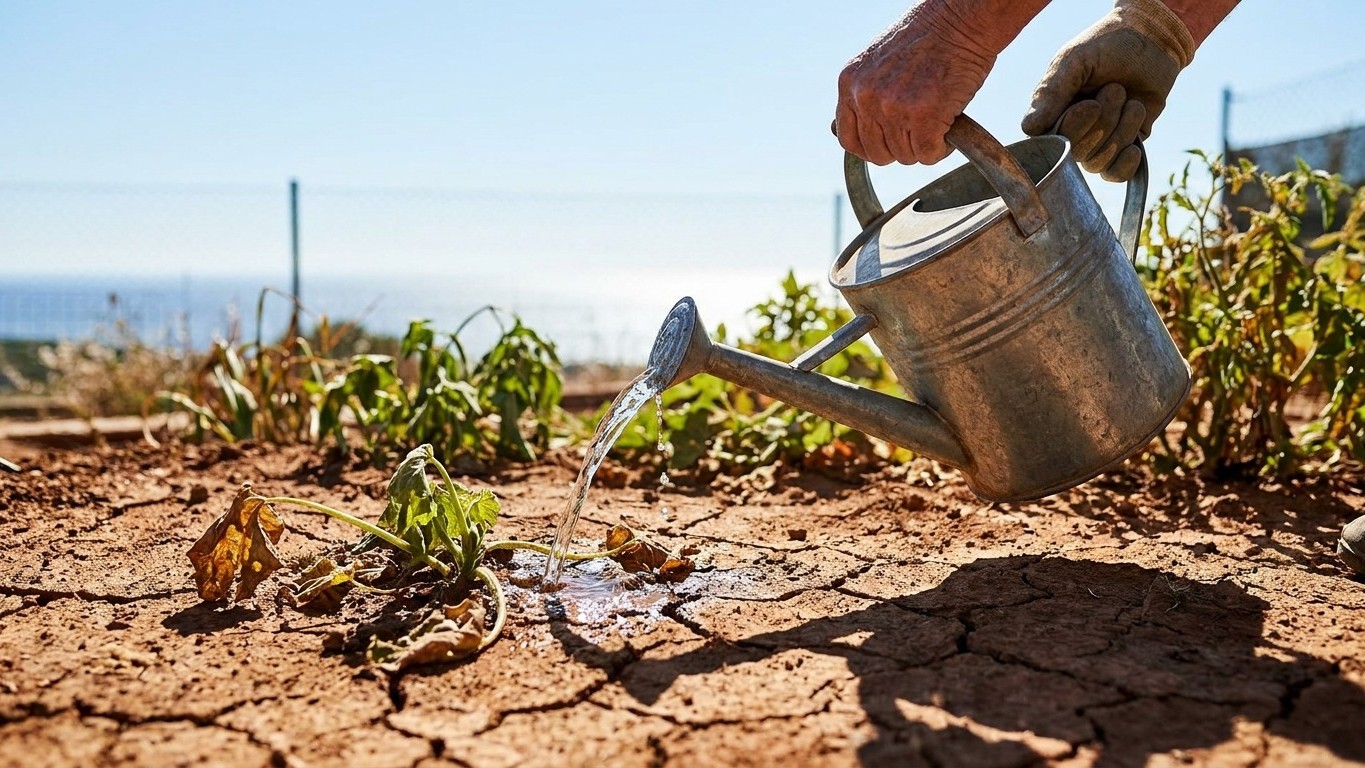

Georgia’s driest summer stretch isn’t really a drought in the technical sense: August still delivers 4.3 inches of rain on average, and June and July bring even more. The challenge is timing. With 35.8 days a year hitting 90F or higher, that rain doesn’t always land when roots need it, and the sun pulls moisture back out almost as fast as it falls.
What changes here

Two numbers set the terms for every Georgia gardener: 4.3 inches of rain in August, the driest summer month, and 35.8 days a year that reach 90F or above. Together they mean the sky delivers a reasonable amount of water over the course of a month, but the heat load is high enough that a lot of it evaporates before a plant’s roots ever touch it. A garden bed generally wants something close to an inch of water a week to keep growing without stress. Do the arithmetic on August’s 4.3 inches and it works out to roughly 0.97 inch per week, spread evenly across the month’s 31 days. On paper, that’s almost exactly what a bed needs.
But rain in a Georgia August rarely falls evenly. It tends to arrive as afternoon thunderstorms, the kind that dump half an inch in twenty minutes and then vanish for a week. A lot of that water runs off a sunbaked surface or a compacted patch of lawn before it has a chance to soak past the first inch or two of soil. Meanwhile, on any of those 35.8 days above 90F, evaporation from bare soil and transpiration from leaves both speed up, pulling moisture out of the top layers of the bed faster than a calm, cool day would. The gap between what the sky provides and what the plant actually gets to use is where the gardener’s hose comes in.
June (4.54 inches) and July (4.75 inches) run slightly wetter than August, so the tightest stretch usually falls late in the season, right as heat accumulation peaks. That’s the window to watch closest. Soil texture changes how forgiving any of this is: a fast-draining sandy bed loses that August rain within a day, while a heavier clay bed can hold the same inch for the better part of a week. Neither the sand nor the clay changes the rainfall total. It changes how long the gardener can go before the hose becomes necessary again.
How to water when it matters
The method that works in Georgia isn’t complicated, but it runs against instinct. Watering deeply and less often beats a daily light sprinkle, because a deep soak pushes moisture down six inches or more, and roots follow the water down. A shallow daily splash keeps roots parked near the surface, exactly where the day’s heat bakes them hardest. Watering at the base rather than overhead matters just as much in a state where summer humidity already sits high. Wet foliage that doesn’t dry quickly is an invitation to fungal disease, and Georgia’s air doesn’t dry it quickly. Morning watering gives the soil time to absorb before the heat of the afternoon starts pulling moisture back out, and it lets any leaves that did get wet dry off before nightfall.
Knowing when to water beats watering on a fixed schedule. A finger pushed two inches into the soil, or a trowel pulled up for a quick look, tells the real story better than a glance at the surface. If it’s dry at that depth, water. If it’s still damp, wait.
- Check soil moisture two inches down with a finger or trowel before watering at all.
- Water at the base of the plant, using a soaker hose or drip line rather than an overhead sprinkler.
- Water in the early morning, before the day’s heat sets in.
- Aim for about one inch of water total per week, combining rainfall and hose time, applied in one or two deep sessions rather than daily.
- On sandy soil, shorten the interval and water more often in smaller amounts, since sand drains within hours.
- On heavy clay, lengthen the interval and let the soil dry between soakings, since clay holds water for days and rewatering too soon drowns roots.
That one-inch figure is a starting point, not a rule. A bed under a shade tree needs less. A raised bed in full sun on sandy fill needs more, and needs it more often. Check the soil, not the calendar.
What goes wrong
A daily sprinkle that never soaks in
Five minutes with the hose every evening feels responsible, but it wets only the top inch of soil. Roots stay shallow because that’s where the water is, and shallow roots are the first to suffer when a stretch of 90F days shows up without rain behind it.
Watering the leaves after dinner
Overhead watering in the evening leaves foliage wet all night. Georgia’s summer humidity already keeps things damp; add standing water on the leaves and fungal diseases like powdery mildew and leaf spot get exactly the overnight window they need.
Trusting a rain shower that only wet the surface
A thunderstorm that drops half an inch in twenty minutes sounds like enough, but a lot of it runs off before soaking in. Check with a finger before skipping the hose. If the soil two inches down is still dry, the storm didn’t do the job the rain gauge suggests it did.
Skipping the mulch
Bare soil in a Georgia summer, with 35.8 days above 90F, gives moisture straight back to the sun within hours of watering. A two to three inch layer of mulch slows that evaporation and keeps the soil at root depth from swinging between soaked and bone dry.
Local help
The University of Georgia Extension offers county-level guidance on irrigation timing and soil conditions specific to local growing zones. Watering restrictions vary by water provider and change with local conditions, so check with the county or municipal water utility for current rules before setting an irrigation schedule.
Common questions
How often should I water a Georgia garden in August?
Check the soil two inches down before watering. On average, a deep soak once or twice a week covers the roughly one-inch weekly need, adjusted for how fast the soil drains.
Is August really the driest month in Georgia?
Among the summer months, yes. August averages 4.3 inches of rain, slightly less than June’s 4.54 inches and July’s 4.75 inches.
Does mulch actually reduce how often I need to water?
It slows evaporation from the soil surface, which matters most on the 35.8 days a year that reach 90F or higher, when bare soil loses moisture fastest.
Should I water my lawn or garden overnight to save water?
No. Overnight watering leaves foliage wet for hours in already humid air, which favors fungal disease. Morning watering lets plants dry out during the day.