
Florida gardeners face a rare combination: heavy summer rain and relentless heat working against each other at the same time. The driest summer month still drops 6.77 inches, and the state logs 73.2 days a year at or above 90F. Together, those two numbers mean rain alone rarely solves the watering question here, because heat pulls moisture back out almost as fast as the sky puts it in.
What changes here

Start with the two numbers that matter most for a Florida garden: July, the driest summer month, brings 6.77 inches of rain, and the state averages 73.2 days a year at or above 90F. Read together, that’s a wet month sitting on top of a heat load that never really lets up, which means the rain that falls doesn’t always translate into water the roots can use.
Do the arithmetic. A garden bed wants roughly an inch of water a week. Spread July’s 6.77 inches evenly across the month’s roughly 4.3 weeks, and the sky is delivering about 1.6 inches a week on average, well above that one-inch target. On paper, that looks like plenty. In practice, Florida rain rarely falls evenly. It tends to arrive as short, intense afternoon thunderstorms, the kind that dump half an inch in twenty minutes and then vanish for a week. A storm like that can satisfy the weekly average on a calendar while leaving a bed bone-dry three days later, especially with 73.2 days a year pushing evaporation into overdrive.
Soil texture decides how much of that rain actually reaches the roots. On the sandy ground common across much of the state, water drains through fast, sometimes within hours, so the same downpour that would keep a clay bed wet for a week barely lasts a day or two in sand. That combination, sharp drainage plus high heat, is why a Florida gardener can get well above an inch of rain in a week and still need to run a hose. The rainfall total tells you what the sky provided over the month; it doesn’t tell you what was still in the ground on Thursday.
How to water when it matters
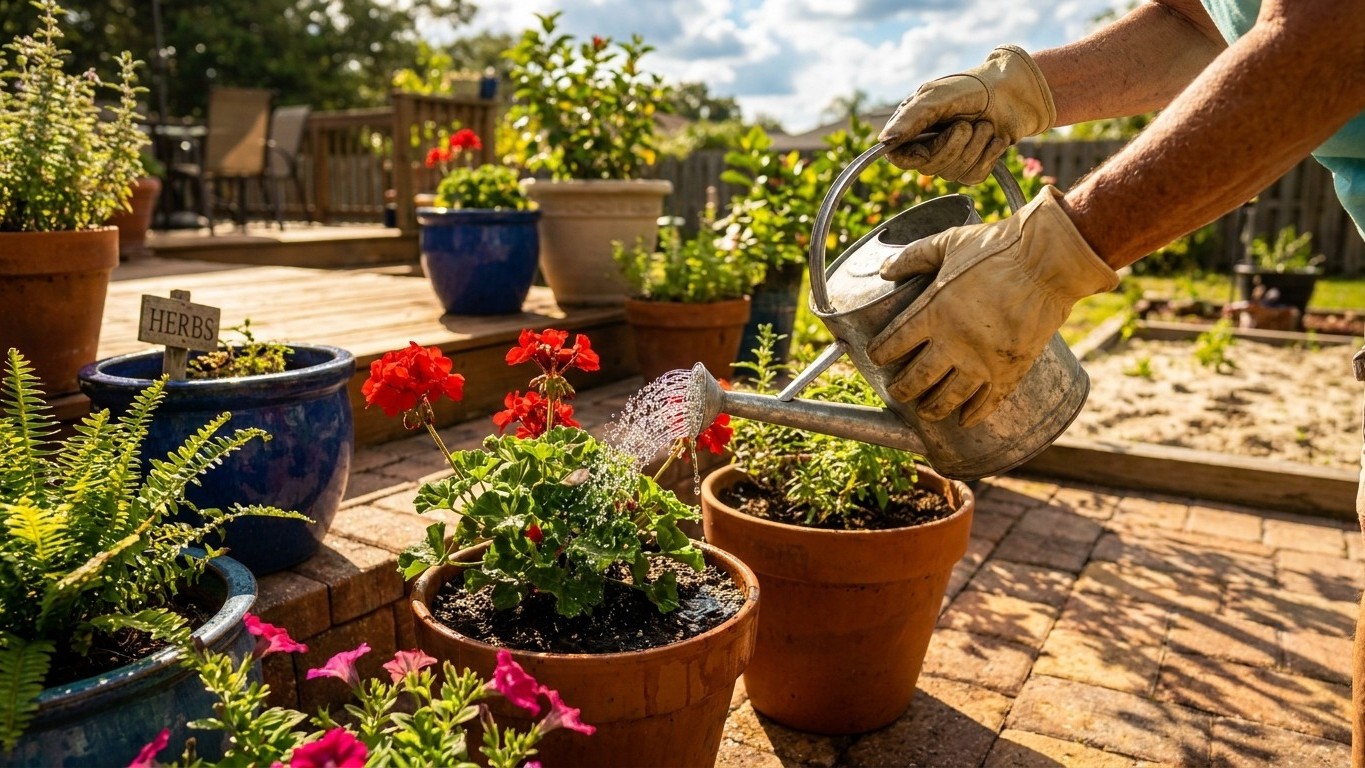
The method that works in Florida isn’t complicated, but it has to account for fast-draining ground and near-daily heat stress. Watering deeply and infrequently, at the base of the plant, in the morning, addresses three separate problems at once: it trains roots to grow downward instead of staying shallow, it puts water where the plant can actually absorb it instead of on foliage, and it gives the surface time to dry before the heat of the day, which cuts down on fungal problems that thrive in standing moisture.
Checking the soil before watering matters more here than almost anywhere else, because a wet-looking surface after a thunderstorm can be hiding dry soil two inches down. A finger pushed into the bed, or a trowel pulled up for a quick look, tells the real story. If it’s dry at that depth, water. If it’s still damp, wait.
- Check moisture first. Push a finger about two inches into the soil near the plant’s root zone before deciding to water at all.
- Water at the base, not overhead. Direct the hose or drip line to the soil, keeping foliage dry.
- Water in the early morning. This lets excess moisture evaporate from leaves and the soil surface before evening humidity sets in.
- Adjust frequency to soil type. On sandy ground, plan on shorter, more frequent soakings, since water passes through quickly; on heavier clay pockets, space watering out further apart and let the top few inches dry before the next round.
- Start with about one inch per week as a baseline, delivered in one or two sessions, and adjust up or down based on what the finger test shows on your own plot.
That one-inch figure is a starting point, not a rule. A raised bed in full sun with sandy fill will dry faster than a shaded border with richer soil, even on the same block.
What goes wrong
Watering a little bit every day
A daily light sprinkle feels responsible, but it only wets the top inch of soil. Roots follow the water, so they stay shallow and close to the surface, exactly where 73.2 days a year of 90-degree heat can bake them dry within hours of the sun coming up.
Watering leaves in the evening
Wetting foliage after dark leaves moisture sitting on the leaves overnight with no sun or breeze to dry it off. That’s the exact condition fungal diseases need to take hold, and Florida’s humidity makes the risk worse than in drier climates.
Trusting a rain shower that never soaked in
A fast summer thunderstorm can look like a soaking rain from the porch while only wetting the top half-inch of soil. Given that July alone averages 6.77 inches, it’s tempting to assume the garden is covered for the week. Checking with a finger two inches down is the only way to know whether that storm did real work or just wet the surface.
Skipping mulch
Bare soil in Florida heat loses moisture fast. A two- to three-inch layer of mulch slows evaporation and keeps the soil temperature down, which matters directly given how many days a year cross 90F. Leaving soil exposed hands back a good portion of whatever water, sky-delivered or hose-delivered, was just put down.
Local help
Watering restrictions in Florida are set at the local water management district level and change with drought conditions, so check with your county water provider before setting a schedule. For soil testing, plant recommendations and site-specific guidance, the University of Florida IFAS Extension is the state’s official resource.
Common questions
How often should I water my garden in Florida?
There’s no single schedule that fits every yard, but checking soil moisture two inches down before each watering, rather than watering on a fixed calendar, works better given how unevenly Florida rain falls.
Does Florida’s rain mean I don’t need to water in summer?
Not reliably. Even in July, the driest summer month at 6.77 inches, rain tends to arrive in short bursts that can leave soil dry a few days later, especially with 73.2 days a year hitting 90F or above.
Is sandy soil good or bad for watering in Florida?
It drains fast, which means less risk of waterlogged roots but also means water passes through before plants can use much of it, favoring shorter, more frequent watering over a single heavy soak.
What time of day should I water in Florida?
Morning is best. It gives the soil surface and any wet foliage time to dry out before the evening humidity and overnight moisture that encourage fungal disease.