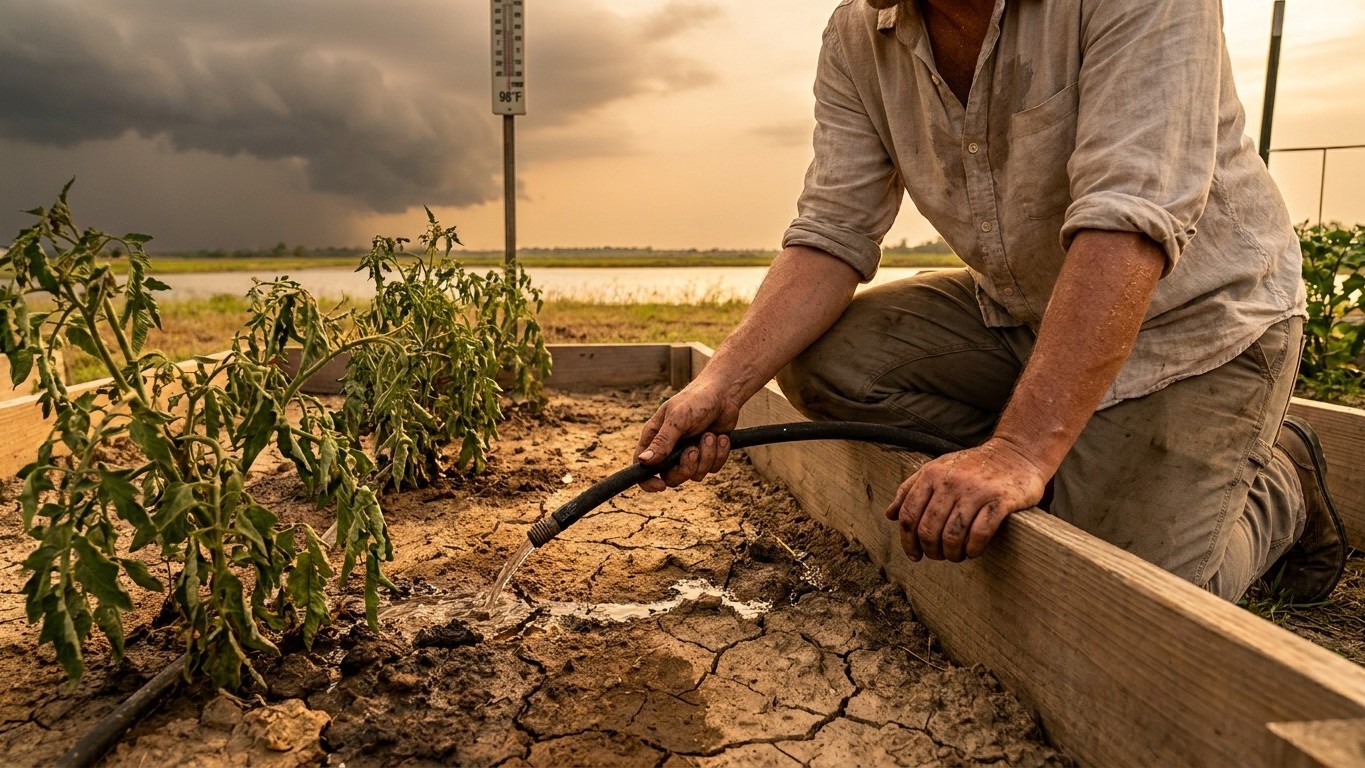

Louisiana gardens face a specific math problem each summer: plenty of rain on paper, but heat and clay soils that eat through it fast. The fix is watering deeply and infrequently, checking soil moisture at root depth rather than trusting a passing shower, and adjusting the rhythm to whether the ground underfoot drains in an hour or holds water for a week.
What changes here

Start with the two numbers that run this show. July, Louisiana’s driest summer month, still averages 6.79 inches of rain. At the same time, the reference station logs 70.7 days a year at 90F or above. Put together, that’s a paradox any gardener here has felt: a month with real rainfall on the books, sitting inside a season hot enough to undo most of it before it does any good.
Run the arithmetic and the paradox gets clearer. A vegetable bed or a young shrub wants roughly an inch of water a week. Spread evenly across July’s roughly four and a half weeks, 6.79 inches works out to somewhere around 1.5 inches a week from the sky alone, which on paper is more than enough. But rain in Louisiana summers rarely falls evenly. It tends to arrive as a single afternoon thunderstorm that dumps a large share of the month’s total in under an hour, and a downpour like that sheds more water off the surface than it lets soak in, especially on ground that’s already baked hard from the days above 90F stacking up around it. The gardener who reads “6.79 inches” and assumes the hose can stay coiled up all July is usually the one with a wilted bed by August.
Soil texture decides how much of that inch actually reaches the roots. Louisiana ground runs from sandy river terraces to heavy clay flats, sometimes within the same lot, and the same inch of water behaves in opposite ways depending on which one a plant is sitting in. On sand, water drains through within a day, leaving little reserve once the surface dries out under a 90-degree afternoon. On clay, that same inch can sit in the root zone for the better part of a week, which sounds convenient until a second storm arrives on top of it and drowns roots that never got the chance to breathe. Neither soil forgives guesswork. Both call for a gardener who checks the ground rather than the sky.
How to water when it matters
The method that works on Louisiana ground isn’t complicated, but it depends on doing a few things in the right order and for the right reason, rather than just turning on a sprinkler on a schedule.
- Water early in the morning, before the day’s heat sets in, so the plant absorbs moisture before evaporation and the day’s climb toward 90F start competing for it.
- Deliver water at the base of the plant, not overhead, so it reaches the root zone directly instead of sitting on leaves where it does nothing for the roots and everything for fungal disease.
- Check soil moisture two inches down with a finger or a trowel before watering at all. If it’s still damp at that depth, skip the session; surface dryness alone means nothing in Louisiana heat.
- Water deeply rather than briefly, aiming to soak the top six to eight inches of soil in one session, which pushes roots downward and away from the surface layer that bakes fastest.
- On sandy soil, shorten the interval between waterings since the ground holds little reserve, while on heavy clay, stretch it out and confirm with the finger test that the previous soaking has actually dried before adding more.
- Start from about 1 inch of water per session as a baseline during dry stretches, then adjust up or down based on how quickly the soil dries between waterings in that particular bed.
Deep watering encourages roots to chase moisture downward, which matters directly in a place logging 70.7 days a year above 90F: shallow-rooted plants are the first to collapse once heat stress sets in, while deep-rooted ones have a buffer even during a dry stretch of July. Morning watering isn’t a superstition either. It gives foliage time to dry before nightfall, and overnight moisture on leaves is exactly what fungal disease needs to take hold in a humid Gulf climate.
What goes wrong
“I water a little every evening”
A light daily sprinkle wets only the top inch or so of soil, which trains roots to stay near the surface where they’re first to dry out and first to cook once the afternoon temperature climbs. In a region logging 70.7 days a year at 90F or higher, that shallow root system is the single most expensive habit a Louisiana gardener can fall into.
“I water the leaves after work”
Watering overhead in the evening leaves foliage wet through the night, and that combination of standing moisture and Gulf humidity is close to ideal for fungal disease. The fix is the same water, delivered at the base, in the morning instead.
“I figure the storm took care of it”
A loud afternoon thunderstorm can look like it solved the watering problem while only wetting the top half-inch of soil, with the rest running off a surface baked hard by the heat. The finger test settles it in ten seconds; the sound of rain on a roof does not.
“I skip the mulch”
Bare soil in a Louisiana summer gives back to the sun almost as fast as it takes in, and every inch of moisture just delivered evaporates within a day or two without a layer of mulch to slow it down. Given how much of the state’s ground runs to heavy clay, the reverse mistake is just as real: watering a bed that’s still holding last week’s rain, which drowns roots in soil that never got the chance to dry.
Local help
The LSU AgCenter is Louisiana’s land-grant extension service and the right first stop for soil testing, plant selection and drought guidance specific to the state’s parishes. Watering restrictions vary by water district and change with drought conditions, so check current rules with your own local water provider before setting a schedule.
Common questions
How often should I water my garden in Louisiana during summer?
Aim for roughly one deep soaking a week as a starting point, adjusted by soil: more often on sandy ground, less often on clay, and always confirmed by checking moisture two inches down rather than by the calendar alone.
Is July really the driest month in Louisiana?
At the reference station, July averages 6.79 inches of rain, slightly below June’s 7.62 and August’s 6.91, making it the driest of the three summer months, even though all three still bring meaningful rainfall.
Why does my garden dry out fast even with regular rain?
Louisiana logs 70.7 days a year at 90F or above, and that heat drives evaporation quickly, especially when rain arrives as a short, heavy thunderstorm that runs off rather than soaking into the soil.
Does clay soil mean I can water less often?
Clay holds water longer than sand, so intervals can stretch out, but watering it again before it has actually dried risks drowning roots. Check with a trowel rather than assuming the calendar week has passed.