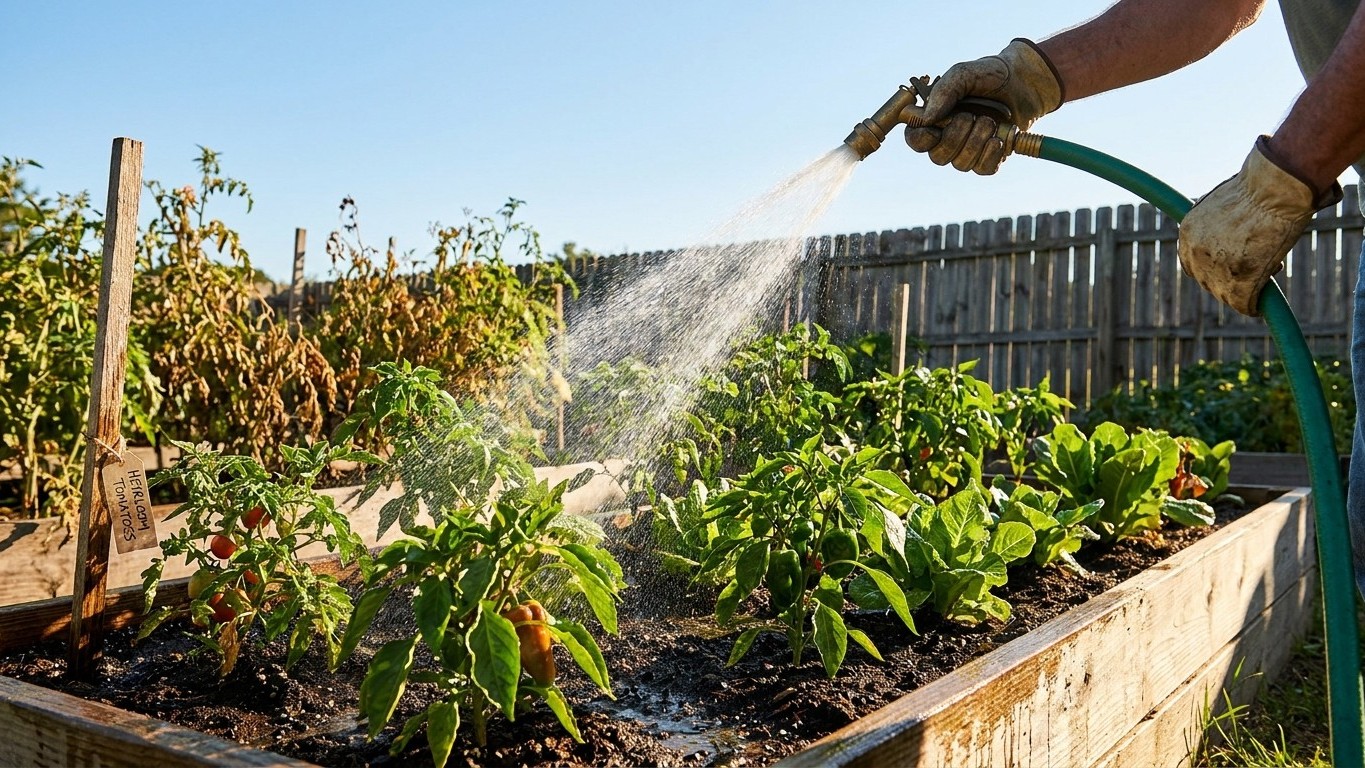

Mississippi gardens don’t run dry from lack of rain alone. The state’s driest summer month, June, still delivers 4.43 inches on average, and the year logs 71.1 days at or above 90 degrees. Together those numbers mean water arrives unevenly and evaporates fast, so the fix isn’t more rain, it’s a deliberate watering rhythm that fills the gaps the sky leaves behind.
What changes here

Start with the two numbers side by side: 4.43 inches of rain in June, the driest summer month at the reference station, and 71.1 days a year that hit 90 degrees or hotter. Read together, they tell a gardener something specific: the rain totals look almost adequate on paper, but the heat load is high enough to burn through that moisture before roots get much use of it.
Do the arithmetic. A vegetable bed or a young shrub bed wants roughly an inch of water a week. June has about 4.3 weeks in it, so 4.43 inches spread evenly would land close to an inch a week, right at the target. But rain in Mississippi summers rarely spreads evenly. It comes as a thunderstorm that dumps half an inch in twenty minutes, then nothing for ten days. The monthly total can hit the mark while any given week falls far short, and the gardener is the one who has to notice the gap and fill it with a hose.
July climbs to 5.02 inches and August settles at 4.69, so the season doesn’t get drier as it goes, it gets hotter. That’s the part the rainfall number hides on its own. With 71.1 days above 90 degrees spread across a Mississippi summer, evaporation from soil and transpiration from leaves both accelerate, pulling moisture out of the top few inches of ground faster than an equivalent rain would in a cooler month up north. The same inch of water also behaves differently depending on what it lands on. On a loose, sandy plot it drains through within hours, leaving little for roots to draw on by the next afternoon. On heavy clay it can sit near the surface for the better part of a week, which sounds generous until a second storm arrives on top of ground that never drained, and roots start to suffocate instead of drink. Knowing which kind of ground is under a given bed changes the whole watering calendar that follows.
How to water when it matters
The method that works in Mississippi’s summer heat isn’t complicated, but it runs against instinct. Deep and infrequent beats a light daily spritz, because a deep soak pushes water down six inches or more, which is where a plant’s real feeder roots want to be. A shallow sprinkle every evening trains those roots to stay near the surface, exactly where the day’s heat hits hardest. Watering at the base rather than overhead keeps moisture where roots can use it instead of losing a good share to evaporation off wet leaves in 90-degree air. Morning is the right window because the plant gets to drink before the day’s heat sets in, and any leaf splash has hours to dry before nightfall, which matters since damp foliage sitting overnight is an open invitation to fungal disease.
The surface of the soil lies. It can look bone dry and pale while two inches down it’s still damp from last week’s storm, or it can look fine on top while the root zone underneath is parched. Push a finger or a trowel down two inches before deciding to water at all. If it’s dry at that depth, water. If it’s still damp, wait another day and check again.
Soil texture sets the rhythm as much as the calendar does. Sandy ground holds water for a short time, so it asks for smaller, more frequent soakings rather than one big weekly dose. Heavy clay can carry a week’s worth of water, but watering it again before it’s had time to dry pushes air out of the soil and drowns roots instead of feeding them. Here’s a sequence to start from and adjust once the reader has watched their own bed respond:
- Check soil moisture two inches down with a finger or trowel before watering, not by looking at the surface.
- If dry, apply about one inch of water in a single session, using a soaker hose or drip line at the base of the plants.
- On sandy soil, split that inch into two shorter sessions a few days apart instead of one long soak.
- On clay soil, water once and let it fully dry at root depth before watering again, even if that stretches past a week.
- Water in the early morning, before 9 a.m. if possible, so leaves dry before evening.
- Add two to three inches of mulch around the base to slow evaporation between waterings.
That one-inch figure is a place to start, not a rule carved in stone. A raised bed of loose compost drains faster than the ground itself; a low spot that collects runoff needs less. Watch how a bed actually responds over a couple of weeks and adjust from there.
What goes wrong
Watering a little every day
It feels responsible, checking on the garden every evening with a can. But a light daily pass wets only the top inch of soil, and roots follow the water. They stay shallow, right in the zone that heats up fastest under 71.1 days a year of 90-degree sun, and the plant becomes more fragile, not less, over the course of the summer.
Soaking the leaves after dinner
Evening watering overhead leaves foliage wet through the night, and that damp window is exactly when fungal spores multiply. In a state where summer humidity is already high, that mistake compounds fast, and a gardener can lose a tomato plant to blight in a week without any error in how much water it got.
Trusting the last rain shower
A storm that dumped half an inch looks like a job done, but a hard, fast Mississippi thunderstorm often wets only the surface before running off a clay bed or draining straight through sand. The only way to know is to check two inches down with a finger rather than assume the sky did the work.
Skipping the mulch
Bare soil left exposed under 90-degree afternoons gives back a good share of whatever water was just applied, straight into the air. A two- to three-inch layer of mulch slows that loss and buys the root zone time between waterings, which matters most in the driest stretch of June before the season’s storms pick back up.
Local help
The Mississippi State University Extension Service publishes region-specific guidance for home gardens and can answer questions particular to a county’s soil and conditions. Watering restrictions vary by city and utility district and change with drought conditions, so check current rules with the local water provider before setting a summer watering schedule.
Common questions
How often should I water my garden in Mississippi during summer?
Check soil moisture two inches down before watering rather than following a fixed calendar. On average, that works out to roughly once or twice a week on clay soil and more often, in smaller amounts, on sandy soil.
Is June really the driest month in Mississippi?
At the reference station, June averages 4.43 inches of rain, slightly less than July’s 5.02 and August’s 4.69, making it the driest of the three summer months even though all three see meaningful rainfall.
Does mulch actually reduce how often I need to water?
Yes. A two- to three-inch layer slows evaporation from the soil surface, which matters directly in a state that logs 71.1 days a year at or above 90 degrees.
Can I rely on rainfall totals alone to decide when to water?
No. Monthly totals can look adequate while individual weeks run dry, since summer rain often arrives in short, heavy storms rather than spread evenly across the month. A finger test at root depth settles it better than the monthly average.