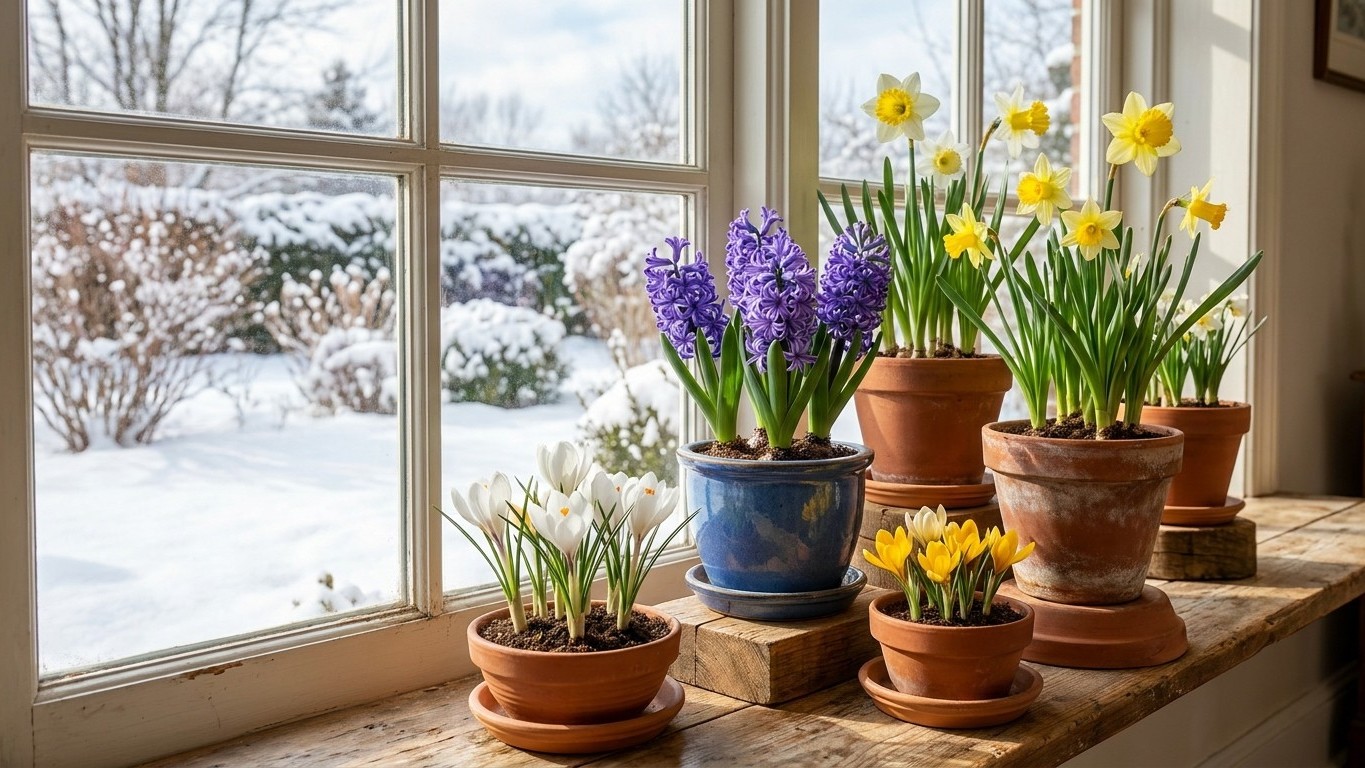

Forcing Spring Bulbs Indoors here means giving a bulb its cold period yourself, in a refrigerator drawer or an unheated garage, instead of trusting a Missouri winter to do it outdoors. The technique works because a bulb doesn’t care where the chill comes from, only that it gets enough of it before it will bloom. The payoff: a hyacinth or a pot of crocus flowering on a windowsill weeks before anything outside has even broken ground.
Why this matters in Missouri

The coldest-month average minimum here, measured at the Kansas City reference station, is 19.5°F, based on NOAA NCEI Climate Normals for 1991-2020. That single number tells you which of two problems you’re actually solving by forcing bulbs indoors in this region.
In places where winter never gets cold enough, forcing exists to supply a chill period the outdoor season simply won’t provide. That’s not the situation here. A coldest-month minimum of 19.5°F means Missouri ground stays well below the 45°F threshold a spring bulb needs for its full twelve to fourteen weeks, and usually far longer than that. Tulips, daffodils, and hyacinths planted in a garden bed get their chilling requirement met without any help from a gardener. If lack of cold were the issue, forcing wouldn’t be worth discussing here at all.
The real reason forcing matters in this territory is timing and containers, not scarcity of cold. A bulb chilled indoors on a schedule blooms when you decide, not when the ground finally warms in spring. And a bulb potted up and left outside all winter faces a different threat entirely: a container freezes straight through, roots and all, while the same ground a few feet away only freezes at the surface. That distinction is what makes the USDA hardiness zone map, which covers 5b through 7b across the state (USDA Plant Hardiness Zone Map, 2023, based on 1991-2020 normals), a poor guide for anything planted in a pot. A bulb rated hardy to the zone listed for your address can still die in a container in that same zone, because the pot offers none of the insulation that surrounding soil mass provides.
So the practical answer for Missouri splits in two directions. If your goal is early indoor bloom, you’re supplying artificial cold on purpose, and the state’s naturally cold winters are irrelevant to that project. If your goal is overwintering potted bulbs outdoors, the 19.5°F coldest-month minimum is exactly the number that should worry you, because it’s cold enough to freeze an unprotected pot solid.
How to do it here
Once you know which problem you’re solving, forcing indoors follows a fixed sequence. Skip a step and the bulb either won’t bloom or will bloom too fast to hold its shape.
- Pick a bulb with a known chill requirement. Hyacinths, crocus, and muscari need roughly ten to fourteen weeks below 45°F. Paperwhite narcissus and amaryllis need none at all and can skip straight to potting.
- Pot the bulb shallow, in a container with drainage holes. Set the nose of the bulb just at the soil surface, using a loose, fast-draining mix. A pot without drainage is the single most common cause of forced bulbs rotting before they ever bloom.
- Find the twelve to fourteen weeks of cold. An unheated garage that stays reliably above freezing works, since the goal is chilling, not freezing. A refrigerator produce drawer also works, but keep it away from ripening fruit: apples, pears, and bananas release ethylene gas, and ethylene kills the flower bud forming inside the bulb before it ever gets the chance to open.
- Check the soil every couple of weeks. Keep it barely moist, never soggy, for the full cold period. This is also when to check that garage temperatures haven’t dropped below freezing, since a chilling container is not the same as a frozen one.
- Move the pot into a cool, bright spot once shoots reach one to two inches. A room around 60 to 65°F lets the stem develop before the flower opens, rather than forcing bloom prematurely on a stem that hasn’t finished growing.
- Shift to full light and normal room temperature for bloom. Expect flowers within two to four weeks of that final move.
For bulbs left in containers outdoors rather than forced indoors, the rule of thumb is different: the pot needs to perform as if it were at least two USDA zones hardier than the bulb requires, or it needs to come indoors to an unheated garage and get buried in mulch for the winter. Given the 19.5°F coldest-month minimum at the Kansas City reference station, an exposed pot left on a porch is not a safe bet for anything rated to the zones common across this state.
Which bulbs are worth it
Not every bulb repays the effort of forcing. The ones that force well share two traits: a short cold requirement and a stem that stays upright without staking. The ones that sulk usually fail on one of those two counts, or both.
Worth noting too: several of the best forcing candidates aren’t hardy in Missouri ground anyway. Paperwhites and amaryllis are tender bulbs that won’t survive a Missouri winter outdoors regardless of zone, so forcing them costs nothing in the long run. They were a one-season purchase from the start.
- Paperwhite narcissus — no chilling required at all, blooms in three to four weeks from potting
- Amaryllis — no cold period needed, only warmth and consistent watering
- Hyacinths — short ten to thirteen week chill requirement, sturdy stem holds its shape
- Crocus — short chill, low compact habit suits a small pot
- Muscari (grape hyacinth) — short chill, compact enough that it never needs staking
Against that, some popular bulbs simply aren’t built for a pot on a windowsill.
- Large trumpet daffodils — tall stems flop under their own weight indoors and need a long chill period to bloom well
- Large hybrid tulips — require fourteen to sixteen weeks of cold and often bloom unevenly in a container
- Alliums — very long chill requirement relative to the size of bloom they deliver, rarely worth the pot space
- Fritillaria — prone to rot in pots and fussy about drainage even outdoors
A reader deciding between a bag of hyacinths and a bag of large tulips at the store is really choosing between a bulb that forgives a few mistakes and one that doesn’t.
What goes wrong, and when you can still fix it
Leaves come up, but no flower
The cold period was too short. The bulb had enough energy to push foliage but never finished forming the flower bud inside. This season’s bulb won’t bloom no matter what you do now. It can still be planted outside in the garden bed once the ground is workable, where it may recover and flower normally the following spring with a full season of natural chill.
A flower opens on a stem too short to see
The bulb was moved into warmth too fast after the cold period ended. The flower bud raced ahead of the stem, which never had time to elongate. There’s no fixing this bloom once it’s opened. Next time, hold the pot in that intermediate 60 to 65°F room longer before moving it into full warmth and light.
Rot in the pot
This one traces back to drainage, either a pot without holes or a soil mix that stayed wet through the entire cold period. Once a bulb has gone soft or moldy, it’s finished for good, not just for this season. The bulb can’t be saved. The fix applies only to the next attempt: drainage holes, a loose mix, and watering just enough to keep the soil barely moist rather than damp.