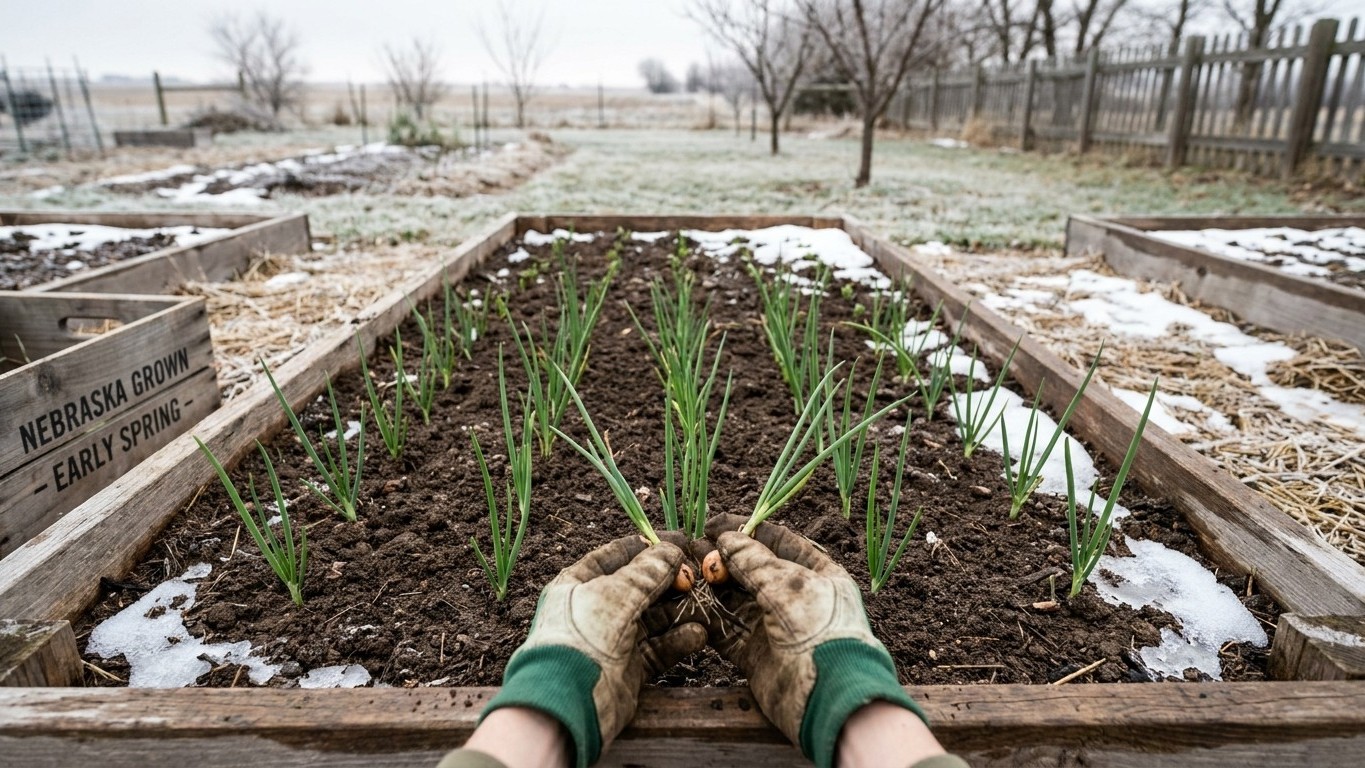

In Nebraska, onions go into the ground in late winter to early spring, usually as transplants or sets set out three to four weeks before the last frost, not tucked into fall soil like they are farther south. That’s because Lincoln sits at 41.31 degrees north, where the ground freezes solid every winter, and where the growing season leans on nearly 15 hours of daylight at the June solstice to push a bulb to size before summer ends.
The short answer for Nebraska

Onion bulbing has nothing to do with heat. It’s triggered by day length, and at Lincoln’s latitude the longest day of the year runs 14 hours and 59 minutes, according to the standard sunset hour-angle calculation for that spot. Long-day onions need 14 to 16 hours of daylight before they’ll switch from making leaves to making a bulb. Nebraska’s summer daylight clears that bar with room to spare, which is why the state is long-day and intermediate-day territory, not short-day country.
What that means for the calendar: seed gets started indoors roughly eight to ten weeks before the last spring frost, usually sometime in January or February depending on your county. Transplants or sets then go into the garden two to four weeks ahead of that last frost date, since young onion plants shrug off a light freeze that would kill most other vegetable starts. From there, the plant has from spring thaw until the solstice to build leaf mass, because whatever size it reaches by then is the size it works with once bulbing starts.
Why the South plants in fall and Nebraska doesn’t
States with mild winters, think the Gulf Coast or the lower Southeast, plant onions in autumn because the ground never freezes hard enough to stop root growth. The plant spends winter quietly sizing up, then hits its day-length trigger in early spring with months of head start already banked. Nebraska doesn’t get that option. A fall-planted onion here would sit in frozen ground through January and February, doing nothing, then face the same short window everyone else does. Spring planting isn’t a compromise in this climate. It’s the only planting.
What will not work here
Planting late doesn’t push the harvest back. It shrinks it. An onion doesn’t wait for a gardener who got a late start, it hits the same day-length trigger everyone else’s onions hit, and whatever size the plant has reached at that moment is the size the bulb will be. A transplant that goes in three weeks late doesn’t give you bulbs three weeks later. It gives you bulbs three weeks smaller, permanently.
Variety choice carries the same kind of consequence, and it’s not a soft one. Short-day onions are built to trigger bulbing at around 12 hours of daylight, a threshold Nebraska’s spring reaches while the plants are still small. Plant one of these varieties this far north and you don’t get a smaller harvest, you get an early one that never had a chance to grow. On the other end, a couple of long-day varieties need more daylight than Nebraska’s sky ever provides, and those plants don’t bulb small, they don’t bulb at all.
- Gabriella (short-day), triggers at 12 hours, well before Nebraska plants have sized up, leaving tiny bulbs.
- Madalyn (short-day), same early trigger, same result: bulbs form before there’s any leaf mass to feed them.
- Red Rock (short-day), bulbs before the spring-planted foliage has grown enough to matter.
- Red Sensation (short-day, bred for 25-35N), trips its bulbing switch far too early at Nebraska’s latitude.
- Texas Grano 1015Y (short-day, bred for 25-35N), a Gulf Coast standard that stalls out small this far north.
- Vidora (short-day, bred for 25-35N), the same short-trigger problem, the same undersized outcome.
- White Castle (short-day, bred for 30-38N), needs shorter days than Nebraska’s summer ever offers to time correctly.
- Powell (long-day, needs 43-47N) : Nebraska’s longest day tops out at 14 hours 59 minutes, short of what this variety needs, so it never bulbs at all.
- Redwing (long-day, needs 43-65N), same ceiling problem: the plant makes leaves all summer, then rots with nothing underground.
What changes across Nebraska
Nebraska isn’t one latitude, it’s a stretch of roughly three degrees, from around 40 degrees north on the Kansas border up to about 43 degrees north where the Panhandle meets South Dakota. Lincoln, the reference point behind the 41.31N and 14:59-hour figures above, sits in the southeast corner of the state. A gardener in Scottsbluff or Chadron, up near that northern edge, is working with more summer daylight than someone in Lincoln or Beatrice, and that shifts which varieties are a comfortable fit versus a stretch.
| Location | Approx. latitude | What it changes |
|---|---|---|
| Southern border (near Kansas) | ~40N | Sits at the low edge for intermediate-day types; a variety like Candy (rated 33-40N) is a solid fit here but stretched further north. |
| Lincoln (reference city) | 41.31N | Comfortable long-day and intermediate-day territory; the 14:59-hour figure above applies directly here. |
| Panhandle (near South Dakota) | ~42-43N | Closer to the range where Safrane and Talon (42-50N) perform reliably; also a slightly later average last frost than Lincoln. |
Three varieties sit close enough to the edge of their published ranges that they shift with location rather than giving a flat yes or no. Candy, an intermediate-day type rated for 33-40N, is a safer bet in the southern tier than farther north. Safrane and Talon, both long-day and rated for 42-50N, are more at home in the Panhandle than in Lincoln, where they’re at the low edge of their range and may bulb later or less reliably than a variety built specifically for 41N. None of this is a reason to guess. It’s a reason to know which corner of the state you’re gardening in.
Sweet now, or onions that last
Every Nebraska gardener eventually runs into this trade-off, and it isn’t about luck or growing skill. The compounds that give an onion its bite, volatile sulfur compounds, are the same ones that protect the bulb once it’s sitting in a pantry or root cellar. University of Missouri Extension puts it plainly: sweet onions, as a rule, don’t store as well as the pungent types, because pungency and shelf life come from the same chemistry.
Among the long-day and intermediate-day varieties that actually bulb at Nebraska’s latitude, that split shows up clearly. Walla Walla Sweet, rated for 35-55N and comfortably at home here, is prized for eating fresh precisely because it carries fewer of those sulfur compounds, but that’s also why it won’t hold through winter storage. Varieties bred with more pungency carry more of that natural preservative and hold up far longer in a cool, dry space.
What that means for a Nebraska kitchen: a garden built around sweet varieties gives you onions to eat through fall and into early winter, then nothing left by January. A garden that includes the sharper, more pungent long-day types keeps giving you onions into March, sometimes later, out of the same root cellar shelf. Most gardeners here end up planting both, sweet ones for the table now, pungent ones for the pantry later, rather than betting the whole bed on one or the other.
Checking this against your own garden
Everything above is built around Lincoln’s numbers, and Lincoln isn’t every Nebraska garden. Before locking in a planting date or a variety list, it’s worth confirming a few things specific to your own address rather than trusting a statewide figure to fit a Panhandle backyard or a southern-border plot equally well.
- Look up your own latitude if you’re gardening well north or south of Lincoln, since a couple of degrees changes which varieties sit comfortably inside their range versus at the edge.
- Pull your local average last frost date rather than relying on a statewide average; it can shift by two weeks or more between the southeast and the Panhandle.
- Check whether your soil is actually workable in early spring, since a late thaw can push transplant dates back regardless of the calendar.
- Call your county office of University of Nebraska-Lincoln Extension for planting windows and variety trials specific to your part of the state.
- Track the actual weather each spring instead of a fixed date, since a warm March or a cold April can move the safe transplant window either direction.