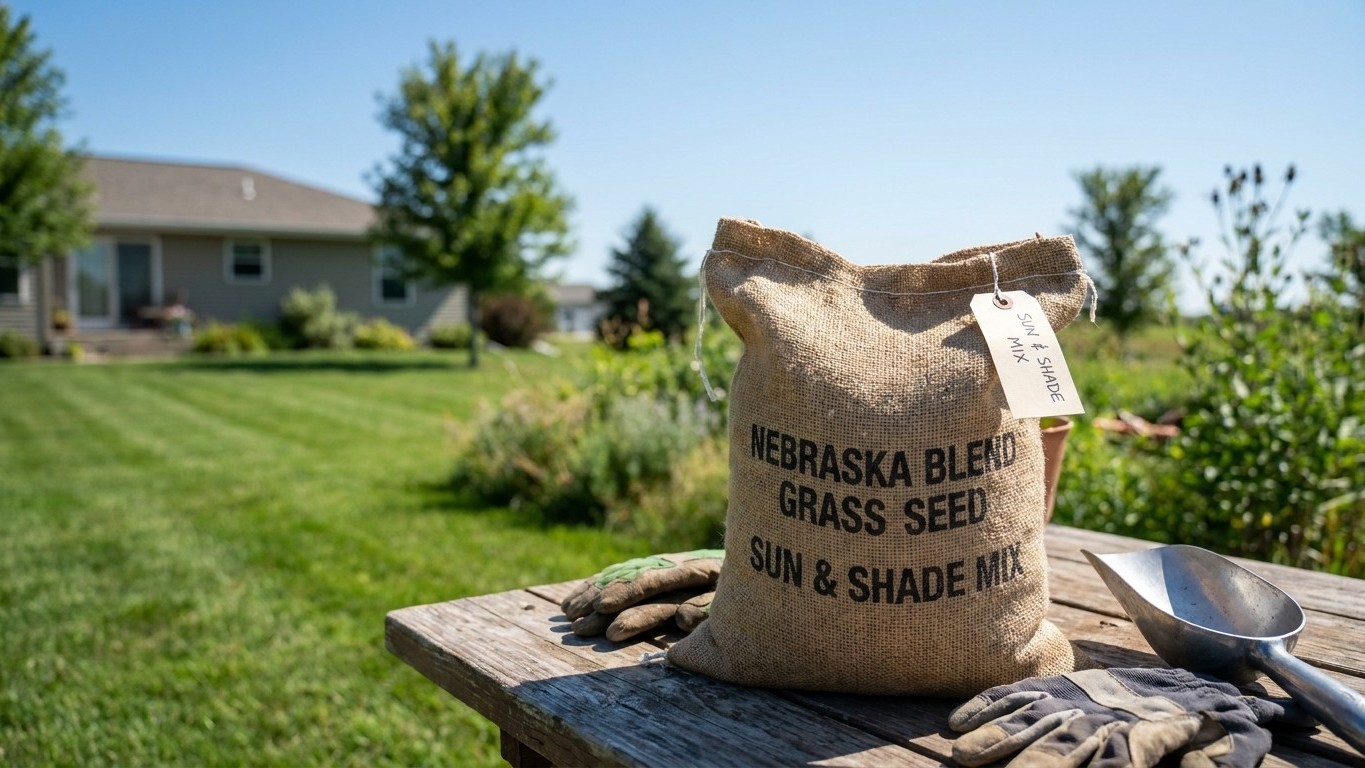

Nebraska sits squarely in cool-season turf territory, so the realistic seed choices are Tall Fescue, Kentucky Bluegrass, Perennial Ryegrass, and Fine Fescue for shade, not a warm-season species like Bermudagrass or Zoysia that will not survive the winter here. NOAA’s 1991-2020 climate normals put Omaha’s first fall frost between October 15 and October 26, and that window anchors the fall seeding schedule most cool-season lawns run on. Check that frost window against your own county, and lean toward Tall Fescue if you want one bag of seed to cover drought, wear, and moderate shade at once.
The short answer for Nebraska
For most Nebraska yards, Tall Fescue is the strongest single-species choice. It roots deeper than the bluegrasses, tolerates the state’s dry summer stretches better, and holds up to foot traffic from kids and dogs. Kentucky Bluegrass gives a denser, more uniform lawn and spreads to heal bare patches on its own, but it drinks more water and thins out faster in a hot, dry August than Tall Fescue does. Perennial Ryegrass germinates fastest of the group and is often blended in to hold soil while slower species establish, though it does not have the same staying power on its own.
Fine Fescue is the pick for shaded areas under mature trees, where Kentucky Bluegrass and Tall Fescue both thin out from lack of sun. Rough Bluegrass is a narrower tool: it only earns its place in consistently moist, shaded spots, since it has almost no drought tolerance and folds under regular foot traffic. These five species, named by Clemson Cooperative Extension’s HGIC 1214 guide to selecting a lawn grass and by Penn State Extension for the cool-season group specifically, are the only ones that hold through a Nebraska winter.
What the right answer depends on
The species that suits a given yard depends on how much sun it gets, how much you’re willing to water, and whether the lawn takes heavy foot traffic. A full-sun yard that gets watered on a schedule can carry Kentucky Bluegrass. A yard that goes weeks without rain in July is better served by Tall Fescue. This “cool-season” label is based on climate normals measured near Omaha specifically. Higher ground in the Panhandle and the far north of the state can run cooler still, and that does not change the species list, just how forgiving the timing windows are.
Working through the year

Cool-season grass does most of its growing in spring and fall, goes semi-dormant in the heat of summer, and shuts down for winter. The schedule below follows the pattern set out in Clemson Cooperative Extension’s HGIC 1219 Tall Fescue Maintenance Calendar, the calendar that matches the species most Nebraska lawns are actually growing.
Late winter into spring
Start mowing once growth resumes, and keep the deck at 2.5 to 3.5 inches rather than scalping the lawn low for the season. Put down a pre-emergent crabgrass control early, before soil warms into the range where crabgrass germinates. Exact timing shifts year to year with the weather, so watch soil temperature and germination cues rather than a fixed date on the wall calendar. If you haven’t handled the basic soil prep and grading that a new lawn depends on, that groundwork is covered in our guide to Nebraska Lawn Care and is worth doing before seed goes down.
Summer
Raise the mowing height to the top of the range through the hottest stretch, and hold off on nitrogen. Feeding cool-season turf while it’s under heat stress pushes leaf growth the roots can’t support and invites disease. Water deeply and less often rather than a light daily sprinkle, since shallow watering trains roots to stay near the surface where they dry out fastest.
Fall and winter
Fall carries the heaviest nitrogen application of the year for Tall Fescue, along with core aeration and any overseeding the lawn needs. Aeration relieves the compaction that builds up over a summer of mowing and foot traffic, and overseeding works best right after, while seed-to-soil contact is good. Timing that seeding against the frost dates matters: six weeks before Omaha’s earliest recorded first frost of October 15 lands around the start of September, and eight weeks before the latest date of October 26 lands around the end of August. That puts the practical seeding window at late August into early September for gardens near Omaha, narrower for anyone farther north or at higher elevation. Skip the final mow before real cold sets in, taking the height down slightly to reduce matting under snow. For the full month-by-month sequence, see The Nebraska Lawn Care Calendar, Month by Month.
What changes across Nebraska
The figures in this article come from the weather station near Omaha, and Nebraska is wide enough that other parts of the state run on a different clock. The Panhandle, around Scottsbluff, sits at meaningfully higher elevation than Omaha, and higher ground typically means an earlier first fall frost and a later last spring frost, which shortens the seeding window on both ends. A lawn out there needs its fall seeding done earlier relative to the calendar than one near Omaha, even though the species list is the same.
The Sandhills region brings sandy soil that drains fast and holds little water, which pushes the balance toward Tall Fescue’s deeper root system over Kentucky Bluegrass, and toward more frequent, lighter watering rather than the deep-and-infrequent pattern that works on heavier soil. Southeast Nebraska, along the river valleys near Omaha and Lincoln, holds more humidity through the season, which is kinder to Kentucky Bluegrass and to Rough Bluegrass in the shaded, moist pockets under trees. None of this changes which five species are viable statewide, since the whole state falls in cool-season territory, but it does change which one performs best in a given yard and how tightly the seeding and feeding windows run.
The mistakes this climate punishes
Seeding cool-season grass in late spring or summer
Seed put down after the reliable spring window closes germinates into rising heat instead of cooling temperatures, and young seedlings with shallow roots don’t survive a Nebraska July. The damage shows up as bare, thin turf by mid-summer, and by then it’s too late to do anything but wait for the fall window.
Mowing too short in a hot summer
Cutting Tall Fescue or Kentucky Bluegrass down to two inches or less in July removes the leaf area the plant needs to shade its own root zone and slows moisture loss. The lawn doesn’t die outright, it just browns and thins faster under drought stress that a taller cut would have shrugged off. That browning is not dead turf, cool-season grass browns under summer drought and greens back up once cooler, wetter weather returns, but scalping makes the browning worse and the recovery slower.
Feeding heavily right before a hard frost
A late nitrogen application timed too close to the first freeze pushes soft new growth that has no time to harden off, and that tissue is what takes the frost damage first. The fix is to shift the bulk of the nitrogen earlier in fall, while the grass still has weeks of cool, active growth ahead of it.
Planting a warm-season species out of habit
Bermudagrass and Zoysia are common recommendations in warmer states, but they go dormant and brown at the first hard freeze here and, planted as a full lawn, won’t reliably survive a Nebraska winter the way the five cool-season species will. If a neighboring yard has a warm-season lawn that looks brown from October through May, that’s the frost dormancy talking, not proof the grass belongs here long-term.
Checking this against your county
Every figure above is measured at or near Omaha, and the closer your yard is to that reference point, the closer these dates and rates will land for you. Farther out, especially at elevation or in the far north or south of the state, treat the frost window and seeding dates as a starting range to test against your own conditions rather than a fixed answer.
The University of Nebraska-Lincoln Extension, listed in the USDA NIFA land-grant extension directory, keeps county-specific guidance and can confirm local timing. Find your county’s office through UNL Extension before you commit to a seeding date.
Common questions
Can I mix Tall Fescue and Kentucky Bluegrass in the same lawn?
Yes, and many bagged mixes do exactly this on purpose. Tall Fescue grows in clumps and doesn’t spread well on its own, so a small percentage of Kentucky Bluegrass in the blend helps fill in bare or thin spots over time.
Why did my new grass seed come up thin and patchy?
The most common cause is seeding outside the window, either too late in fall when growth stalled before roots developed, or in late spring when summer heat arrived before the grass matured. Poor seed-to-soil contact and inconsistent watering during the first two to three weeks are the other usual culprits.
Is it too late to seed if I missed the fall window?
A late-fall seeding with cool-season species usually fails or comes in thin, since the seedlings run out of growing weeks before winter. The better move is to wait for the following fall window rather than trying a spring seeding, since spring-seeded cool-season grass has to establish right before summer heat arrives.
Does Nebraska ever support warm-season lawns like Zoysia?
Small pockets in the far southeast of the state sometimes push Zoysia through, but it’s a marginal bet statewide and the lawn typically stays brown far longer each year than a cool-season lawn would, since it breaks dormancy later in spring and browns earlier in fall. For a reliable year-round lawn almost anywhere in Nebraska, one of the five cool-season species is the safer choice.