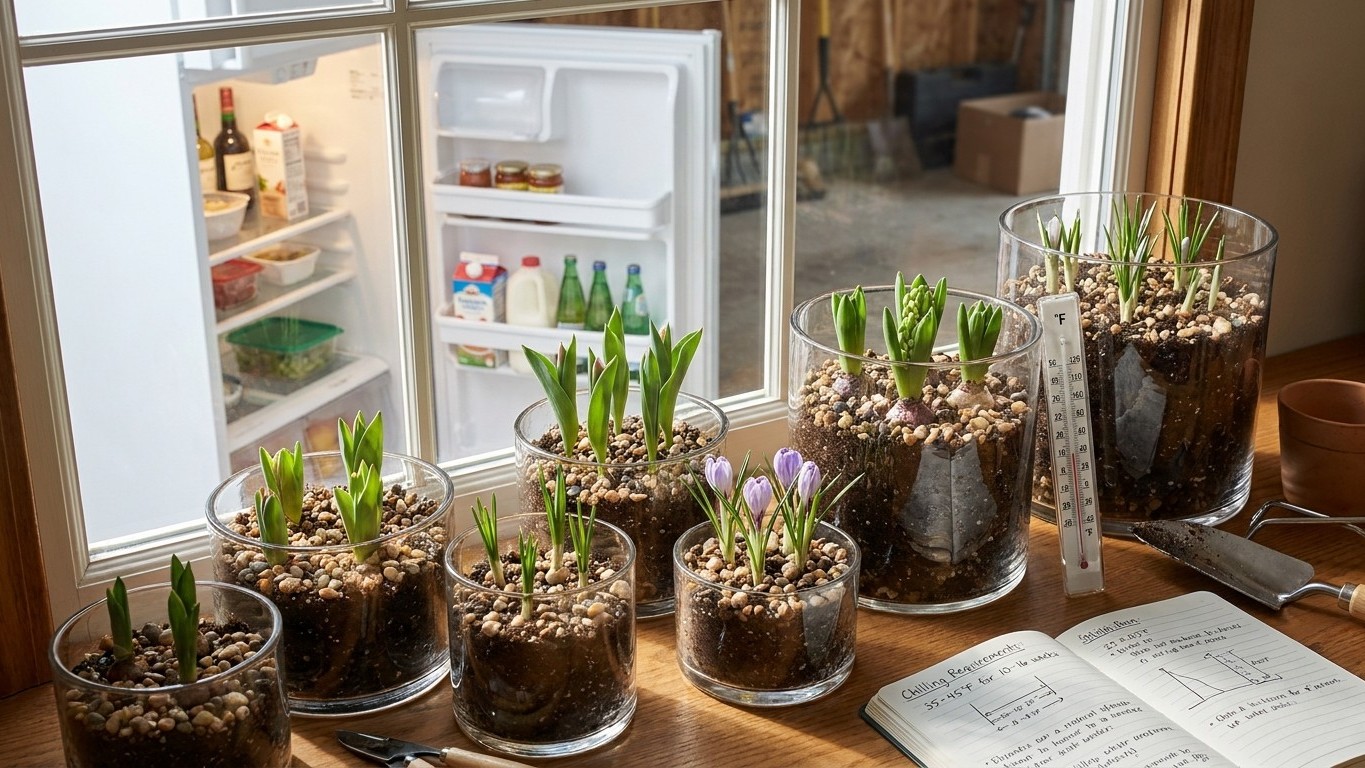

Forcing spring bulbs indoors works throughout Nevada, and around Las Vegas it’s often the only way to get tulips, hyacinths, or crocus to bloom at all. The technique substitutes a refrigerator or an unheated garage for a chill period the ground itself doesn’t reliably supply. Whether you need it, and how you handle containers, depends heavily on which part of the state you’re gardening in.
Why this matters in Nevada

The mean minimum temperature for the coldest month at the Las Vegas reference station is 39.6°F, according to NOAA NCEI’s 1991-2020 climate normals. That’s the average nightly low, not the daytime high, and it’s the figure that decides whether a plant’s roots and buds survive the season at all.
The chill math
A tulip or hyacinth bulb needs roughly twelve to fourteen weeks with soil temperatures staying below 45°F, continuously, for the flower already packed inside the bulb to finish developing. A nighttime average of 39.6°F sounds cold enough on paper, but it’s only half the story: daytime highs in the Las Vegas valley climb well into the 50s and 60s through most of winter, so soil temperature swings back up every afternoon. Sustained, round-the-clock cold for twelve straight weeks rarely accumulates in the ground there. That gap is exactly what forcing solves: a refrigerator or unheated garage holds a steady temperature the outdoor soil can’t match.
Where containers change the equation
Nevada’s USDA hardiness zone range runs from 4a to 10a, one of the widest spreads of any state, reflecting everything from the low desert floor around Las Vegas to alpine ridgelines in the north. For a dated planting recommendation, the reference point has to be the Las Vegas station specifically, since a single zone number can’t describe the whole state. In the colder, higher-elevation pockets near 4a to 6a, the opposite problem shows up: a container left outdoors freezes clear through, bulb and roots together, while the same ground in an open bed only freezes a few inches at the surface. A hardiness rating built for a bulb planted in a garden bed doesn’t protect that same bulb sitting in a pot on a patio in those areas. For the Las Vegas valley itself, where most of the state’s population gardens, the dominant issue is the lack of sustained cold, not container freeze-through, which is why forcing indoors is the standard workaround there.
How to do it here
The sequence is the same whether you’re chilling bulbs for a windowsill display in Las Vegas or supplementing a short winter elsewhere in the state. Each step should be something you can check yourself, not something you take on faith.
- Pot bulbs in early fall in a container with drainage holes, using a loose, well-draining potting mix, and water lightly right after planting.
- Move the pot to a chilling location that stays reliably below 45°F but above freezing: an unheated garage that doesn’t dip below 32°F, or a spare refrigerator drawer.
- Keep chilling bulbs away from ripening fruit if using a refrigerator. Fruit releases ethylene gas as it ripens, and ethylene kills the flower bud growing inside a chilling bulb before it ever emerges.
- Leave the pot undisturbed for the full twelve to fourteen weeks the bulb requires, checking every few weeks that the soil hasn’t dried out completely.
- Once that chilling period is complete and you see roots at the drainage holes or shoots an inch or two tall, move the pot to a cool, bright spot indoors, out of direct sun at first.
- After a week or two of that gradual transition, move the pot to a warmer, sunnier spot to finish opening the flowers.
If you’re chilling a potted bulb outdoors rather than in a garage or refrigerator, the container needs to be rated at least two USDA zones hardier than the bulb itself, or it needs to come indoors to an unheated but insulated space and get mulched heavily around the sides. A pot offers almost none of the insulation that surrounding soil provides, so the same bulb that survives fine in a garden bed can die in the same spot in a container.
Which bulbs are worth it
Not every spring bulb repays the effort of forcing. Bulbs with a short chilling requirement and a compact stem tend to succeed reliably in a pot; bulbs bred for tall garden display often flop over or need chill periods long enough to make the process impractical indoors.
- Paperwhite narcissus: needs no chilling period at all, so it skips this whole process; useful as a one-season indoor bloom since it isn’t winter-hardy outdoors in most of Nevada anyway.
- Hyacinth: chills in roughly ten to twelve weeks, short sturdy stem holds up well in a pot.
- Crocus: short chilling window, low stem height, rarely topples.
- Grape hyacinth (Muscari): short chilling requirement, compact size, forgiving of small pots.
- Standard tulips: need the longer end of the chilling window and grow a tall stem that often leans or falls once it’s indoors and warm.
- Large trumpet daffodils: long chill requirement paired with a tall stalk, making indoor timing and stability harder to manage.
- Fritillaria: finicky about chilling duration and prone to rot in a container before it ever flowers.
Since paperwhites and most forced tulips aren’t going back in the ground afterward in Nevada’s low-desert winters anyway, forcing them costs nothing in terms of a lost future bloom. They were purchased for one season of flowers, and that’s exactly what forcing delivers.
What goes wrong, and when you can still fix it
Leaves but no flower
This means the chilling period ran short. The bulb had enough cold to push foliage but not enough to finish forming the flower bud. There’s no fix this season; the bulb has already spent its stored energy on leaves alone. Note the shortfall and give the next batch the full recommended chilling weeks.
A flower on a stem too short to see
This happens when the pot gets moved into warmth too early, before the shoot had a chance to elongate. The bud opens low and stays low. It isn’t fixable once it’s happened. For the next attempt, hold the transition period a week or two longer in the cool, low-light stage before moving the pot into full warmth and sun.
Rot in the pot
Soft, mushy bulb tissue almost always traces back to standing water, either from a container without drainage holes or a mix that holds too much moisture. If you catch it early and the bulb is still mostly firm, repotting immediately in fresh, well-draining mix can sometimes save it. If the bulb has gone soft all the way through, it’s done for the season, and it won’t be viable to replant next year either.