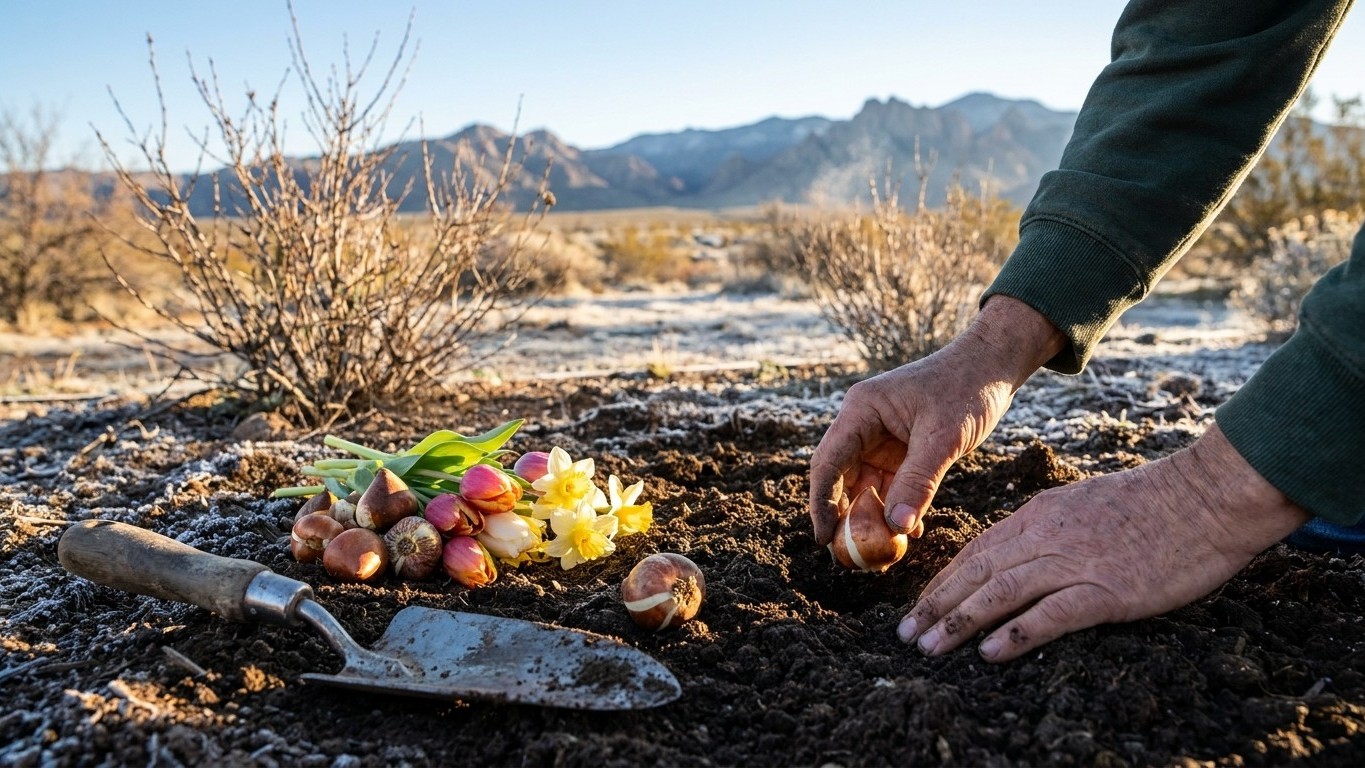

Nevada gardeners split into two camps every fall: those who can plant tulips straight into the ground and forget them, and those who need a refrigerator to make it work at all. The dividing line isn’t luck or skill. It’s whether your patch of the state gets enough sustained cold, and which bulbs you’re asking it to satisfy.
When to plant bulbs in Nevada

The general rule for spring bulbs anywhere is to get them into the ground about six weeks before the soil freezes hard. That gives roots time to establish before winter locks things down, without giving the bulb enough warmth left to push top growth that then gets killed by the first real freeze.
Here’s where Nevada gets complicated. The only frost-date figure available for this state comes from the Las Vegas airport station: an average first fall frost between December 8 and December 23. That’s useful for exactly one thing, telling you how extreme the low desert is. It is not a planting calendar for the state. Las Vegas sits in a desert urban heat island, and that Dec. 8-23 window is nothing like what happens in Reno, Carson City, or any town with real elevation, where the ground can freeze two or three months earlier in the fall and stay locked up weeks longer into spring.
Why the window has two failure modes
Plant too early, while soil is still warm from summer, and many bulbs sprout leaves that winter promptly kills, weakening or destroying the bulb before it ever flowers. Plant too late, after the ground has already gone cold and unworkable, and the bulb goes in without building the root system it needs, coming up thin, late, or not at all the following spring.
An average frost date is exactly that: an average. Half of all years in any given location fall on the early side of it, half on the late side. Treating December 8 as a hard deadline in Las Vegas, or treating any single date as gospel anywhere in Nevada, sets you up to miss the window in years that run early. The safer approach is to watch soil temperature directly and to get a planting date from a local source rather than a statewide guess, which is exactly the fix covered further down.
Whether your winter is cold enough
This is the question that decides whether Spring Bulbs in Nevada actually flower, and it has nothing to do with whether they survive the winter. Most spring-flowering bulbs, tulips and hyacinths especially, need a sustained cold period of roughly twelve to fourteen weeks with soil temperatures below about 45°F to complete the internal process that forms a flower bud. Skip that requirement and the bulb doesn’t die. It just leafs out with no bloom, or sends up a flower stalk too short and weak to notice. Gardeners in the warmer valleys who can’t count on that stretch of cold outdoors can substitute it artificially, which is the whole premise behind Forcing Spring Bulbs Indoors in Nevada. That number, twelve to fourteen weeks below 45°F, is the one figure worth remembering no matter what bulb catalog or garden center display you’re looking at.
Nevada’s own numbers cut two very different ways depending on where you stand. The only cold data point available for the state comes from the Las Vegas reference station: a coldest-month mean daily minimum of 39.6°F. That’s below the 45°F threshold, which is a start, but it only describes about one month of the year at that station. It does not stretch into the twelve-to-fourteen-week span that tulips and hyacinths are counting on. In the low desert around Las Vegas, natural chill runs short.
Move north or up in elevation and the picture flips. Nevada’s USDA hardiness range spans 4a to 10a, and the 4a-6b end (Reno, Carson City, most of the state’s higher basins) means winters that sit well below 45°F for months at a stretch, not weeks. Gardeners there generally clear the requirement several times over, with no pre-chilling needed and a much longer list of bulbs that will actually bloom.
For the low desert, the fix is pre-chilling: twelve weeks in a refrigerator before planting, kept away from apples, pears, or other ripening fruit, because the ethylene gas they release will kill the flower bud inside the bulb before it ever sees soil. Skip that step in Las Vegas and plant tulips straight into the ground, and you’ve bought a bag of bulbs that will not repeat what the picture on the package promised.
| Bulb | Cold required | What Nevada delivers | Verdict |
|---|---|---|---|
| Tulip (hybrid) | 14-16 weeks below 45°F | Las Vegas: ~4-5 weeks. Reno/Carson City area: 16+ weeks | Pre-chill required in low desert; fine unchilled in north/elevation |
| Hyacinth | 13-15 weeks below 45°F | Same split as above | Pre-chill required in low desert |
| Daffodil (narcissus) | 12-14 weeks below 45°F | Marginal in Las Vegas; ample in north/elevation | Plant early-flowering types in low desert; treat as perennial elsewhere |
| Crocus | 8-10 weeks below 45°F | Close to marginal in Las Vegas; ample elsewhere | Workable statewide with attention to timing |
| Allium | 8-12 weeks below 45°F | Marginal in low desert; ample elsewhere | Reliable in north/elevation; hit-or-miss in Las Vegas |
Which bulbs suit Nevada
Given that split, the bulbs worth planting in most of Nevada are the ones whose hardiness range and chill needs line up with either end of the state’s climate, not the ones bred for a mild coastal winter. These generally perform well:
- Daffodil / Narcissus — hardiness zones 3-9: reliable across nearly the whole state, and unfussy about soil
- Crocus — hardiness zones 3-8: early, tough, and one of the few bulbs that tolerates the low desert’s short chill fairly well
- Grape hyacinth (Muscari) — hardiness zones 4-8: spreads readily in the northern and high-elevation parts of the state
- Species tulips (as opposed to hybrid Darwin or Triumph types), hardiness zones 3-8: shorter, tougher, and less demanding of a long chill than the big hybrid tulips sold as cut-flower stand-ins
- Snowdrop (Galanthus) — hardiness zones 3-7: well suited to Reno, Carson City, and other cold-winter pockets, disappointing in the low desert
The bulbs that let people down are almost always the hybrid tulips and hyacinths bought because they looked good in a catalog photographed somewhere in the Pacific Northwest. Planted unchilled in Las Vegas or another low-desert yard, they typically manage one thin flush the first spring, on stored energy already in the bulb, and then nothing but leaves in every year after. Snowdrops and other classic cold-climate bulbs planted in that same low desert usually skip flowering altogether rather than rotting. And hardiness ranges are never a hard line: a species tulip rated to zone 8 can hang on for years in a sheltered, north-facing bed in a marginal zone 9 yard, and die out fast in an exposed, south-facing one a mile away.
What digs them up here
Squirrels and voles are picky eaters, and the difference between the bulbs they leave alone and the ones they dig up by the dozen comes down to chemistry, not chance. Daffodils and anything in the onion family carry compounds that make them bitter or mildly toxic, so wildlife generally avoids them. Tulips and crocus have no such defense and read as food.
- Bulbs squirrels and voles usually take: tulip, crocus
- Bulbs squirrels and voles usually leave: daffodil/narcissus, allium, grape hyacinth, snowdrop
The one measure that reliably works is physical: lay galvanized wire mesh flat over the planting bed right after you cover the bulbs, and leave it down until the ground freezes hard, since that’s the window when digging animals do the most damage. Repellent sprays and granules get mentioned constantly, and they wash off in the first watering or rain, leaving the bed unprotected right when it matters. If you’re planting a mix, put the tulips and crocus under mesh and let the daffodils and alliums go in without it.
Where to check for your own county
Nevada runs from below sea-level desert basins to mountain valleys over a mile high, crossing multiple USDA hardiness zones and a huge range of first-frost dates inside one state’s borders. Every figure in this article, the frost window, the coldest-month minimum, is tied to a single reference station in Las Vegas, and it will be wrong, sometimes by three weeks or more, for a yard in Elko, Ely, or even the outskirts of Reno.
Before you finalize a planting date or decide whether a bulb needs pre-chilling, check with the University of Nevada Cooperative Extension, the state’s land-grant extension service, and specifically your county office. They track local frost dates and microclimate patterns that a statewide average simply can’t capture, and that’s the difference between a bulb bed that blooms on schedule and one that either freezes out too early or never gets the chill it needs.