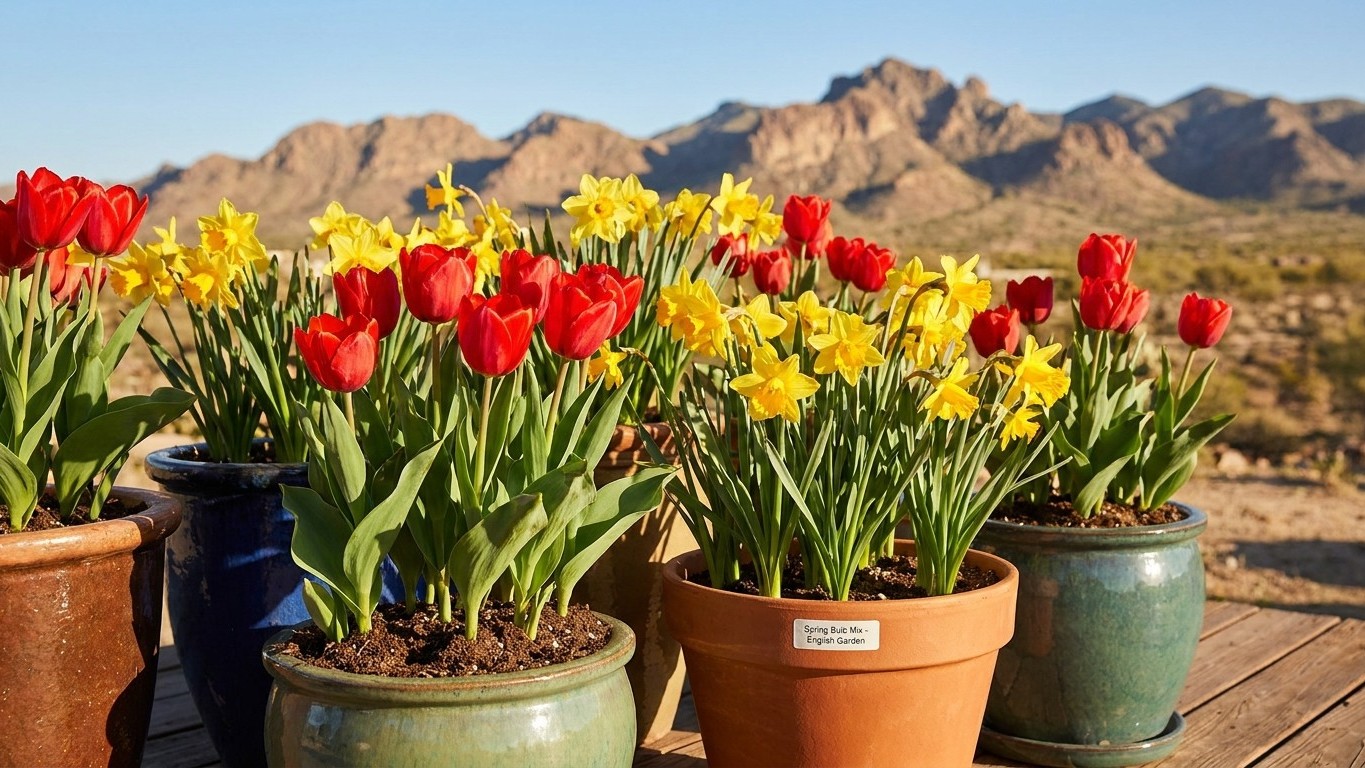

Forcing is the answer for most of Nevada’s low-elevation gardens, where winter doesn’t hold the twelve to fourteen weeks of sustained cold a tulip or daffodil bulb needs to bloom. In the state’s colder, higher-elevation pockets, the problem flips: the ground gets cold enough on its own, but a container freezes solid, roots and all, in a way open soil never does. Which fix applies depends on where you’re planting.
Why this matters in Nevada

The reference figure here is the mean daily minimum for the coldest month at the Las Vegas station: 39.6°F, per NOAA NCEI Climate Normals covering 1991-2020. That’s a nighttime number, and it sits comfortably below the 45°F threshold most spring-flowering bulbs need for chilling. On paper, that looks promising. In practice, it isn’t the whole story, because chilling accumulation depends on temperatures staying low across the full day, not just overnight. A cold night followed by a warm afternoon doesn’t bank the same chill as a day that never climbs out of the 40s. The low desert’s wide day-to-night temperature swing is exactly the kind of pattern that interrupts sustained chilling, which is why bulbs planted straight in the ground around Las Vegas or Reno’s lower valleys often leaf out without ever setting a flower bud.
That’s the forcing situation: not a lack of cold nights, but a lack of continuous cold. The gardener has to supply what the calendar won’t, which means twelve to fourteen weeks of steady, controlled chill rather than hoping the season delivers it.
Nevada’s other complication comes from its size. The USDA Plant Hardiness Zone Map, built on the average annual extreme minimum temperature, places the state anywhere from zone 4a to zone 10a. That’s not one climate, it’s several stacked on top of each other, from low desert basins to mountain valleys. In the colder end of that range, winter cold is not the shortfall. There, a bulb rated hardy for the zone can still die in a pot, because a container has no surrounding earth to buffer it. Soil in the ground only freezes at the surface and insulates itself as it goes down; soil in a pot has no such protection and can freeze straight through. A bulb that shrugs off zone 5 in a garden bed can be killed by the same winter in a zone 5 container, because the pot behaves like a colder zone than the map says.
Because that hardiness range spans the whole state, any dated recommendation below has to anchor to a single reference point. This one uses Las Vegas, the station tied to the 39.6°F figure above; gardeners in cooler parts of Nevada should expect their own numbers to run colder.
How to do it here
The steps below assume the low-desert case, where the chill has to be supplied rather than waited out. Container growers in colder zones should skip to the sizing note at the end.
- Buy bulbs early and check firmness. Soft spots or mold mean the bulb won’t hold through a long chilling period; discard those before they contaminate the batch.
- Pot the bulbs in a container with drainage holes, using a loose, well-draining mix. Set them close together, tips up, with the tip barely covered.
- Move the pot to a spot that stays consistently below 45°F for twelve to fourteen weeks. An unheated garage that never drops below freezing works if it’s cold enough to feel it through a jacket; a spare refrigerator drawer works too.
- Keep the pot away from ripening fruit if it’s in a refrigerator. Apples, pears, and other ripening produce give off ethylene gas, and ethylene can kill the flower bud forming inside the bulb before it ever emerges.
- Check the soil monthly and water lightly if it’s gone bone dry. The bulb should stay barely moist through the whole chilling period, never soaked.
- Watch for a inch or two of pale shoot growth before moving the pot into light and warmth. That’s the sign the chilling requirement has been met.
- Bring the pot into a cool, bright room first, not straight into full sun or heat. A gradual warm-up gives the stem time to elongate before the flower opens.
For the colder parts of the state where the ground already delivers enough cold, the rule is different: the container needs to be rated at least two hardiness zones colder than the bulb itself, or it needs to come indoors or get heavily mulched over winter. A bulb hardy to zone 5 needs a pot treated like zone 3 conditions unless it’s moved or insulated. There’s no shortcut around that; it’s a sizing problem, not a chilling one.
Which bulbs are worth it
Not every bulb rewards the effort of forcing, and the difference usually comes down to two traits: how long a chilling period the bulb demands, and how tall and top-heavy the flower stem gets. A bulb with a short chill requirement forces faster and with less risk of failure. A bulb that throws up a tall stem is fighting a lightweight pot the whole way, and often loses.
Bulbs that force reliably here
- Paperwhite narcissus — needs no chilling period at all, which makes it the most forgiving option in a territory short on sustained cold.
- Crocus — short chill requirement, low stem that doesn’t need staking.
- Hyacinth — sturdy, short stem, tolerates the indoor warm-up well.
- Iris reticulata (dwarf iris) — compact and quick once chilling is done.
- Muscari (grape hyacinth) — short chill period, stays low enough that a pot never has to fight gravity.
Bulbs that tend to sulk
- Tall trumpet daffodils — a longer chill requirement and a stem heavy enough to lean or topple in a light pot.
- Darwin and other tall tulip types — same combination: long chill, top-heavy once the flower opens.
- Alliums — a long chilling window paired with a tall stem makes them a poor match for container forcing.
Paperwhites deserve one more note: since Nevada’s mild winters don’t give them a hardy future in the ground anyway, they’re a one-season bulb no matter what. Forcing them doesn’t cost anything long-term, because there was never a “next year” for that bulb to return to.
What goes wrong, and when you can still fix it
Leaves, but no flower
This is a chilling period that ran too short. The bulb had enough stored energy to push leaves but never finished forming the flower bud inside. There’s no fix for the bulb already in the pot; the flower simply isn’t there to force out. The correction is for next time: track the weeks in cold storage and don’t move the pot until the full twelve to fourteen weeks are done.
A flower on a stem too short to see
This is the opposite mistake: the chill period finished, but the pot was warmed up too fast or too early, before the stem had time to elongate. The flower is real, it’s just buried in the foliage. Nothing rescues that stem this season, but a slower, cooler transition out of the fridge or garage next time gives the stem the room it needs to stretch.
Rot at the base of the bulb
This one is drainage, almost always. A pot without enough drainage holes, or a mix that holds too much water, keeps the bulb’s base wet for weeks at a time, and rot sets in before the roots ever get going. If caught early, the bulb can sometimes be lifted, trimmed of soft tissue, and replanted in drier mix. Once rot has reached the core, it’s over for the season, and the fix belongs to the next planting: more drainage holes, a looser mix, and a pot that never sits in a saucer of standing water.