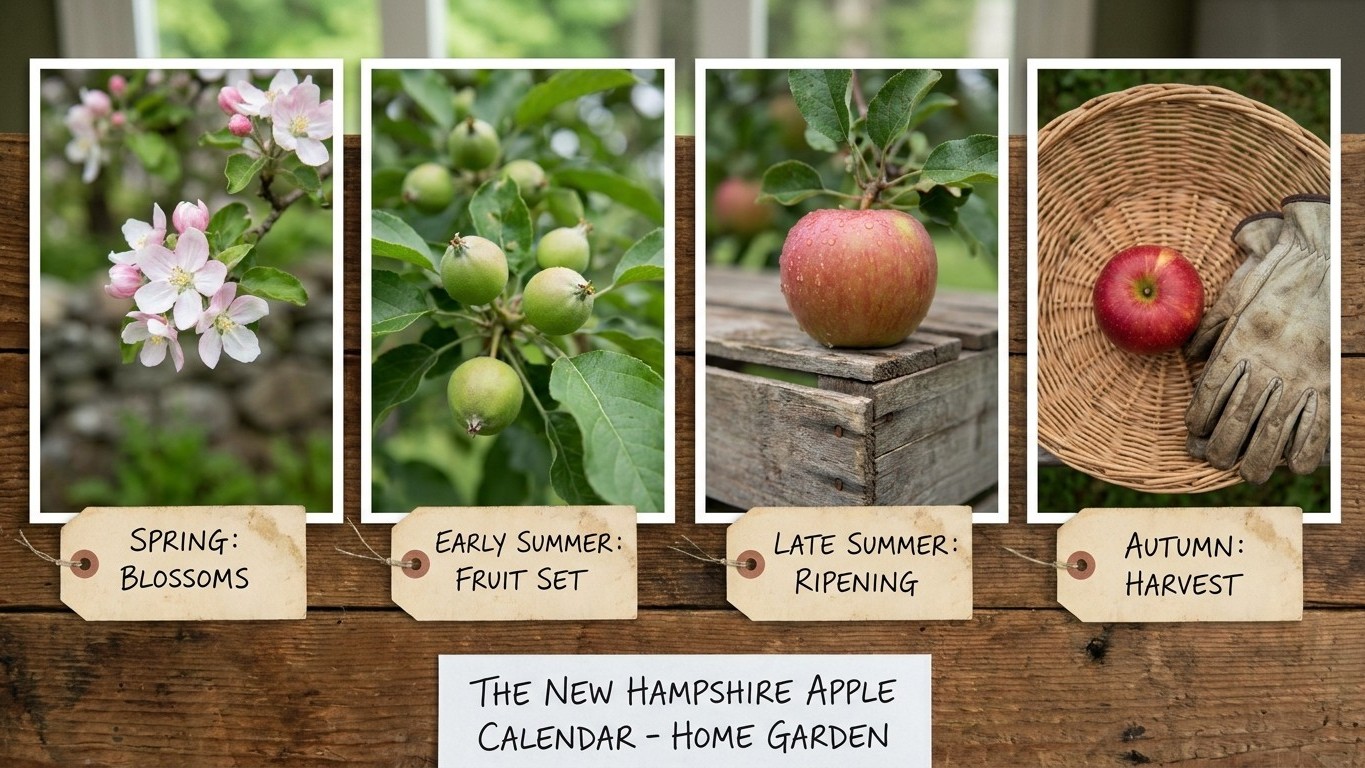

April 16 to April 27 sounds like a bloom date for New Hampshire apples, but it’s really NOAA’s frost-probability window for Manchester — the 30-70% band for a 32F freeze, so a frost after it still lands in plenty of years. Bloom itself opens about a week after pink stage cracks and ends when petals fall. Harvest isn’t fixed either: ‘Zestar!’ clears the tree well before the October frost window opens, while ‘GoldRush’ waits for it. The tree’s stage decides, not the calendar.
The short answer for New Hampshire
Apple trees in New Hampshire bloom, on average, in the window bracketing NOAA’s 1991-2020 last-spring-frost normal for Manchester, April 16 to April 27. That figure is the 30-70% probability band for a 32F freeze, which means a frost after that window still happens in a meaningful share of years. Bloom itself usually opens about a week after the pink stage, once the tight pink buds crack open and the petals separate, and it ends when petals begin to fall.
Harvest timing depends on the variety planted, not on a fixed date. Early apples such as ‘Zestar!’ and ‘Paula Red’ can come off the tree well ahead of NOAA’s Manchester first-fall-frost window of October 13 to October 26, while late-keeping varieties such as ‘GoldRush’ or ‘Northern Spy’ often hang on the tree until that window arrives, or later, provided the fruit has had enough warm days to finish.
What the whole calendar depends on is the stage of the tree you’re looking at, not the date on the wall. A cold, wet spring pushes green tip and bloom later against the same frost window. A warm one pulls them earlier. Manchester’s own figures are a reference point, not a guarantee for any single orchard, and elevation, slope and distance from the coast all shift the real date. The rest of this page works stage by stage from that reference, and The Best Apple Varieties for New Hampshire is the place to match a cultivar’s bloom timing and chill needs to your specific spot before deciding what to plant.
Working through it

Each stage of the apple tree’s growth is triggered by accumulated warmth, not by a date, so the ranges below shift earlier or later with the weather each year. All are anchored on NOAA’s 1991-2020 Manchester frost normals: last spring frost April 16 to April 27, first fall frost October 13 to October 26. Treat every date in this section as a guide to check against your own tree, an assumption this page shares with Growing Apples in New Hampshire.
Dormancy

The tree sits bare and inactive through winter, and this is when structural pruning happens: no sap is flowing, wounds close cleanly, and the branch structure is visible without leaves in the way. Pruning too early doesn’t hurt the tree, but pruning too late, once the buds have started to swell, wastes energy the tree has already committed to that growth.
Green tip

Small green points push through the bud scales as the tree wakes up. This is the last easy window for a dormant-oil spray against overwintering mites and scale, because once leaves expand the oil can burn new tissue. Green tip generally arrives some weeks ahead of the Manchester last-frost window, and a frost at this stage rarely kills the buds outright.
Pink

The blossom buds swell and separate into individual pink florets just before opening. This is the highest-value fungicide window because the flower parts are exposed but not yet pollinated, and it’s also the stage most exposed to a late frost, since a freeze now can kill the florets before a single flower opens.
Bloom

Full bloom is the single stage where the Manchester frost window matters most. A 32F freeze during open bloom can wipe out the flowers, and with them the year’s crop, on any variety caught blooming inside that April 16 to April 27 band. Pollinators need to be working at this stage, so this is not the moment for an insecticide spray of any kind.
Petal fall

Petals scatter under the tree within days of pollination, leaving a small green ovary at the base of each flower. Thinning decisions and any fungicide program restart here, once the risk to open flowers has passed.
Fruit set

Fruitlets swell to marble size over the following weeks. This is when hand-thinning to one apple per cluster pays off, since a tree that sets too much fruit produces smaller apples and stresses next year’s bud formation.
Harvest
Harvest timing is set by variety, not by the calendar. Early apples come off well before the Manchester first-fall-frost window of October 13 to October 26, and late-keeping varieties are often still on the tree as that window opens. Picking before a hard freeze matters most for late varieties, since a freeze on the tree can soften the flesh even if the fruit still looks fine.
What changes across New Hampshire
Elevation and the White Mountains
Orchards gain elevation moving north and west toward the White Mountains, and every added few hundred feet delays bud break and bloom while bringing the first fall frost forward. NOAA’s Manchester normals are measured at an airport near sea level in the Merrimack Valley, and the agency’s own caution on this data set notes that suburban and rural sites typically see the last spring frost later and the first fall frost earlier than the airport figures, often by one to two weeks, more at elevation. An orchard block in the higher terrain of Coos or Grafton County should expect bloom and harvest to run later than a Manchester-anchored calendar suggests.
The seacoast
The narrow strip of Rockingham County along the coast is buffered by the ocean, which tends to moderate both the coldest winter nights and the timing of the last frost compared to inland valleys at the same latitude. That buffering effect is real, though the figures available here don’t include a coastal-specific frost date, so a grower in Rye or Hampton should still track their own site’s bloom stage rather than borrow Manchester’s window outright.
Valleys and lake shorelines
Low-lying valleys that trap cold air overnight, and orchard blocks near Lake Winnipesaukee or the Connecticut River, behave differently from the open floodplain around Manchester. Cold air drains downhill and pools in valley bottoms, so a planting in a hollow can see frost on a night when a slope two hundred feet upslope stays clear. Site selection inside your own property matters as much as regional climate, and a block planted on a gentle slope above the valley floor buys real protection against a late bloom-stage frost.
The mistakes this climate punishes
Planting an early-blooming variety in a frost pocket
Varieties bred for a longer, milder growing season often break dormancy and bloom earlier than the hardier northern selections. In New Hampshire, a variety that blooms ahead of NOAA’s Manchester last-frost window of April 16 to April 27 by more than a week or two is gambling every spring on the tail end of that window, and a low-lying or valley planting site adds another week of real exposure on top of the airport figure. The failure shows up as a bloom-time frost that blackens the flowers, and by early summer the tree simply carries no fruit, though the leaves look perfectly healthy.
Feeding or pruning too late in the season
A dose of nitrogen fertilizer in mid to late summer, or a hard prune that forces a flush of new growth, leaves the tree with soft, unhardened wood heading into fall. That growth hasn’t had time to harden off by the time NOAA’s Manchester first-fall-frost window of October 13 to October 26 arrives, and it dies back or splits at the first real freeze, taking hardiness at the branch tips with it. Feed in spring, not in August, and hold structural pruning for dormancy.
Choosing a variety on hardiness alone and skipping chill
Cold hardiness and winter chill are different filters. A variety can be rated hardy enough to survive New Hampshire’s winters, where NOAA’s 1991-2020 normals put the mean minimum of the coldest month at Manchester at 15.7F, and still perform badly if its chill requirement is mismatched to the actual winter it gets. The reverse mistake, choosing on low chill alone, wastes the state’s naturally long, cold dormant season and often blooms into frost risk it didn’t need to take. Check both figures on the catalogue tag before you plant, not just one.
Picking too early or leaving fruit on too long
Picking an early apple too soon loses sugar and flavor it would have gained in another week. Leaving a late-keeping variety on the tree past its ripeness, gambling on more warm days before frost, risks losing the crop to a freeze that softens the flesh on the tree rather than in storage. Either error shows at the same moment, at the counter, not on the tree.
Checking this against your county
Manchester’s frost dates are a starting reference, not a local guarantee. UNH Extension tracks county-level growing conditions and can confirm how your specific town’s frost timing, elevation and soil differ from the Manchester station used throughout this page. Contact your county office through the UNH Extension directory before locking in a spray schedule or a harvest date, especially if your orchard sits above 800 feet, in a river valley, or within a few miles of the coast.
- Your county’s own average last spring frost and first fall frost dates
- Local elevation and cold-pocket effects on your specific parcel
- Which varieties are performing well in orchards near you this year
Common questions
How do I know what stage my tree is at right now?
Walk out and look at the buds themselves rather than checking a date. A bud with tight brown scales and no green showing is still dormant, a bud with a sliver of green at the tip has reached green tip, and a cluster of separated pink or white florets means you’re at pink or bloom. The visual stage tells you more than any calendar date, since the same tree can run a week or two ahead of or behind its neighbor from one year to the next.
Is it too late to plant a tree if I missed the spring planting window?
A container-grown tree can usually still be planted through most of the growing season, since it isn’t being transplanted bare-root. A bare-root tree is a different matter and depends on catching it while still dormant, so check with the nursery on what stock they’re shipping before assuming you’ve missed your chance.
Will one late frost after bloom wipe out the whole crop?
Not necessarily. A light frost right at bloom can kill some flowers and leave others untouched, especially if the tree bloomed over several days rather than all at once, and a tree that loses part of its bloom sometimes ends up better thinned than one that keeps every flower. A hard freeze across a full, open bloom is the scenario that does real damage, and that’s the one worth protecting against with row cover or wind machines if the forecast calls for it.
Do I need two apple varieties for pollination?
Most apple varieties need pollen from a different variety blooming at the same time to set fruit reliably, since very few are self-fertile enough to crop well alone. That means bloom-time overlap matters as much as the varieties themselves, which is one more reason to check bloom timing for any pair you’re considering, covered in The Best Apple Varieties for New Hampshire before you plant.