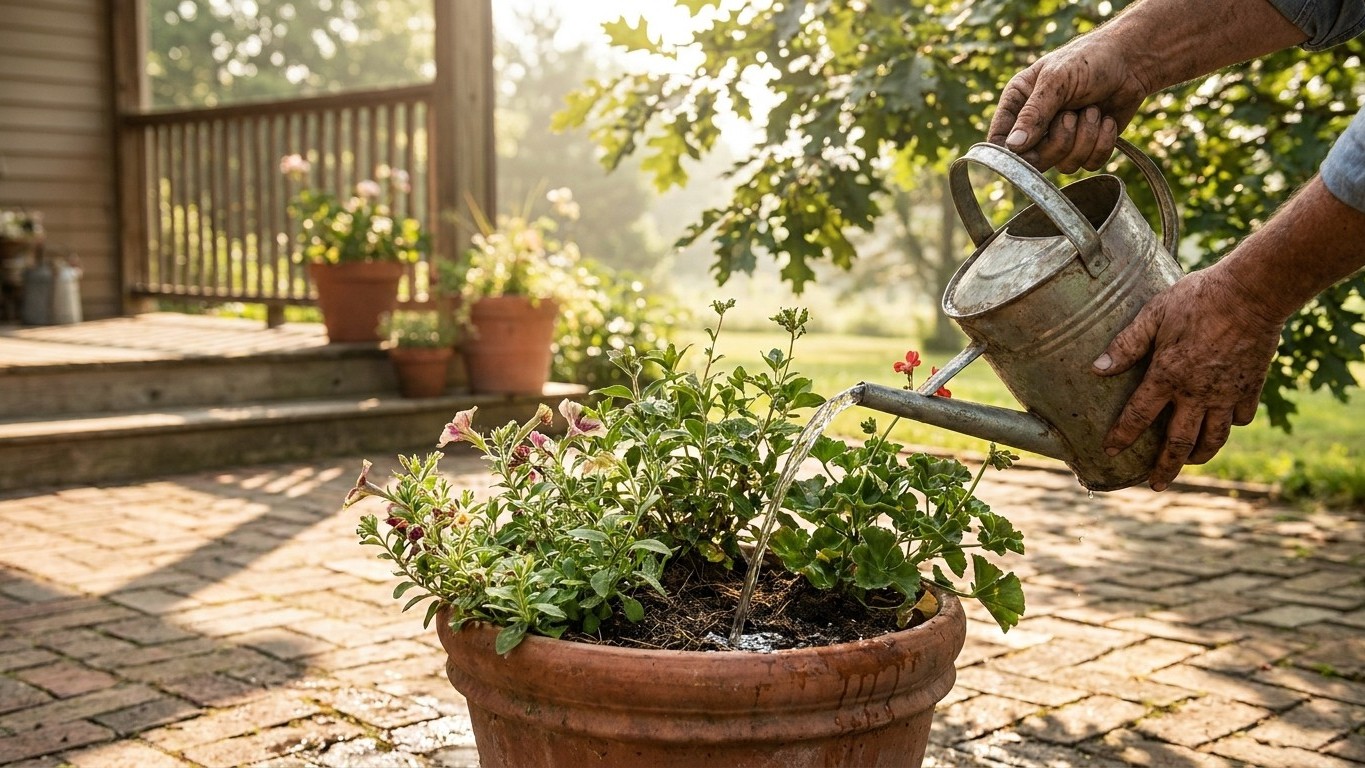

North Carolina gardeners growing in Pots and Containers face a specific math problem: July delivers 3.74 inches of rain, the driest month of the summer, while 35 days a year climb to 90F or hotter. Potting mix dries faster than garden soil, so Containers need direct watering on a rhythm that has little to do with what falls from the sky.
What changes here

Two numbers set the terms for anyone watering containers in North Carolina: 3.74 inches of rain in July, the driest month of summer, and 35.0 days a year that reach 90F or above. Together they mean the ground gets a decent soaking most weeks, but heat pulls moisture back out fast, and a container sitting on a porch or patio often sees none of that rain at all.
Run the arithmetic on a garden bed first, since it shows why containers behave so differently. A bed wants roughly an inch of water a week. July has about 4.3 weeks, so 3.74 inches spread evenly works out to close to 0.86 inch a week from the sky, just under the target. A gardener with an in-ground bed only needs to carry the remaining 0.14 inch or so, a light top-up, not a full watering.
A container gets none of that credit if it sits under an eave, a porch roof, or a tree canopy, which describes a large share of the pots people actually keep. Even a pot standing in the open catches less water than the number above suggests, because rain that lands as a short, hard summer thunderstorm runs off a rounded soil surface and out the drainage holes before it soaks in. Potting mix also holds far less reserve water than native soil. A typical 12-inch container might hold only a day or two of usable moisture in July heat, compared to a week or more for the same volume of ground. That gap is the reason container watering in this state runs on its own schedule, driven mostly by the 35 days of 90F heat rather than by the 3.74 inches of July rain.
The practical takeaway: treat the summer rainfall figure as background information, useful for deciding whether to skip a watering after a real soaking rain, but not as a substitute for checking the pot itself. The heat figure is the one that actually drives the calendar.
How to water when it matters
Containers ask for a different rhythm than garden beds, but the underlying logic is the same: get water deep into the root zone, do it at the base rather than overhead, and do it early enough in the day that the surface dries before evening. Deep watering pushes roots down and outward through the full pot rather than letting them cluster in the top inch, which is exactly where heat and drying hit hardest during a 90F afternoon. Morning watering gives the plant a full reservoir before the day’s heat load starts pulling moisture back out, and it means any water that splashes onto leaves has hours to dry rather than sitting overnight, which is when fungal problems get their start.
Checking the pot itself matters more than checking the sky. A surface that looks dry can sit over mix that is still damp two inches down, and a surface that looks damp after a quick sprinkle can hide a bone-dry root ball underneath.
- Push a finger about two inches into the potting mix, near the edge of the container rather than right against the stem, before deciding whether to water at all.
- If that depth feels dry, water slowly at the base until liquid runs freely out the drainage holes, which confirms the full root zone got soaked rather than just the top crust.
- During stretches that reach the 35 days-a-year mark of 90F heat, check small and medium containers daily, since their limited soil volume can dry out within 24 hours regardless of how much rain fell that week.
- After a heavy summer thunderstorm, empty any saucer that collected standing water within an hour or two, so roots aren’t sitting in a puddle overnight.
- Ease back to checking every two to three days once temperatures drop below that 90F threshold, using the same two-inch finger test rather than a fixed calendar.
Daily checking during peak heat is a starting point, not a rule. Larger containers, self-watering reservoirs, and plants with deeper root systems can stretch that interval, and the two-inch test is what should settle it for any individual pot.
What goes wrong
A quick daily splash that never reaches the roots
Giving a pot a light sprinkle every day feels responsible, but it usually wets only the top half-inch of mix before draining away, leaving the root ball below bone dry. Roots respond by staying shallow and thin, right where the day’s heat does the most damage. A slower, deeper soak two or three times a week does more for the plant than a splash every single day.
Watering the leaves at dusk
Wetting foliage in the evening leaves moisture sitting on leaf surfaces overnight with no sun to dry it off, which is exactly the condition fungal diseases need to take hold. Watering at the base in the morning avoids the problem entirely.
Trusting a storm that only wet the surface
A hard summer downpour can look like it solved the watering problem for the week, but a lot of that water runs straight off a container’s rounded mix and out the drainage holes before it soaks in. The two-inch finger test settles the question a glance at wet leaves and a puddled patio can’t.
Skipping a top layer of mulch
Bare potting mix left exposed to direct sun on a 90F day gives up moisture fast. A thin layer of mulch or bark on top of the mix slows that evaporation and stretches the interval between waterings, which matters most on the 35 days a year when the heat load is highest.
Letting a saucer sit full after a storm
North Carolina’s summer rain arrives in bursts rather than a steady drizzle, and a saucer that fills during a thunderstorm and stays full for days will drown roots that never got the chance to dry out. Emptying saucers after heavy rain matters as much as watering during a dry spell.
Local help
For questions specific to a county, soil, or plant variety, the North Carolina Cooperative Extension is the state’s land-grant resource for home gardeners. Watering restrictions during dry spells vary by city and water provider, so check with the local utility before setting a fixed outdoor watering schedule for containers.
Common questions
How often should I water container plants in North Carolina during summer?
Check small and medium pots daily during stretches of 90F heat, using a two-inch finger test rather than a fixed calendar, since 35 days a year typically reach that threshold.
Does July’s rainfall mean I can skip watering my pots?
Not reliably. July averages 3.74 inches of rain, the driest summer month, but containers under a roof or canopy get little of it, and a hard thunderstorm often runs off the mix rather than soaking in.
Should I water containers in the morning or evening?
Morning. It lets any splashed foliage dry before nightfall and gives the plant a full water reserve before the day’s heat sets in.
What’s the biggest watering mistake with pots in this climate?
A light daily sprinkle that wets only the surface. It looks like care but leaves the root ball dry underneath, right where the heat does the most damage.