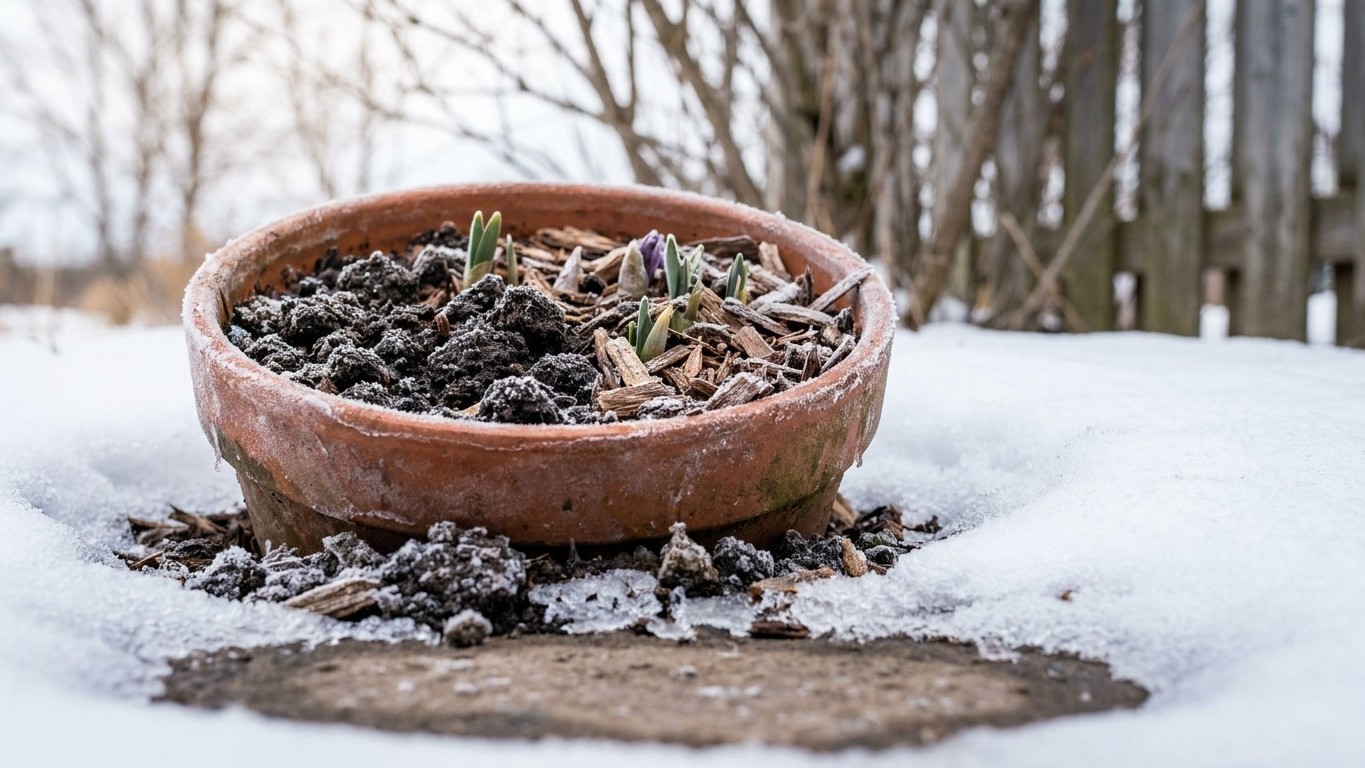

Spring bulbs in Prince Edward Island don’t need help getting cold in the ground. Winters here deliver far more chill than any bulb requires, so forcing isn’t the issue. The real challenge is the pot: a container freezes solid, roots and all, while garden soil only crusts on top. Growing bulbs in containers on the Island means giving that pot the same protection the ground gives everything else for free.
Why this matters in Prince Edward Island

The coldest month here averages a daily minimum of 10.3 F, according to Environment and Climate Change Canada’s 1981-2010 Climate Normals for the Charlottetown reference station. That number settles the forcing question before it’s even asked. Forcing exists for gardeners whose winters don’t drop below 45 F for the twelve to fourteen weeks a spring bulb needs to break dormancy and build a proper flower stem. Anyone gardening where 10.3 F is the average low in January has the opposite problem: too much cold, not too little, and it lasts for months, not weeks.
That means a daffodil or crocus planted straight into a garden bed on the Island gets its chilling requirement met several times over, with no refrigerator drawer or trip to an unheated closet required. So far, so simple. The complication starts the moment that same bulb goes into a pot instead of a bed.
Garden soil behaves like a blanket. Even in a hard winter, the frost line creeps down from the surface, but a few inches under ground level, the soil around a bulb rarely drops as low as the air above it. A container has no such blanket. Surrounded by air on every side, a pot’s soil mass tracks the outside temperature closely, and in a cold snap it can freeze solid, from the drainage hole to the crown of the bulb. Roots that would survive fine buried in a border can die outright once they’re sitting in a frozen block of potting mix with nothing around them but plastic or clay.
This is where the hardiness zone number matters, and where it’s easy to misread. Charlottetown sits in Canadian hardiness zone 5b, using Natural Resources Canada’s 1991-2020 normals, a rating built from seven climate variables rather than the single-factor USDA system used south of the border, and the two scales don’t convert into each other. Zone 5b describes what a bulb survives planted in the ground here. It does not describe what a bulb survives sitting in a pot on a deck, because a container of that same bulb is effectively facing a colder zone with no soil mass to buffer it. The working rule: treat a containerized bulb as needing hardiness two zones colder than the ground rating suggests, or give the pot the insulation the ground would have supplied on its own.
How to do it here
Because the ground in Prince Edward Island already supplies more cold than any spring bulb needs, the real project is protecting a potted bulb from an unfiltered dose of it. The steps below assume a standard container, not a raised bed built into the soil.
- Pick bulbs rated for a hardiness zone at least two zones colder, Canadian system, than 5b before buying. A bulb rated for 5b in the ground has no safety margin once it’s sitting exposed in a pot.
- Plant in fall, in a container with drainage holes, at the depth given on the bulb packaging. Skipping drainage holes is the most common cause of rot once winter meltwater has nowhere to go.
- Choose one protection method before the first hard freeze: bury the pot to its rim in a garden bed and mulch heavily over the top, or move it into an unheated garage or shed that stays reliably above freezing all winter.
- If neither option is available, cluster the pots against a house foundation wall, out of the wind, and wrap them in burlap or old blankets. It’s a weaker substitute for burial, worth checking after any deep cold snap.
- Check the storage spot with an actual thermometer instead of guessing. A spring bulb wants cold, generally below 45 F, but a spot that regularly drops below freezing gives an exposed pot no ground insulation to fall back on.
- Keep stored pots away from any spot where fruit is ripening. Ripening fruit gives off ethylene gas, and ethylene kills the flower bud forming inside a chilling bulb even when the temperature is otherwise right.
- Leave the pot undisturbed through the cold months. Twelve to fourteen weeks below 45 F is the general requirement for a spring bulb to flower properly, and an Island winter, even inside an unheated garage, generally supplies that several times over.
- Bring the pot back into full sun once nights are reliably staying above freezing, and resume watering as new growth appears.
Which bulbs are worth it
Not every spring bulb is a good candidate for a container on the Island, and the reasons are mechanical rather than a matter of taste. A bulb with a short cold requirement reaches bloom faster and tolerates the compressed conditions of a pot better than one that needs a long, slow chill. Stem height matters just as much: a pot has a narrow base and shallow soil depth compared to a garden bed, so a tall flower stalk with a heavy bloom is far more likely to topple in wind or rain than the same variety planted in open ground.
- Crocus, short stem, short cold requirement, rarely topples
- Grape hyacinth (Muscari), compact and reliable in a shallow pot
- Dwarf iris (Iris reticulata), low growing, well suited to a container’s shallow depth
- Snowdrops, tolerate the temperature swings of an exposed pot better than most
- Miniature daffodils, shorter stems than standard trumpet varieties, less prone to falling over
On the other side of the ledger are bulbs that ask more from the cold and give back less stability in a pot.
- Standard trumpet daffodils, tall stems that lean or snap in a container exposed to wind
- Tulips, top-heavy blooms, and many gardeners already treat them as a one-season planting in this climate anyway, so a container that doesn’t come back the next year costs nothing that wasn’t already spent
- Large alliums, flower heads out of proportion with the pot’s root volume
- Hyacinths, dense flower spikes that make the whole plant top-heavy in a small container
The pattern holds across most bulbs: short and dense wins in a pot, tall and top-heavy loses, and if a bulb was headed for the compost after one season regardless, a container is the cheapest way to get that single season of bloom out of it.
What goes wrong, and when you can still fix it
Leaves but no flower
The bulb grew foliage and stopped there, no bud, no bloom. This usually points to a cold period that ran short, often because the pot spent part of the winter somewhere warmer than intended, a heated garage instead of an unheated one, or got moved indoors during a mild stretch. There’s no fix for that bulb this season. The stored energy went into leaves instead of a flower, and the bulb needs a full, uninterrupted cold cycle before it will try again. Let the foliage die back naturally, replant in fall, and give it the full stretch of Island winter this time, undisturbed.
Flower on a stem too short to see
The bloom opens buried in the leaves instead of standing above them. This usually means the pot warmed up too quickly after the cold period ended, pushing the flower to open before the stem had time to elongate. Moving the pot to a cooler, brighter spot as soon as this is noticed can sometimes coax a bit more stem length before the bloom fades, but it won’t fully correct the season. A slower transition from cold storage into warmth next time gives the stem room to stretch before the flower opens.
Rot in the pot
Soft, discolored bulb tissue and no growth at all usually trace back to water with nowhere to drain, either a container without drainage holes or a saucer left full under the pot through a wet stretch. Once a bulb has gone soft, it isn’t coming back this season or any other. The fix is prevention for next time: drainage holes in every container, a potting mix that doesn’t stay waterlogged, and a pot lifted clear of any saucer that collects standing water.