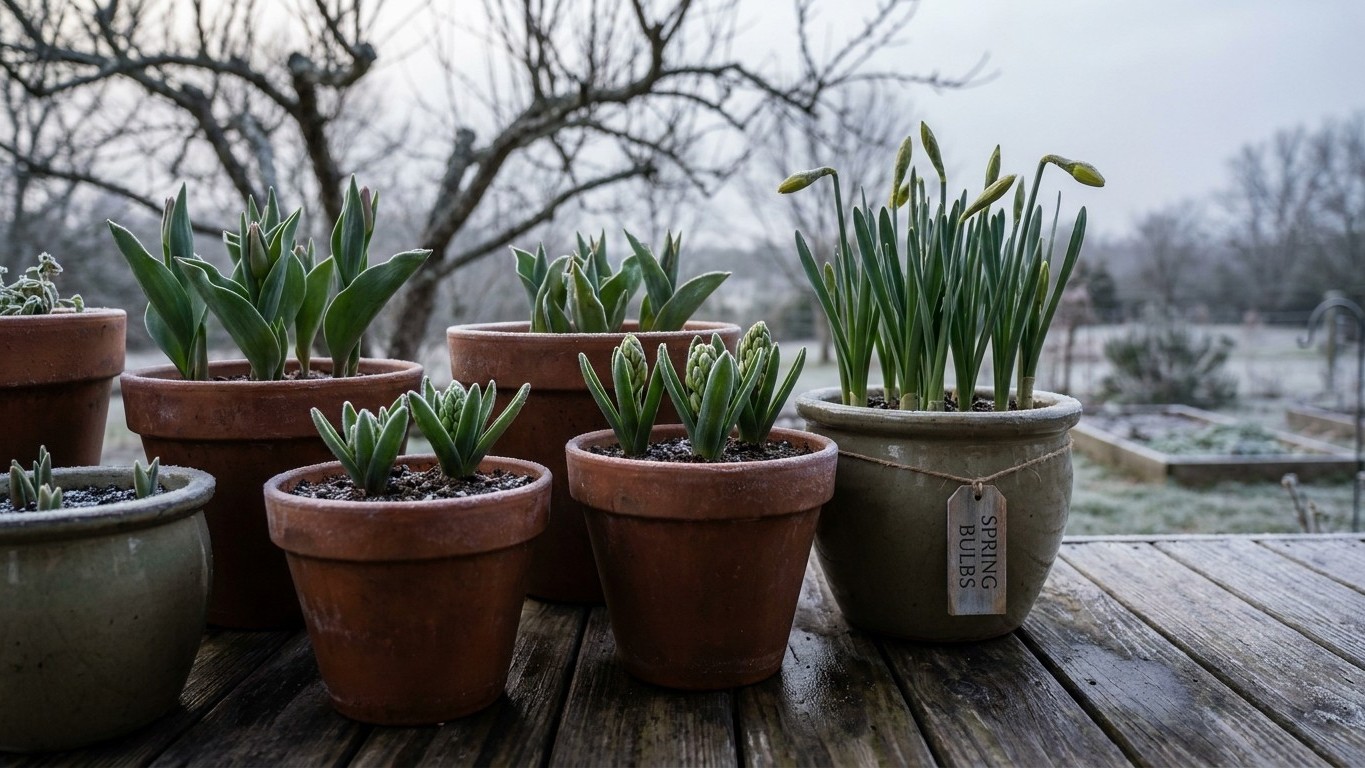

Container-grown spring bulbs need one thing potted bulbs in the ground don’t: real protection from a pot that freezes clean through. Tennessee’s own winter, averaging 30.1°F for the coldest month’s daily low at the Nashville reference station, already supplies the chill hardy bulbs need outdoors. The risk here isn’t a mild winter. It’s an exposed pot with no soil mass to buffer it, and that changes which precautions actually matter.
Why this matters in Tennessee

Start with the number that decides everything: 30.1°F. That’s the mean daily minimum for the coldest month, measured at the Nashville reference station under NOAA’s 1991-2020 climate normals. It’s not a record low and not a seasonal average. It’s the temperature the coldest month typically dips to on an ordinary night, and it sits comfortably below the 45°F ceiling a spring bulb needs to break dormancy properly.
That figure settles a question gardeners elsewhere have to wrestle with: does this place deliver enough natural cold, or does a gardener have to manufacture it? In much of the Deep South, winters run too mild for tulips and hyacinths to get their twelve to fourteen weeks below 45°F, so gardeners force the chill artificially in a refrigerator. Tennessee, at 30.1°F for the coldest month’s nightly low, isn’t in that camp. Bulbs planted straight into garden soil here get their cold naturally, without any help.
Containers change the equation, and that’s the real complication for this territory. Garden soil has mass. It absorbs heat during the day and releases it slowly overnight, so even when the air dips well below freezing, the ground a few inches down rarely does. That’s why a bulb planted eight inches deep survives a night that would kill the same bulb sitting exposed. A container has none of that buffering. A pot’s soil column is small, surrounded on every side by cold air, and it can freeze straight through, roots, bulb, and all, during a cold snap that barely touches the top two inches of an in-ground bed.
This is where the USDA hardiness zone map matters, and where it gets confusing. Tennessee spans USDA zones 5b through 8a, built from the average annual extreme minimum temperature under the 1991-2020 normals. A bulb rated for a given zone might sail through winter in a garden bed in one part of the state, yet die in a pot on the same porch, because the container offers none of the insulation that earned that zone rating in the first place. The rule of thumb nurseries use (treat a container as roughly two zones colder than the ground around it) exists precisely because of this gap.
So the situation here isn’t a shortage of winter. It’s a container that doesn’t get to use the winter Tennessee actually has.
How to do it here
The method below assumes two things about this territory: garden soil already delivers enough winter cold for hardy bulbs, and a container does not, unless it’s protected. Follow the sequence in order rather than skipping to whichever step sounds most interesting, since each one depends on the last.
- Pick a bulb rated at least two USDA zones hardier than where the pot will actually sit. Since Tennessee ranges from zone 5b to 8a depending on location, check the reference city closest to the garden rather than assuming the state-wide range applies evenly everywhere.
- Pot up in fall in a container with real drainage holes, using a loose, fast-draining mix. A pot that holds standing water freezes into a solid block of ice faster than one that drains, and ice does more damage to bulb tissue than dry cold ever does.
- Give the bulb its cold period, twelve to fourteen weeks below 45°F. An unheated garage that stays just above freezing works, as does a refrigerator drawer, kept away from any ripening fruit, since the ethylene gas fruit gives off as it ripens kills the flower bud hidden inside the bulb before it ever gets a chance to open.
- Track the weeks on a calendar, not by feel. Cold that’s too short is the single most common reason a forced or potted bulb produces leaves with no flower, and there’s no shortcut around counting the actual weeks.
- Once the cold period is complete, choose the pot’s fate. Move it to a sheltered, unheated spot outdoors, mulched over the rim, for a normal spring bloom on the porch. Or bring it into a cool room, around 50 to 60°F for a few days, then into full warmth, to force an earlier indoor bloom.
- If a hard freeze is forecast and the pot is still outdoors, move it against a house wall or into an unheated garage rather than leaving it exposed. A container’s soil has no mass to buffer a sudden drop the way garden soil does.
Water sparingly through the whole process: enough that the mix never fully dries out, never so much that it sits wet, since a soggy container is the fastest route to the rot described further down.
Which bulbs are worth it
Not every spring bulb earns its space in a pot. Some force fast and stay short enough to look good in a container; others need cold for so long, or grow so tall, that a pot becomes more trouble than it’s worth.
Crocus and grape hyacinth top the reliable list because their cold requirement is short and their stems stay low, so a late cold snap or a wobbly pot never topples them. Hyacinth forces almost as easily and rewards the wait with scent, which matters more indoors in a container than it does spread across a garden bed. Paperwhite narcissus is the outlier worth knowing about: it needs no cold period at all, which makes it the fastest, least fussy container bulb available, though it also means it can’t be treated as a repeat-blooming garden plant here the way a true daffodil can.
- Crocus
- Grape hyacinth (Muscari)
- Hyacinth
- Paperwhite narcissus
- Dwarf daffodil cultivars
Tulips sit in a category of their own in Tennessee. In the warmer end of the state’s zone range, most tulip varieties act as one-season plants regardless of where they’re grown, since they rarely rebloom reliably after the first spring. That actually makes them a low-risk container choice: forcing one for an early indoor bloom costs nothing in the long run, because the bulb was never going to come back next year anyway.
The bulbs that sulk in containers tend to share one trait: they were built for garden beds, not pots. Tall Darwin and Triumph tulips carry heavy flowers on stems that catch wind and topple once the pot’s soil can’t anchor a deep enough root run. Giant alliums have the same top-heavy problem on a larger scale. Fritillaria imperialis needs a long, steady cold period and resents having its bulb disturbed at all, which makes the repeated moving a container demands close to a guarantee of failure.
- Tall Darwin and Triumph tulips
- Giant alliums
- Fritillaria imperialis
What goes wrong, and when you can still fix it
Most container bulb failures in Tennessee trace back to one of three mistakes, and each one leaves a different, recognizable clue.
Leaves, but no flower
The bulb put up green growth right on schedule, then never produced a bud. This almost always means the cold period ran short of the twelve to fourteen weeks a spring bulb needs, so it had just enough stored energy to leaf out but not enough signal to flower. There’s no fix this season, since the bulb already spent what it had. The only real remedy is counting the weeks properly next time and starting the cold period earlier.
A flower on a stem too short to see
The bud opened, but the stem barely cleared the soil line, hidden under the foliage. That’s a bulb moved from cold straight into full warmth without the gradual, cool-room transition in between, so the flower formed before the stem had time to elongate. Once it’s happened, there’s nothing to reverse for that bloom. Next time, hold the pot at 50 to 60°F for several days before moving it into a warm room.
Rot in the pot
Soft, dark, foul-smelling tissue at the base of the bulb means water sat in the container instead of draining through it. Once rot has set in, the bulb is finished for this season, and it’s not worth trying to save. The fix belongs entirely to the next planting: drainage holes that actually work, and a mix loose enough to let excess water pass through instead of pooling around the bulb.