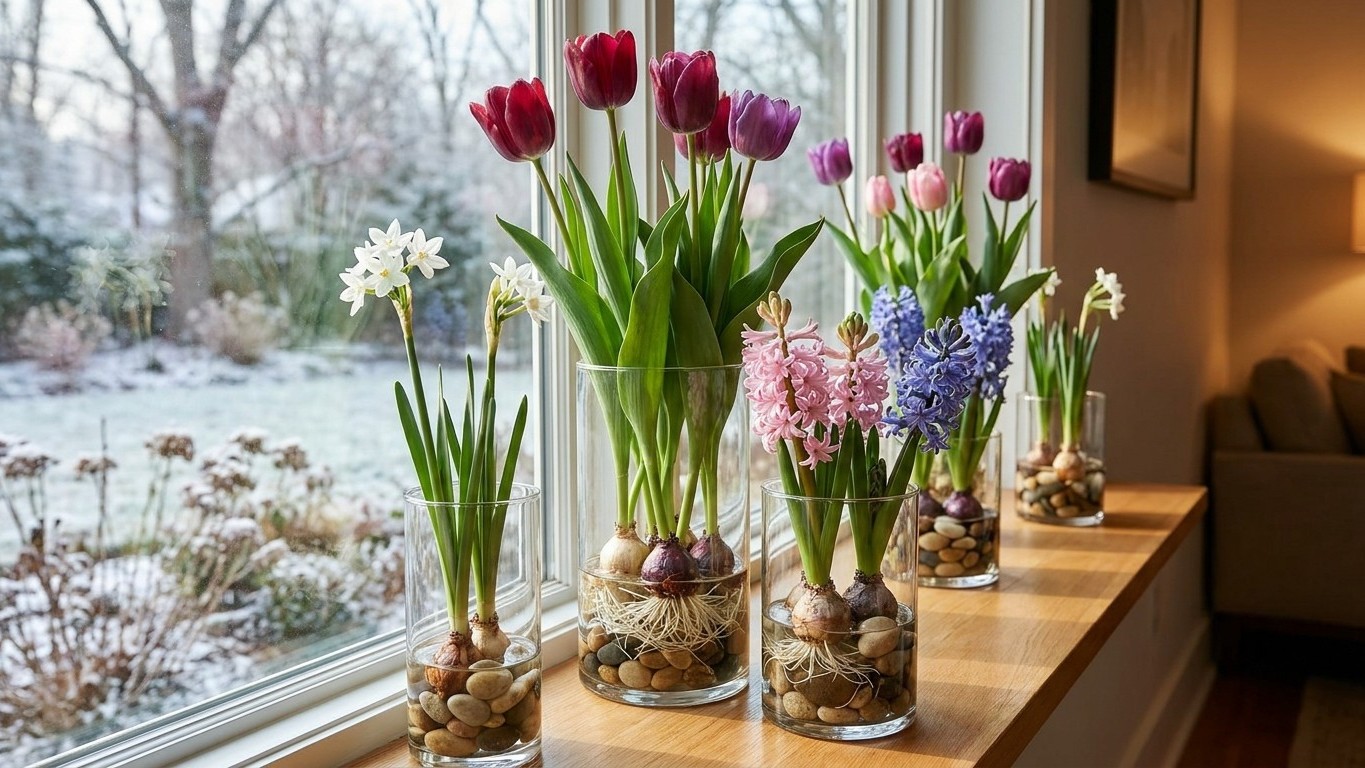

Forcing spring bulbs indoors means tricking a bulb into believing it already lived through winter, then bringing it into a warm room to bloom weeks before the garden does. Nashville’s winter is cold enough to do that chilling naturally outdoors for most hardy bulbs; forcing indoors here is mostly about timing a bloom for your windowsill, not making up for a mild climate.
Why this matters in Tennessee

The number that settles this question is 30.1°F. That’s the mean daily minimum temperature for the coldest month at the Nashville reference station, according to NOAA NCEI Climate Normals for 1991-2020. A spring bulb needs roughly twelve to fourteen weeks with temperatures under 45°F to break its dormancy and set a flower bud. At 30.1°F average overnight lows through the coldest stretch of winter, Tennessee’s outdoor air spends that entire window well under the threshold. This state does not have a cold shortage.
That changes what “forcing” means here compared with a warmer state. In places where winter barely dips below 50°F, forcing indoors is the only way to get a tulip or hyacinth to bloom at all, because the ground never delivers the chill. In Tennessee, a bulb planted straight into a garden bed gets that chilling for free from the soil. The reason to force bulbs indoors here isn’t a missing winter, it’s a missing living room bloom in January: a heated house sits at 65-70°F year-round, and no houseplant shelf ever drops into the 30s on its own. So the chilling still has to be manufactured artificially, in a refrigerator or an unheated space, even though the yard outside is doing the same job naturally at the same time.
Containers raise a separate question that this page sets aside on purpose. A pot left outdoors all winter freezes clean through, roots and soil together, because there’s no surrounding earth to buffer it the way a garden bed has. That’s a hardiness problem, not a forcing problem, and it follows the USDA Plant Hardiness Zone Map, which for this state spans zone 5b to 8a depending on where you are, built on the average annual extreme minimum temperature. Nashville sits toward the middle of that range; the mountains in the east run colder, the far west runs milder. If your interest is bulbs surviving in an outdoor pot through winter rather than blooming early indoors, that’s a different set of rules than the ones below.
How to do it here
The steps below follow the order a gardener actually performs them, using spaces most Tennessee households already have rather than specialized equipment.
- Pick bulbs bred for forcing and pot them in fall, roughly October through November, in a shallow container with drainage holes. Set them close together, shoulders just above the soil line, and water thoroughly once.
- Choose where the cold will come from. An attached, unheated garage works if it reliably stays above freezing through winter, which lines up with that 30.1°F coldest-month minimum for the Nashville area; a detached garage can run colder and risks freezing the pot solid. A refrigerator produces steadier cold if you have drawer space to spare.
- Keep fruit out of that fridge drawer. Ripening apples and pears give off ethylene gas, and ethylene kills the flower bud inside a chilling bulb before it ever gets a chance to open.
- Hold the pot in the dark and cold for twelve to fourteen weeks, checking every couple of weeks that the soil hasn’t dried out completely.
- Watch for the signal that chilling is finished: pale shoots an inch or two tall pushing up from the soil, or roots visible through the drainage holes if you check from below.
- Move the pot to a bright, cool spot, around 60°F, for about a week before exposing it to a warm, sunny window. Skipping this step is the single biggest reason forced bulbs come up with weak, floppy stems.
- Bring it into full warmth and light once shoots have greened up, and expect bloom within two to three weeks.
Which bulbs are worth it
Not every bulb pays back the twelve weeks of fridge space it takes up. The ones that force well tend to share two traits: a short cold requirement, and a stem short enough to stand up straight in a pot instead of a garden bed. Bulbs that skip the cold requirement entirely are the easiest of all, and since they’re tender in this state’s zone 5b-8a range anyway (they were never going to survive outdoors here past one season), forcing them costs nothing in the long run. You weren’t keeping that bulb regardless.
- Paperwhite narcissus, no chilling needed at all, blooms in three to four weeks from potting
- Amaryllis, also skips the cold step, reliable indoors on a sunny sill
- Crocus, short cold requirement, short sturdy stem
- Hyacinth, moderate cold requirement, upright and stable in a pot
- Grape hyacinth (muscari), short stem, forces predictably
The bulbs that sulk are almost always the ones with a long cold requirement, a tall stem, or both. A tulip typically wants the full fourteen weeks and still tops out on a stem that leans and topples once it’s indoors away from wind resistance. A daffodil bred for garden height does the same. These aren’t unforceable, but they demand more patience and more staking than most windowsill growers expect.
- Tall trumpet daffodils, long chill requirement, top-heavy stems
- Standard tulips, long chill requirement, uneven and floppy bloom indoors
- Fritillaria, unpredictable indoors regardless of chilling
- Alliums, very tall, prone to tipping the pot itself
What goes wrong, and when you can still fix it
Leaves, no flower
Green growth with nothing to show for it almost always means the chilling ran short of the twelve to fourteen weeks the bulb needed. There’s no rescue for that bulb this season; the flower bud simply never finished forming. Note the potting date next fall and count the full chilling period before checking for shoots.
A flower you can barely see
A bloom that opens right at soil level, on a stem that never elongated, usually means the pot was pulled into full warmth and light too soon after chilling, skipping the cool, bright transition period. This bloom cycle can’t be redone, but the fix for next time is straightforward: give it that week at 60°F in indirect light before moving it to a sunny, warm spot.
Soft, rotten bulb in the pot
A bulb that turns soft and dark instead of sending up shoots was almost certainly sitting in soil that never drained. This bulb is done, and there’s nothing to save this season. Next time, use a container with real drainage holes and a loose, fast-draining potting mix rather than garden soil, which compacts and holds water against the bulb through the entire chilling period.
Related guides
- Growing Spring Bulbs in Containers in Tennessee
- Forcing Spring Bulbs Indoors in Texas