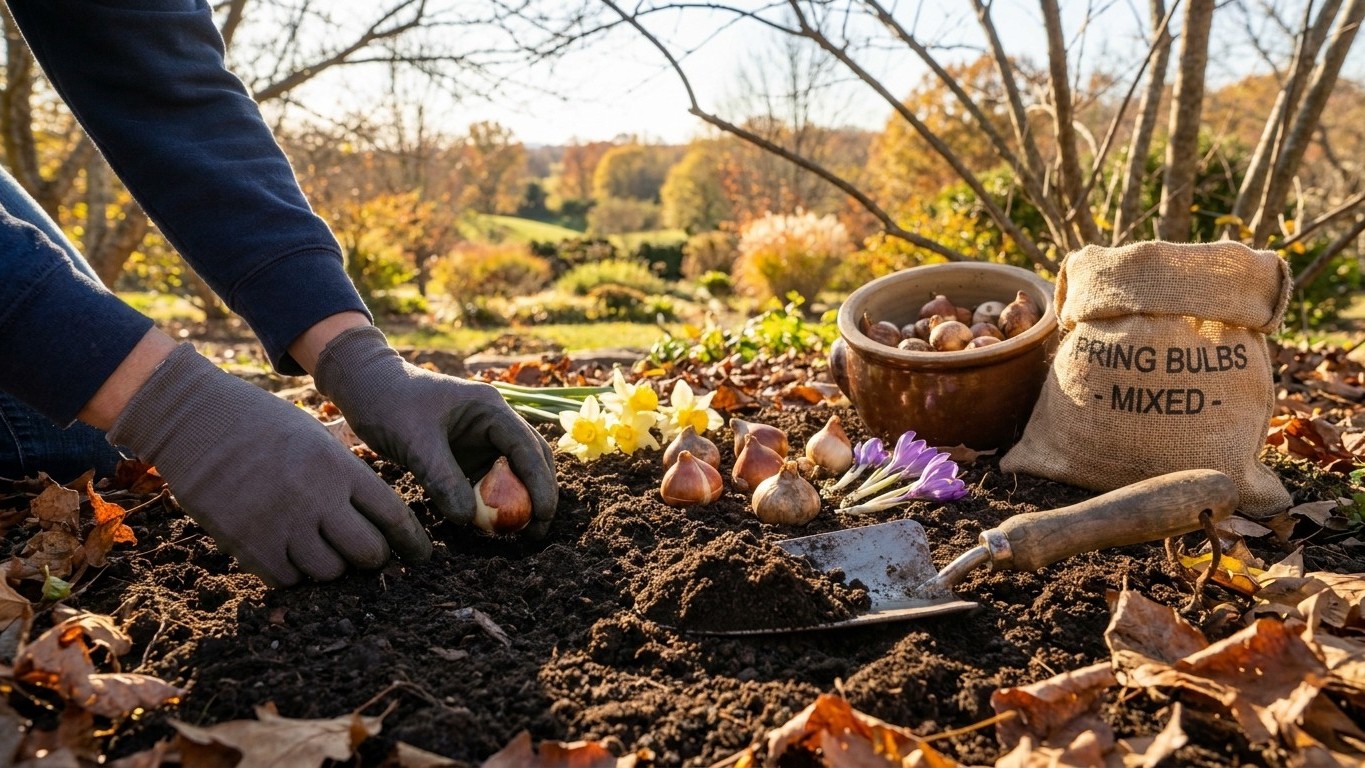

Middle Tennessee winters get cold enough, reliably, to satisfy the chill requirement of nearly every classic spring bulb: tulips, daffodils, hyacinths, crocus. The real questions are timing (when the soil is right) and toughness (which bulbs actually take to Tennessee’s mix of cold snaps and mild spells). For gardeners without in-ground beds, or who simply want more control over placement, Growing Spring Bulbs in Containers in Tennessee follows the same chill-hour logic while making it easier to manage timing and protect against hard freezes.
When to plant bulbs in Tennessee

The planting window is built backward from the first fall frost. Across Middle Tennessee, that frost lands between October 28 and November 8, based on 30-70% freeze probability data from NOAA’s 1991-2020 Climate Normals at the Nashville reference station. Spring bulbs want roughly six weeks of cool-but-unfrozen soil to grow roots before the ground locks up, which puts the practical planting window at mid-October through late November for most of the state.
Plant too early and the soil is still warm from summer. Tulips and daffodils don’t care about air temperature nearly as much as they care about soil temperature, and warm soil in October tricks a bulb into pushing top growth. That green shoot has no defense against a hard freeze in December, and a gardener who planted in September often finds mush where a daffodil should be come spring.
Plant too late and the opposite problem shows up. A bulb dropped into cold, half-frozen ground in late December hasn’t had time to grow the root system it needs to anchor itself and pull in water once spring arrives. It may still bloom, but weakly, or a season behind, or not at all if a hard freeze catches it before roots take hold.
The frost date is an average, not a guarantee
Worth saying plainly: that October 28 to November 8 window is an average drawn from three decades of data. Half of all years fall earlier, half later. A gardener in a low-lying, frost-prone yard outside Nashville might see frost in mid-October some years; someone with a sheltered, south-facing bed might not see a hard freeze until Thanksgiving. Watch your own thermometer, not just the calendar.
East Tennessee and the Cumberland Plateau run cooler and later than Nashville in spring, which also means their fall cooldown and planting window can shift by a week or two relative to the Middle Tennessee dates above. If you garden in Knoxville, Chattanooga, or up on the plateau, treat the Nashville dates as a starting point, not gospel.
Whether your winter is cold enough
Here’s the number that decides everything: most spring-flowering bulbs need twelve to fourteen weeks with soil temperatures below about 45F to complete the internal process that builds a flower inside the bulb. Skip that cold spell, or cut it short, and the bulb still grows leaves, it just won’t flower, or it’ll push up a stem too short and weak to show a bloom. This is true everywhere spring bulbs are grown, whether the reader is in Tennessee, Georgia, or Minnesota. It’s the single figure to check any bulb variety against, no matter wh. Gardeners who’d rather sidestep the outdoor timing entirely, or who want blooms well before spring, can also try Forcing Spring Bulbs Indoors in Tennessee, which recreates that same chill requirement in a refrigerator instead of garden soil.ere you live.
Nashville’s coldest month has an average daily minimum of 30.1F (NOAA NCEI Climate Normals, 1991-2020), a figure that measures the typical low, not a record cold snap. A month that regularly dips into the low 30s at night keeps soil well under 45F for weeks at a stretch, and Middle Tennessee typically strings together twelve or more such weeks from December through February. That clears the standard bulb chill requirement without much room for doubt.
What that margin buys you
Because the cold requirement is met naturally, gardeners in Middle Tennessee don’t need to pre-chill tulip or daffodil bulbs in the refrigerator before planting, the way growers in much warmer climates (coastal Georgia, Florida, southern Texas) often do. That’s real money and effort saved. Pre-chilling, when it is necessary, means twelve weeks in a refrigerator at a steady temperature, kept away from apples, pears, and other ripening fruit, because the ethylene gas fruit gives off will kill the flower bud forming inside the bulb. Tennessee gardeners can generally skip that whole process and let the ground do the work.
| Bulb | Cold required | Nashville winter delivers | Verdict |
|---|---|---|---|
| Tulip (Tulipa) | 12-14 weeks below 45F | ~14-16 weeks, Dec-Feb | Meets requirement; no pre-chill needed |
| Daffodil (Narcissus) | 12-15 weeks below 45F | ~14-16 weeks, Dec-Feb | Meets requirement comfortably |
| Hyacinth | 12-14 weeks below 45F | ~14-16 weeks, Dec-Feb | Meets requirement |
| Crocus | 8-10 weeks below 45F | ~14-16 weeks, Dec-Feb | Meets requirement with margin to spare |
| Allium | 8-10 weeks below 45F | ~14-16 weeks, Dec-Feb | Meets requirement easily |
The margin is wider still up on the Cumberland Plateau and in East Tennessee’s higher elevations, where winters run colder and longer. Where the state falls short isn’t cold, it’s the opposite problem: a mild, wet January in an unusually warm year can shorten the cold window enough that marginal bulbs bloom poorly. That’s the exception, not the rule, but it’s worth knowing before you blame the bulb supplier for a bad spring.
Which bulbs suit Tennessee
Tennessee’s USDA hardiness zones run from 5b to 8a across the state (USDA Plant Hardiness Zone Map, 2023, based on 1991-2020 averages), a range built on the average annual extreme minimum temperature, not on typical winter cold. That’s a wide spread, and it means a bulb that struggles at the northern edge in East Tennessee’s higher ground might do just fine in a warmer Memphis backyard, and vice versa. Treat any hardiness range as a soft edge, not a wall: a sheltered spot against a south-facing foundation often lets a marginal bulb survive where an open, windswept bed would kill it.
With that caveat, these bulbs are dependable across most of the state:
- Daffodil (Narcissus), hardy zones 3-8
- Tulip (Tulipa), hardy zones 3-8 (best treated as an annual replant in warmer pockets)
- Crocus, hardy zones 3-8
- Hyacinth, hardy zones 4-8
- Allium, hardy zones 4-8
- Grape hyacinth (Muscari), hardy zones 4-8
Bulbs bred for colder, drier climates tend to disappoint here in a specific way: they rot. Tennessee’s clay-heavy soils and wet winters, especially in low spots that hold water, are hard on bulbs that expect a dry dormancy, like some species tulips native to Central Asia’s arid winters. The failure isn’t a lack of cold, it’s too much moisture sitting against the bulb through a soggy February. Anyone who’s dug up a mushy, rotted bulb in spring after a wet winter has already met this problem firsthand.
At the warmer edge of the state, in zone 8a pockets around Memphis, tulips in particular can put on a strong first-year show and then fade fast, blooming smaller and sparser each following year because summer soil temperatures run too warm for the bulb to properly reset. Many Tennessee gardeners in those areas treat tulips as an annual, planting fresh bulbs each fall rather than counting on a repeat performance.
What digs them up here
Squirrels and voles don’t raid every bulb bed equally, and the difference comes down to chemistry rather than chance. Daffodils and anything in the onion family contain compounds that are bitter or mildly toxic to rodents, so they’re left alone almost without exception. Tulips and crocus have no such defense. Squirrels view a freshly planted tulip bed the way most people view a bag of chips left open on the counter.
Bulbs squirrels and voles typically leave alone:
- Daffodil (Narcissus)
- Allium
- Grape hyacinth (Muscari), largely ignored
Bulbs squirrels and voles regularly dig up or eat:
- Tulip (Tulipa)
- Crocus
- Hyacinth, to a lesser extent
The one measure that actually holds up is physical, not chemical: lay a sheet of galvanized wire mesh directly over the planting bed after digging, pinned down at the edges, and leave it in place until the ground freezes hard enough that digging isn’t worth the effort. Bulbs still grow up through the mesh gaps in spring. Repellent sprays and pepper flakes, by contrast, wash off with the first rain and need constant reapplication, which makes them a poor match for a bulb bed you plant once and forget for months.
Where to check for your own county
Every figure above, the frost dates, the coldest-month minimum, ties to Nashville as the reference station. Tennessee stretches across several degrees of latitude and multiple hardiness zones, from the Mississippi River bottomlands in the west to the Smoky Mountains in the east, and a planting date calculated for Nashville can run two to three weeks off at either edge of the state.
The University of Tennessee Institute of Agriculture’s Extension service maintains county-level offices that track local frost dates, soil conditions, and variety performance specific to your area. A county agent in Sullivan County, up near the Virginia line, will give you a different planting date than one in Shelby County near Memphis, and both will be more accurate than a statewide average. Since bulb planting is a once-a-year decision with a full season riding on the timing, that local check is worth the phone call.