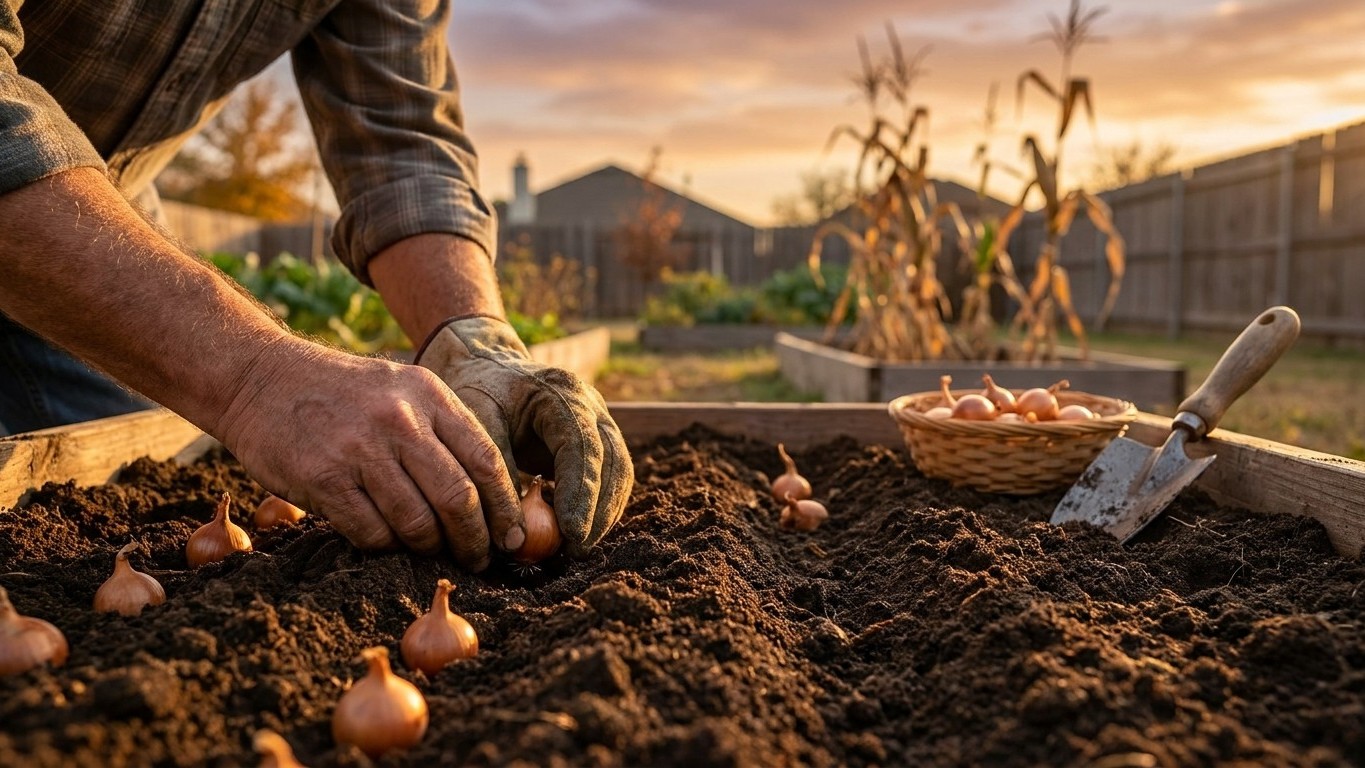

In most of Texas, onions go into the ground in fall, not spring. At the reference latitude of 29.98 degrees north, the growing season is built around mild winters and a summer day that tops out at 13 hours and 56 minutes, just enough light to trigger short-day bulbing but nowhere near enough for the long-day types sold across most of the country. That single fact decides both the calendar and the variety list.
The short answer for Texas

Plant short-day onion transplants or sets from mid-October through December, using the Houston area (29.98N) as the reference point, the same coordinates behind the NOAA weather station this article’s figures come from. That fall window lets the young plants spend winter building leaves while temperatures stay mild enough to avoid a hard freeze, then shift into bulbing once the day stretches toward the 12-hour mark that short-day onions respond to. By the time early summer arrives, the bulbs are already sizing up and ready to pull before real heat sets in.
That’s the opposite of what gardeners do in Minnesota or Maine, where the ground freezes solid all winter and onions go in as sets or transplants in late winter to early spring instead, once the soil can be worked at all. The difference isn’t tradition, it’s day length. Farther north, summer days stretch to 14, 15, even 16 hours at the solstice, which is exactly what long-day onion varieties need before they’ll bulb. Houston’s longest day, at 13 hours 56 minutes, never gets there. A fall-planted short-day onion in Texas reaches the 12-hour threshold early in the season and bulbs on a compact, mild-winter timeline. A spring-planted long-day onion up north needs those extra hours of June and July light to do the same job.
This is also why “when to plant onions” doesn’t have one national answer, and why a calendar written for Ohio or Michigan will actively mislead a Texas gardener. Follow it and you’d be setting out short-day plants in spring, right as day length is already climbing past what they need, and pushing the bulbing trigger too early for the plant to have built any size. Fall planting, tuned to this state’s mild winter, is what actually lines up the plant’s growth with the light it’s waiting for.
What will not work here
Twenty-four onion varieties documented on this site are published for latitudes above 29.98N, and none of them will bulb in a Texas garden at this latitude. These are long-day and intermediate-day types bred for the longer summer days of the Midwest, the Northeast, or the Pacific Northwest. Plant one here and the result isn’t a smaller onion, it’s no onion at all: the plant spends the whole season making leaves, waiting for a day length that never arrives, and eventually the foliage collapses and the bulb rots in the ground.
- Ailsa Craig (long-day, 38-60N), needs day length far beyond what Texas summers provide
- Barolo (long-day, 38-55N), bred for northern summer daylight
- Blush (long-day, 38-55N), will not reach its bulbing trigger here
- Bridger (long-day, 35-50N), day length ceiling too low at 29.98N
- Cabernet (intermediate-day, 35-45N), requires more daylight than Houston’s summer offers
- Calibra (intermediate-day, 35-45N), same daylight gap
- Candy (intermediate-day, 33-40N), still north of what 13h56 supports
- Elsye (intermediate-day, 32-45N), lower bound sits above the reference latitude
- Expression (intermediate-day, 32-45N), same shortfall
- Frontier (long-day, 40-50N), a northern long-day type
- Monastrell (intermediate-day, 35-46N), daylight requirement not met
- New York Early (long-day, 38-50N), needs a much longer summer day
- Patterson (long-day, 38-55N), will only leaf out here
- Powell (long-day, 43-47N), a far-northern range
- Red Carpet (long-day, 40-45N), day length gap too wide
- Red Long of Florence (intermediate-day, 38-50N), will not trigger bulbing
- Red Long of Tropea (intermediate-day, 35-48N), same issue
- Redwing (long-day, 43-65N), an extreme-north range
- Rossa di Milano (long-day, 38-50N), leaves only, no bulb
- Safrane (long-day, 42-50N), day length never reached
- Scout (intermediate-day, 32-46N), lower bound above 29.98N
- Sierra Blanca (intermediate-day, 32-45N), same shortfall
- Talon (long-day, 42-50N), a northern long-day type
- Walla Walla Sweet (long-day, 35-55N), its 16-hour bulbing trigger never arrives here
Timing failures are just as unforgiving, even with the right variety. Planting a short-day onion late doesn’t push the harvest back a few weeks, it shrinks the bulb permanently. An onion bulbs at whatever size it has reached the moment day length crosses its trigger point, and after that the plant stops adding to the bulb no matter how much longer it stays in the ground. Set out transplants in February instead of October, and by the time day length hits the trigger, the plant has had only a fraction of the growing time it needed. The result is a small, tight bulb, not a late one.
What changes across Texas
Texas runs from roughly the Rio Grande Valley near 26 degrees north to the Panhandle above 36 degrees north, a span of about ten degrees of latitude. That’s wide enough that the advice above, anchored to Houston at 29.98N, doesn’t hold evenly from one end of the state to the other.
| Region | Approx. latitude | Day length on longest day | What changes |
|---|---|---|---|
| Rio Grande Valley | ~26N | Slightly under 13h56 | Even more solidly short-day territory; fall planting can start a bit earlier with less frost risk |
| Houston (reference) | 29.98N | 13h56 | Baseline for this article’s dates and variety list |
| North Texas / Panhandle | ~36N | Modestly longer than Houston’s | Some intermediate-day types near their southern bound may become viable; frost dates run later into spring, pushing the planting window closer to late winter |
A gardener in Amarillo isn’t gardening in the same day-length world as one in Houston or Brownsville. Two varieties flagged in the previous section, Red Rock (30-36N) and White Castle (30-38N), sit close enough to 29.98N that they fall into a blurred zone: they may bulb around Houston, but they’re built more for the state’s northern edge. Anyone gardening north of about the Dallas-Fort Worth line should treat this page’s variety list as a starting point, not a final answer, and check their own latitude before ordering seed.
Sweet now, or onions that last
The short-day varieties that actually work at this latitude, ones like Texas Grano 1015Y, Red Sensation, and Vidora, lean toward the sweet, mild end of the onion spectrum. That’s not a marketing description, it’s chemistry. The compounds responsible for an onion’s bite are volatile sulfur compounds, and those same compounds are what protect the bulb from breaking down in storage. Breed or grow for less bite, and you get an onion that’s better sliced raw on a burger, but one that also won’t hold up on a shelf for months.
University of Missouri Extension states it plainly: “As a rule, ‘sweet’ onions do not store as well as the more pungent types.” That single line explains the whole geography of onion growing in the United States. Short-day types, suited to Texas and the rest of the Gulf Coast, run sweeter and milder because they’re bred around this latitude’s shorter daylight trigger. Long-day types, suited to the northern latitudes discussed above, run sharper and keep for months because they carry more of those protective sulfur compounds.
That trade-off shows up in the pantry, not just the garden. A Texas harvest of Texas Grano or Vidora is best used within a couple of months of curing; by March, bulbs that were sweet and thin-skinned in June are soft, sprouting, or already gone. A northern gardener growing a pungent long-day onion, by contrast, can reasonably expect bulbs from the same harvest to still be sound going into late winter. Neither result is a failure. It’s what the latitude, and the chemistry underneath it, was always going to produce.
Checking this against your own garden
Every date and variety above is tied to Houston’s 29.98N latitude and its 13h56 longest day. A garden 300 miles away in either direction is not gardening under the same numbers, and no state-wide planting calendar accounts for that on its own.
- Look up your own latitude if you’re not near Houston, especially if you garden in the Panhandle, West Texas, or deep South Texas
- Check your local first and last frost dates rather than relying on a statewide average
- Call or visit your county extension office, part of the Texas A&M AgriLife Extension network, for planting dates calibrated to your specific county
- Ask that office which short-day varieties they’ve seen perform well locally, since soil and rainfall vary even among gardens at the same latitude
- Re-check any variety near a published boundary, like Red Rock or White Castle, against your actual day length before committing a whole bed to it