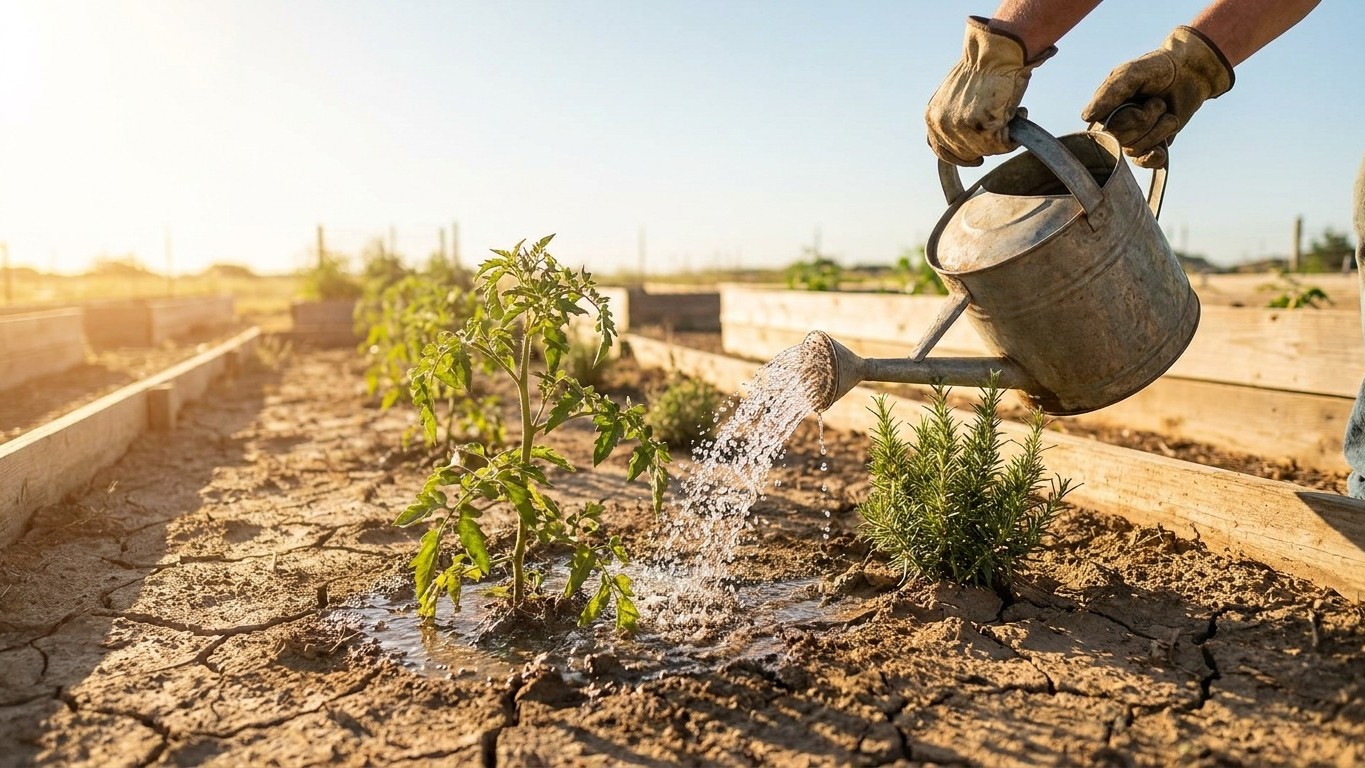

A Texas garden bed wants about an inch of water a week, but in the driest stretch of summer the sky delivers less than that, and the heat pulls out more than usual. The gap between what falls and what the ground loses is what the gardener has to make up, by hand, at the base of the plant, in the cool of the morning.
What changes here

Two numbers set the terms for a Texas summer. July, the driest month of the season, averages 3.77 inches of rain at the reference station. And the region logs 102.4 days a year at or above 90F. Put together, that means the driest month of the growing season arrives at the same time as the heaviest run of heat, so a bed can look green in June and be gasping by the third week of July.
A vegetable bed or a young shrub bed wants roughly an inch of water a week to keep root growth steady. Spread July’s 3.77 inches evenly across its 4.4 weeks and the sky supplies about 0.85 inch a week on its own, if every drop soaked in evenly, which it rarely does in a state where summer rain tends to fall as a single afternoon storm rather than a steady drizzle. That leaves the gardener to carry the rest, and in practice it’s more than the arithmetic alone suggests, because a downpour that dumps most of an inch in twenty minutes runs off a hard surface and soaks in only partway.
June runs wetter, at 6.0 inches, and August recovers a little to 4.84 inches, so July sits as the low point of the season, the month where the watering can does the most work. The heat load doesn’t ease with it: 102 days above 90F spread across the summer means the evaporation that pulls moisture back out of the soil keeps running at full speed even in months when rainfall picks up slightly.
Soil texture decides how far that inch goes once it lands. A sandy bed lets water drain through within a day, so the same weekly inch has to be split into more frequent, smaller soakings to keep moisture at root depth. A heavy clay bed holds that inch for the better part of a week, which is generous in a dry spell, but risky if a second soaking arrives before the first has drained, since clay drowns roots that sit in standing water. Knowing which one is under a given bed matters more in July than in any other month.
How to water when it matters
The method that works in a Texas summer is deep, infrequent, and aimed at the base of the plant rather than the leaves. Deep watering pushes moisture down to where the roots actually are, which trains them to grow downward instead of clustering at the surface where the heat bakes them dry within hours. Watering at the base instead of overhead means the leaves stay dry, so there’s no film of moisture sitting on foliage for the next twelve hours inviting fungus. Morning watering matters because it gives the plant a full day to draw on that moisture before the afternoon heat, the kind that shows up 102 days a year here, starts pulling it back out through the leaves.
Checking the soil rather than guessing is the part most gardeners skip. A finger pushed two inches down, or a trowel pulled up for a quick look, tells the real story: if it’s dry at that depth, it’s time to water, no matter how the surface looks after a light rain.
- Push a finger or trowel two inches into the soil near the root zone before deciding to water at all.
- If it’s dry at that depth, water slowly at the base until the top six to eight inches are moist, not just damp on the surface.
- On sandy ground, split the weekly total into two or three shorter soakings, since sand drains fast and holds little.
- On clay-heavy ground, water once a week in a single deep soaking, and wait for the surface to dry before the next one, since clay holds water far longer.
- Do the watering early in the morning, before the day’s heat starts pulling moisture back out of the leaves and soil.
Start with roughly an inch a week as the baseline and adjust from there. That number is a starting point, not a rule, since two beds on the same street can hold water differently depending on how much compost or clay is mixed into the ground.
What goes wrong
“I water a little every day to be safe”
A light daily sprinkle wets only the top inch of soil, which trains roots to stay shallow instead of reaching down toward moisture reserves. Those shallow roots are the first to bake once a 90F afternoon hits, and in a region logging over a hundred such days a year, that’s most of the summer.
“I water in the evening so it doesn’t evaporate”
Evening watering keeps the leaves wet overnight, and that damp film is exactly what fungus and mildew need to take hold. The water savings from dodging afternoon evaporation get eaten up by disease problems that show up a week later.
“It rained, so I skipped watering this week”
A quick afternoon thunderstorm can look like a soaking and still only wet the top half-inch of ground, especially on compacted or clay soil where water runs off before it sinks in. The only way to know is the same finger test used before any manual watering, checking two inches down rather than trusting how wet the surface looks.
“I didn’t bother with mulch”
Bare soil left exposed to a Texas summer sun gives back a good share of whatever water was just applied, through straight evaporation off the surface. A two to three inch layer of mulch slows that loss and keeps the soil a few degrees cooler at root depth, which matters most in a month like July when both rainfall drops and heat load stays high.
Local help
For planting calendars, drought-tolerant variety lists, and soil guidance specific to Texas conditions, the Texas A&M AgriLife Extension is the go-to resource. Watering restrictions during dry spells vary by city and water district and change from year to year, so check with the local water provider for current rules before setting a watering schedule.
Common questions
How often should I water a Texas garden in July?
Check the soil two inches down before deciding. On sandy ground, that often means two to three shorter soakings a week; on clay, once a week in a deeper soak, adjusting for how fast the previous watering dried out.
Is morning or evening better for watering in a heat wave?
Morning. It gives the plant a full day to use the water before peak heat, and it keeps leaves dry overnight, avoiding the disease risk that comes with evening watering.
Does a summer thunderstorm mean I can skip watering?
Not automatically. A hard, fast storm can run off before soaking in, especially on clay or compacted soil. A finger check two inches down settles it better than judging from the sky.
Why does July matter more than June or August for watering?
July averages the least rain of the three summer months at the reference station, 3.77 inches against June’s 6.0 and August’s 4.84, while the heat load from days above 90F stays high through the whole season, so the gap between what falls and what’s needed peaks in July.