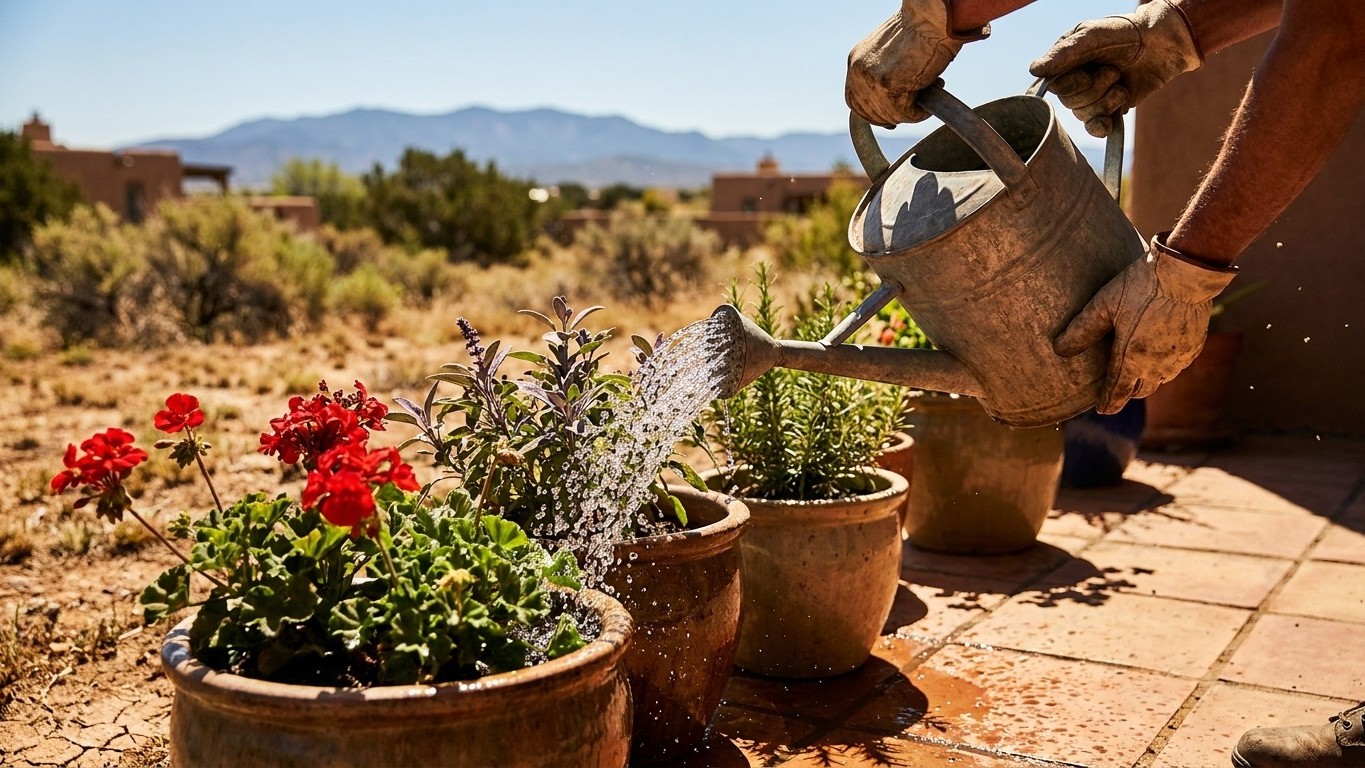

New Mexico’s summer rain totals about 3.5 inches across June, July and August, with June the driest month at just 0.57 inches, while the state averages 42.5 days a year at or above 90F. Together those two numbers mean the sky covers only a small fraction of what a garden bed needs, and the heat burns through soil moisture fast enough that a container or raised bed can dry out within a day or two of watering.
What changes here

Start with the two numbers that matter most: 0.57 inches of rain in June, the driest summer month, and 42.5 days a year that hit 90F or hotter. Read together, they say something a gardener can act on immediately: the sky is nearly silent in early summer, right when the heat load is climbing toward its peak. That combination, low rainfall arriving at the same time as high evaporation, is what makes New Mexico gardens dependent on the hose rather than the clouds.
Do the arithmetic and the gap gets concrete. A vegetable bed or a mixed container planting generally wants about an inch of water a week to keep roots supplied. June’s 0.57 inches spreads across roughly 4.3 weeks in the month, which works out to about 0.13 inches of rain in an average week. That leaves close to 0.87 inches the gardener has to supply by hand or by irrigation system, every single week, just to reach that one-inch target during the driest stretch of summer.
July brings a bit more relief on paper, 1.64 inches for the month, largely thanks to the state’s monsoon pattern, and August holds at 1.31 inches. But both of those totals often arrive as short, intense thunderstorms rather than steady soaking rain. A downpour that drops half an inch in twenty minutes on hard, dry New Mexico soil tends to run off the surface instead of sinking to root depth, so the gauge reading and the actual moisture in the ground can tell two different stories.
Soil texture changes how far that water actually gets. Sandy soil, common in much of the state’s lower elevations, lets water drain through quickly, so the same rainfall or the same watering session leaves less behind at root depth by the next afternoon. Heavier clay soil holds water far longer, sometimes for the better part of a week, which changes the calculation entirely: less frequent watering, but a real risk of drowning roots if it’s applied before the ground has had a chance to dry. Knowing which side of that line a particular bed falls on matters more here than in a climate where rain evens things out on its own.
How to water when it matters
The method that works in New Mexico is deep and infrequent, applied at the base of the plant, in the morning. Deep watering pushes moisture down to where roots actually live, training them to grow downward instead of clustering near a surface that bakes dry within hours under 42.5 days of 90-plus heat every year. Watering at the base instead of overhead means less is lost to evaporation before it ever reaches the soil, which matters when every drop is competing against a driest month that offers just 0.57 inches from the sky. Morning watering gives plants moisture reserves before the heat of the day arrives, and lets any wet foliage dry off before evening, when damp leaves overnight become a breeding ground for fungal problems.
Checking soil moisture at root depth, not just the surface, is what keeps this method honest. A finger pushed two inches into the soil, or a trowel pulled up for a quick look, tells the real story; the top half-inch can look dry and crumbly while there’s still plenty of moisture just below, or it can look fine while the root zone is bone dry underneath.
- Check the soil two inches down with a finger or trowel before watering; if it’s dry at that depth, it’s time to water regardless of how the surface looks.
- Water slowly at the base of the plant, giving the soil time to absorb roughly one inch of water per session rather than letting it run off.
- On sandy soil, shorten the interval and water more often, since the same inch drains through faster and leaves less behind for the plant to draw on.
- On heavy clay, lengthen the interval and let the soil dry partway between waterings, since clay holds moisture for close to a week and re-watering too soon risks suffocating roots.
- Water in the early morning so plants have moisture in reserve before the heat of the day and any wet foliage has time to dry before nightfall.
Treat the one-inch weekly figure as a starting point rather than a rule. A container in full sun, a raised bed with fast-draining mix, or a spot next to a reflective wall will all need adjustment upward from there, and the only way to know for sure is to check the actual soil in that specific spot rather than trust a general guideline.
What goes wrong
Watering a little every day
A light daily sprinkle feels responsible, but it only wets the top inch or two of soil. Roots follow the water, so they stay shallow and close to the surface, exactly where New Mexico’s 42.5 days of 90-plus heat can bake them dry within hours. This is probably the single costliest habit in a climate this hot and this dry: it trains a plant to be fragile right when resilience matters most.
Watering the leaves at night
Wetting foliage in the evening leaves moisture sitting on the leaves through the cool overnight hours, and that damp window is exactly when fungal diseases like powdery mildew and various leaf spots get their start. Watering at the base, in the morning, sidesteps the problem entirely.
Trusting a rain shower that only wet the surface
A summer thunderstorm can look like it solved the watering problem, but June, July and August rain here often arrives fast and heavy, running off hard soil instead of soaking in. Checking two inches down with a finger before skipping a scheduled watering avoids the mistake of assuming a storm did more than it actually did.
Leaving the soil bare
Without a layer of mulch, the sun pulls moisture straight back out of the soil almost as fast as it goes in, undoing a watering session within a day in peak summer heat. A two-to-three-inch layer of mulch around the base of plants slows that evaporation and stretches the value of every inch of water applied, whether it came from the hose or from one of those rare monsoon downpours.
Local help
New Mexico State University’s Cooperative Extension Service, at aces.nmsu.edu, offers county-level guidance on soil, planting schedules and watering practices suited to local conditions. Watering restrictions vary by city and water district and change with drought conditions, so check current rules directly with your local water utility before setting an irrigation schedule.
Common questions
How often should I water a vegetable garden in New Mexico during summer?
Aim for about one inch of water a week, adjusted for soil type: more frequent, lighter sessions on sandy soil, and less frequent, deeper sessions on clay. Check soil moisture two inches down before watering rather than following a fixed calendar.
Is June really the driest month in New Mexico, even though it’s not the hottest?
Yes. NOAA climate normals put June rainfall at 0.57 inches, lower than July’s 1.64 inches or August’s 1.31 inches, even though the monsoon season later in summer often brings more dramatic, if less reliable, rainfall.
Can I rely on monsoon thunderstorms to water my garden in July and August?
Not fully. Those storms add up to more total rainfall than June, but they tend to arrive as short, heavy bursts that run off hard or dry soil rather than soaking in evenly, so checking actual soil moisture afterward still matters.
Does mulch really make a difference in a climate with 42.5 days a year above 90F?
It does. Mulch slows evaporation from the soil surface, which matters more here than in milder climates precisely because so many summer days push temperatures high enough to pull moisture out of bare ground within hours of watering.