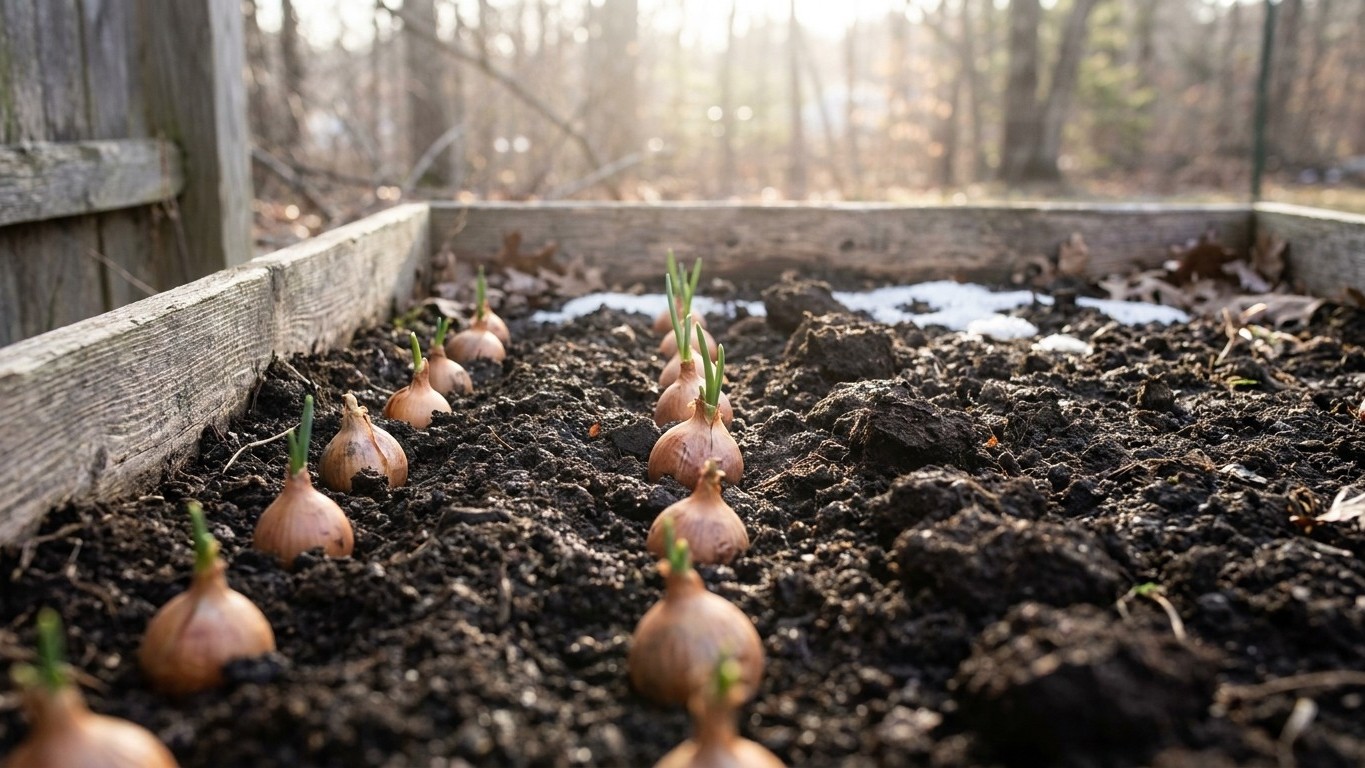

Vermont gardeners get one real planting window for onions, and it opens in early spring, not fall. At 44.47 degrees north, the reference weather station in Burlington logs 15 hours and 22 minutes of daylight on the summer solstice, more than enough to trigger bulbing in long-day onions well before autumn arrives. That single number decides which varieties can even finish a bulb in this state, and it explains why sets or transplants need to go into the ground as soon as the soil can be worked.
The short answer for Vermont

Onions are triggered into bulbing by day length, not by temperature, and that fact changes the calendar depending on where you garden. In mild-winter states, gardeners can tuck onion sets into the ground in October and let them overwinter, because the soil never freezes hard enough to kill young plants. Vermont does not get that option. Winters here run cold enough to heave and kill fall-planted onions outright, so the entire growing season has to be compressed into spring and summer.
That means Vermont onions go in as transplants or sets in late winter to early spring, typically as soon as the ground has thawed enough to be worked, often through April across most of the state. Seed started indoors eight to ten weeks ahead gives the plant a head start, so by the time the June solstice pushes day length past the 15-hour-22-minute mark measured at Burlington, the onion already has a real root system and several leaves to convert into bulb.
The day-length group matters as much as the calendar date. Burlington’s summer daylight sits well inside the range that triggers long-day onions, and it also covers many intermediate-day varieties whose published ranges stretch north to 45 or 46 degrees. Of the 31 varieties documented across this site, 23 have a published latitude range that covers 44.47N, including long-day types such as Ailsa Craig, Bridger, Frontier, Redwing, Safrane, and Talon, alongside intermediate-day types like Monastrell, Scout, and Red Long of Tropea. Any of those can be planted in Vermont on the early-spring schedule described above. Short-day onions are a different story, and that story belongs in the next section.
What will not work here
Planting the wrong day-length group in Vermont does not produce a smaller onion. It produces no onion at all. Short-day varieties are built to start bulbing once daylight reaches about 12 hours, a threshold Vermont blows past by early May most years. A short-day onion planted here spends the entire summer making leaves, because the plant never gets the “stop growing leaves” signal it was bred for, then it either fails to bulb before frost or rots in the ground. This is a variety mistake, not a feeding or watering mistake, and no amount of fertilizer fixes it.
Eight varieties documented across this site fall outside Burlington’s 44.47N latitude on the low end, meaning their published range sits south of Vermont:
- Candy (intermediate-day, 33-40N), range tops out five degrees south of Burlington; it will bulb too early and too small
- Gabriella (short-day, 20-35N, not covered elsewhere on this site), triggers bulbing at 12 hours, long before the plant has grown
- Madalyn (short-day, 20-35N, not covered elsewhere on this site), same short-day mismatch, tiny bulbs at best
- Red Rock (short-day, 30-36N, not covered elsewhere on this site), bred for Gulf Coast and southern Plains day lengths
- Red Sensation (short-day, 25-35N), bulbs before the plant has enough leaf mass to fill out
- Texas Grano 1015Y (short-day, 25-35N), a classic short-day type with no place in a New England spring
- Vidora (short-day, 25-35N), same 12-hour trigger, wrong hemisphere of the calendar for Vermont
- White Castle (short-day, 30-38N, not covered elsewhere on this site), closest of the group but still six degrees short of Burlington
Timing compounds the variety problem. Planting a correct long-day or intermediate-day variety two or three weeks late does not simply push the harvest back on the calendar the way it would with tomatoes or squash. Whatever size the onion plant has reached when day length crosses its bulbing threshold is the size the bulb will be, full stop. A late-planted onion still bulbs on the same June and July schedule the daylight dictates. It just does so with fewer leaves behind it, which means a smaller onion, not a later one.
What changes across Vermont
Vermont runs roughly from 42.7 degrees north at its southern border near Vernon to just past 45 degrees north at the Canadian line, a span of more than two degrees of latitude. The Burlington figures used above come from a single station near the middle of that range, on Lake Champlain, so gardeners at either edge of the state are not looking at identical numbers.
| Location | Approximate latitude | Day length on longest day | What it changes |
|---|---|---|---|
| Southern Vermont (Bennington/Brattleboro area) | ~42.8N | Slightly less than 15h22 | Marginally shorter growing window on the daylight side; frost dates also run a bit earlier in spring here |
| Burlington (reference station) | 44.47N | 15h22 | Baseline used throughout this page |
| Northern Vermont (Franklin/Orleans counties) | ~45.0N | Slightly more than 15h22 | Slightly longer summer daylight, but a shorter frost-free season overall |
The direction of the shift matters more than the exact minutes. Farther north, summer days get longer, which is why northern gardens across the country lean on long-day onions in the first place and southern gardens cannot grow them at all. A gardener near the Canadian border sits solidly in long-day territory, no different in principle from Burlington, just with an even later spring and an even shorter window to get transplants in before the solstice does its work. A gardener in the far southern tip of the state is close enough to Burlington’s latitude that the same variety list applies, but should still expect the growing season to open a week or so earlier in spring.
Sweet now, or onions that last
Vermont’s day length pushes gardeners toward long-day and intermediate-day varieties, and that choice carries a flavor and storage trade-off that has nothing to do with luck. The compounds responsible for an onion’s sharp bite are volatile sulfur compounds, and those same compounds are what protect the bulb from rot in storage. A sweet onion has fewer of them, which is exactly why it tastes milder raw and exactly why it will not make it through winter in a root cellar. As University of Missouri Extension puts it, “‘sweet’ onions do not store as well as the more pungent types.”
Southern gardens, growing short-day varieties bred for that region’s daylight, lean toward the sweet, short-keeping end of that spectrum, eaten within weeks of harvest. Northern gardens like Vermont’s land on the other end almost by default: long-day varieties tend to run sharper and pack more of those protective sulfur compounds, which is what lets a well-cured Vermont onion sit in a cool, dark spot and still be sound in March. No variety on the recommended list above will taste like a supermarket sweet onion fresh out of the ground, but that same sharpness is the reason the pantry still has onions left when mud season arrives.
Checking this against your own garden
Every figure in this article traces back to one weather station in Burlington, and a state that runs from the Massachusetts line to the Canadian border cannot share a single planting date or a single day-length number across every backyard. Before locking in a planting schedule, it’s worth confirming a few things specific to your own address.
- Look up your own latitude if you garden well north or south of Burlington, since a couple of degrees shifts the summer day length that triggers bulbing
- Check your local last-frost and first-frost dates, which vary by more than two weeks between the Champlain Valley and higher elevations or the Northeast Kingdom
- Contact your county’s University of Vermont Extension office for planting-date guidance tuned to your specific area
- Confirm the day-length range printed on any onion variety’s label or catalog listing before buying, rather than assuming a name sounds northern or southern
- Watch your soil temperature and workability in spring rather than a fixed calendar date, since a wet April can push planting back regardless of what the calendar says