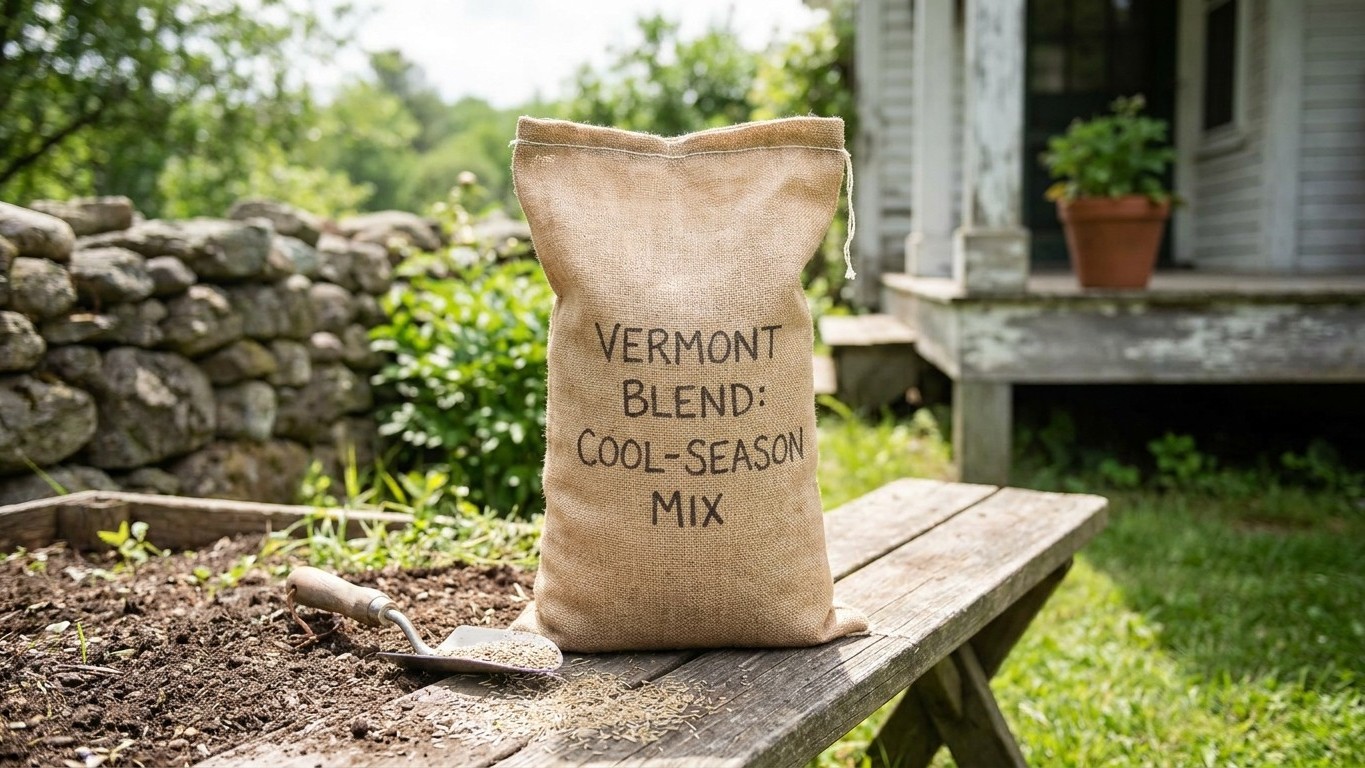

What’s the right grass seed for a Vermont lawn? Cool-season is the only kind that survives here, and the safest starting point is a blend of Kentucky bluegrass and fine fescue for a yard with mixed sun and shade. Which one actually earns its place depends on your own patch of ground: how much sun it gets, how much foot traffic it takes, how much you’re willing to water, and whether that low corner stays soggy after rain. Walk your yard and answer those four questions before you buy a single bag.
The short answer for Vermont
The Homestead Post places Vermont in the cool-season turf zone, a classification built from Burlington’s climate normals (days at or above 90F and the mean daily minimum of the coldest month) read against the thresholds Clemson Cooperative Extension uses in HGIC 1214. That means every grass worth buying here is a cool-season species: Kentucky bluegrass, fine fescue, perennial ryegrass, tall fescue or rough bluegrass, the same list Clemson’s HGIC 1214 and Penn State Extension give for climates like this one. Nothing on the warm-season list, bermudagrass or zoysia among them, belongs in a Vermont lawn.
Which of the five to lean on depends on conditions specific to your yard, not the state as a whole. Before picking a bag of seed, work out:
- How much direct sun the lawn gets through a full summer day
- Whether kids, dogs or mowing equipment put real traffic on the turf
- How much irrigation you’re willing to run in a dry stretch
- Whether the soil drains freely or stays damp in low spots
A full-sun lawn with moderate traffic does well on a Kentucky bluegrass and fine fescue blend. A shaded dooryard under maples leans harder on fine fescue alone. A lawn that takes real wear, a play area or a path to the garden, holds up better with tall fescue mixed in. The fall seeding window matters more than the species mix for a new lawn’s first year, and that’s true across all five. If the groundwork, soil test, mowing schedule, watering routine, isn’t already in place, that’s covered in Vermont Lawn Care before you buy seed at all.
Working through the year

Cool-season grass in Vermont does most of its growing in spring and fall, coasts through summer under stress it usually survives, and goes dormant under snow. Clemson Cooperative Extension’s HGIC 1219 tall fescue maintenance calendar, written for a species on this list, lays out a pattern that holds even though the calendar itself is built for a milder climate: feed hardest once the fall heat breaks, feed light in spring, and pull back on nitrogen through summer so the grass isn’t pushed to grow while it’s under heat stress.
Spring
Spring is cleanup and prevention, not the main growing push. A light nitrogen feed gets the lawn moving after winter, and if crabgrass has been a problem, a pre-emergent goes down before soil warms enough for it to germinate. This is a poor time to seed: perennial ryegrass germinates fast enough to patch a bare spot, but seed put down in spring competes with weeds all summer and often thins out by fall anyway.
Summer
Vermont summers are mild next to most of the country, but cool-season turf still slows down and can brown under drought stress. Brown is not dead. It’s the grass conserving itself, and it typically recovers once fall rain and cooler nights return. Raise the mower deck rather than lower it during hot, dry stretches, since taller grass shades its own root zone and needs less water to stay alive. Hold off on nitrogen here. A summer feeding pushes soft new growth right when the plant is least able to support it.
Fall, the main event
Fall is when Vermont cool-season lawns do their real growing, and it’s the right time for the heaviest feeding, for aeration, and for seeding or overseeding. Count back four to six weeks from Burlington’s first fall freeze window of October 3 to October 13, NOAA’s 1991-2020 climate normals, and you land in mid-August to mid-September for getting seed into the ground with enough time to root before frost. Gardens at elevation or in the colder corners of the state should move that window earlier, since frost reaches them sooner than it reaches Burlington. For the full month-by-month sequence, including when to pull a soil sample and when aeration fits best, see The Vermont Lawn Care Calendar, Month by Month.
Choosing among the five
None of the five is free of a trade-off. Here’s what each one costs you in exchange for what it gives.
| Grass | Best for | What it costs you |
|---|---|---|
| Kentucky Bluegrass | Full sun, self-repairing lawns | Slow to establish, needs more water and fertility than the others |
| Fine Fescue | Shade, low-input lawns | Low wear tolerance, thins under heavy foot traffic |
| Perennial Ryegrass | Fast patching, nurse grass in blends | Bunch-type, doesn’t spread to fill gaps on its own |
| Tall Fescue | Traffic, drought stretches, part shade | Coarser texture, bunch-type, needs regular overseeding |
| Rough Bluegrass | Wet, shaded spots like under downspouts | Shallow roots, thins out fast in sun or dry soil |
What changes across Vermont
Every figure in this article is measured at or near Burlington, and Burlington sits on Lake Champlain, the mildest corner of the state. A large lake moderates temperature swings on the land around it, which is why NOAA’s climate normals put Burlington’s first fall freeze as late as October 3 to October 13. That’s a late date by Vermont standards, and it gives Champlain Valley lawns a longer window to get fall seed established before frost stops growth.
Move up into the Green Mountains and the growing season compresses from both ends. Higher elevation means a colder mean daily minimum in winter and a later spring green-up, so a fall seeding schedule built on Burlington’s dates runs too late for a hillside lawn. The same is true, more severely, in the Northeast Kingdom, the northeastern corner of the state farthest from the lake’s moderating effect, where the growing season runs substantially shorter than it does in the Champlain Valley. A lawn there needs its fall work done earlier, not on the calendar this article’s dates suggest for Burlington.
None of this changes which species belong on a Vermont lawn. The cool-season list, Kentucky bluegrass, fine fescue, perennial ryegrass, tall fescue and rough bluegrass, holds across the whole state, from the valley floor to the high towns. What shifts is timing, and by enough that a gardener in Craftsbury or Peacham should treat Burlington’s frost dates as a starting point to move earlier from, not a date to copy.
The mistakes this climate punishes
Seeding cool-season grass in the heat of early summer is the most common one. Seed put down in June germinates into weeks of heat and drought stress before it has a root system to handle either, and the damage shows by midsummer as bare, thin patches that never fully fill in that season. The fix isn’t more water, it’s timing: wait for the fall window covered above.
Cutting cool-season turf too short during a hot, dry summer is the second. Short grass has less leaf area to shade its own roots and loses moisture faster, and a lawn mowed tight through a July dry spell often shows scorched, thinning turf by August that a taller cut would have avoided. Raising the mower deck in summer costs nothing and prevents most of this.
Heavy nitrogen in early spring is a subtler mistake. It produces fast, soft top growth at the expense of the root reserves the plant needs to get through summer stress and the following winter, and the damage doesn’t show until months later, as thin patches or snow mold the next spring rather than anything visible when you applied it.
The last one is planting a warm-season species here at all, bermudagrass or zoysia bought because a catalog promised drought tolerance. It’s not a matter of the lawn going brown for winter and bouncing back the way cool-season turf browns in a summer drought. A warm-season grass in Vermont dies outright over winter, because the state’s winters run too long and too cold for it to survive, which is exactly why Clemson’s HGIC 1214 splits grasses into cool-season and warm-season lists in the first place rather than treating them as interchangeable.
Checking this against your county
Every date and figure here comes from Burlington, and Burlington is the mildest corner of a state with real elevation and latitude differences. Before locking in a seeding date or a species mix, check it against UVM Extension, the state’s land-grant extension service, which can point you to county-specific frost data, soil testing and lawn recommendations closer to your own address. Start at UVM Extension and look for the office covering your county, especially if you’re gardening in the Northeast Kingdom or at elevation, where the Burlington-based figures in this article run noticeably late.
Common questions
Can I just mix all five grasses together and plant that?
You can buy a pre-mixed bag with several of these species, but dumping equal parts of all five together isn’t how a working blend is built. Ratios matter: a bluegrass-heavy mix suits sun, a fescue-heavy mix suits shade, and mixing them badly just means one species crowds out the others within a season or two.
Why did my spring-seeded lawn come in patchy?
Spring seeding puts new grass in direct competition with weeds and summer heat before it has time to establish a real root system. It’s not that the seed was bad, it’s that spring is the wrong season for it here. Fall seeding, timed to the window covered above, gives roots months of cool weather to develop before the first stress test of summer.
How long does grass seed stay good if I don’t use the whole bag?
Cool-season grass seed loses germination rate gradually in storage, faster if it’s kept somewhere warm or humid. A sealed bag kept cool and dry in a garage or basement generally germinates fine the following season, but don’t expect the same germination rate three or four years out.
Is rough bluegrass a good idea for a regular lawn?
Only in the specific wet, shaded spots it’s suited for, like the damp strip under a downspout or a low corner that never quite dries out. Planted across a whole lawn it thins out fast anywhere the soil dries or the sun gets strong, so it works best mixed into a blend for one problem area rather than seeded on its own everywhere.