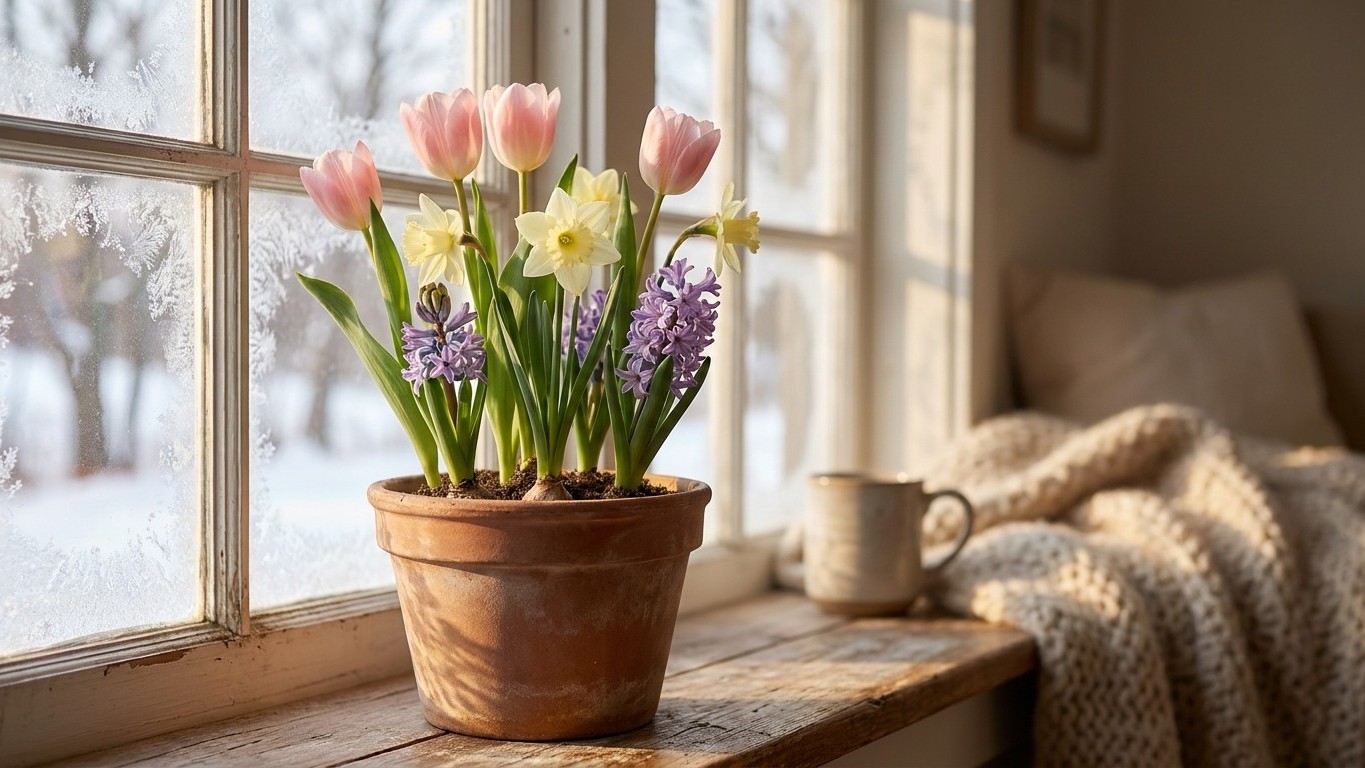

Vermont winters supply more cold than any spring bulb needs to bloom, so forcing indoors here isn’t about making up for a mild winter. It’s about timing and about protecting potted bulbs from a freeze that goes all the way through the pot, root ball and all, long before the ground itself has finished thawing.
Why this matters in Vermont

The average daily minimum in the coldest month, measured at the Burlington reference station, sits at 12.9°F. That’s the number that decides whether a bulb survives winter here, not the record low and not some seasonal average that sounds worse than it is. A figure like that tells you plainly: Vermont ground does not run short on cold. Tulips, daffodils, crocus and hyacinths planted in a garden bed get their twelve to fourteen weeks below 45°F with room to spare, usually before Thanksgiving.
That changes the reason to force bulbs indoors here. In a warm-winter state, forcing exists because the ground never gets cold enough on its own, so the gardener has to fake it in a refrigerator. Vermont doesn’t have that problem. What Vermont has is two separate situations that get mixed up constantly, and only one of them is a real cold shortage.
The first situation is wanting flowers indoors in January or February, weeks before anything outdoors would think about budding. That’s a timing choice, not a rescue. The second, and the one that actually trips people up in this state, is containers left outdoors over winter. A pot sitting on a porch or deck freezes solid, roots and soil together, in a way an in-ground bed never does because the earth insulates itself from below. The USDA Plant Hardiness Zone Map puts this territory at 3b to 5b, a range wide enough that a bulb rated hardy for Burlington’s zone can still die in a container set outside in the same yard, because the pot offers none of the ground’s protection.
So the practical answer for Vermont splits in two. If the goal is indoor bloom in deep winter, forcing means giving a potted bulb its cold period somewhere controlled, then bringing it inside on your schedule. If the goal is simply keeping a potted bulb alive through a normal Vermont winter outdoors, the fix isn’t forcing at all. It’s treating that pot as if it needed to survive a colder zone than the ground around it does, because in every practical sense it does.
How to do it here
Forcing a bulb indoors is a sequence, and skipping a step usually shows up as no flower at all rather than a smaller one. Here’s the order that works with what Vermont’s winter actually offers.
- Pick bulbs suited to forcing in early fall, while they’re still firm and dormant. Soft or sprouting bulbs won’t recover once potted.
- Pot them shallow, in a well-draining mix, with the shoulders of the bulb close to the soil surface and pots spaced tight, almost touching, since forced bulbs don’t need room to spread roots outward the way garden-planted ones do.
- Water once, thoroughly, then let the pot drain fully before moving it. A bulb sitting in standing water during its cold period is the single most common way to lose the whole pot to rot.
- Give the pot its cold period, roughly twelve to fourteen weeks, somewhere that stays above freezing but well below 45°F. An unheated garage that doesn’t drop below freezing on its own works for most of the season here; a spare refrigerator or a dedicated crisper drawer works too, but never a drawer holding ripening fruit, since the ethylene gas fruit gives off will kill the flower bud forming inside the bulb before you ever see it.
- Check for roots after about ten weeks by tipping the pot gently. White roots showing through the drainage holes, or a firm resistance when you tug the shoot, mean the cold period has done its job.
- Move the pot to a cool, dim spot indoors for a few days once shoots reach a couple of inches, then into bright light. Skipping this transition and going straight from cold garage to a sunny windowsill is what produces a stunted, floppy stem.
For bulbs left in containers outdoors rather than forced on purpose, the rule is different: the pot needs to behave like it’s sitting in a zone at least two steps colder than what’s printed on the tag, because a container offers none of the ground’s buffering. Either sink the whole pot into a garden bed for winter, mulch it heavily above the rim, or move it into an unheated but insulated space like a garage or shed. There’s no shortcut that lets an exposed pot survive a Vermont winter on the strength of the bulb’s own hardiness rating alone.
Which bulbs are worth it
Some bulbs force easily because their cold requirement is short and their stems stay low enough to hold themselves up in a light pot. Others fight the process the whole way, either because they demand a longer chill than most people are willing to manage indoors or because a forced stem grows tall and thin without the wind and sun that would normally stiffen it outdoors. There’s also a category that costs nothing to force badly, since the bulb was a single-season purchase either way.
Bulbs that force reliably
- Paperwhite narcissus, which need no cold period at all and bloom a few weeks after potting
- Hyacinths, sold pre-chilled by many suppliers specifically for indoor forcing
- Crocus, short-stemmed and rarely toppling in a pot
- Dwarf daffodils and dwarf tulip varieties, bred short on purpose
- Muscari (grape hyacinth), compact and forgiving of an imperfect cold period
Bulbs that sulk
- Standard tall tulips, which grow leggy indoors and topple without outdoor wind to build stem strength
- Fritillaria, which wants a long, steady chill that’s hard to replicate in a garage that fluctuates with the weather
- Large trumpet daffodils, tall enough to lean in low indoor light
- Alliums, which need a longer cold period than most gardeners are willing to give an indoor pot
Where paperwhites and hyacinths are concerned, there’s nothing to lose by forcing them badly. Neither one is expected to survive Vermont’s ground afterward, so a mediocre bloom this winter still gets more use out of the bulb than it would have gotten sitting in a bag in the basement.
What goes wrong, and when you can still fix it
Leaves come up but no flower forms
This means the cold period ran short, either too few weeks or a garage that never dropped consistently below 45°F. The flower bud inside the bulb simply never finished developing. There’s no rescue for the bulb this season; the leaves you’re seeing are the plant trying anyway. Note how long the cold period actually ran and add two or three weeks next fall.
The flower opens on a stem too short to see over the pot rim
This usually means the pot was pulled into warmth and bright light too fast after the cold period ended, before the stem had a chance to elongate in the cooler transition stage. The bloom itself is fine, just low. Nothing brings the stem back up once it’s set; the fix is giving the next batch a few extra days in dim, cool light before moving it to a sunny window.
The bulb rots in the pot
Soft, mushy bulbs or a sour smell in the soil almost always trace back to drainage, either a pot with no hole or a mix that held water during the cold period. This one can’t be saved this season, the bulb is gone. It can be prevented next time with a mix that drains fast and a single thorough watering rather than repeated light ones during the weeks in cold storage.