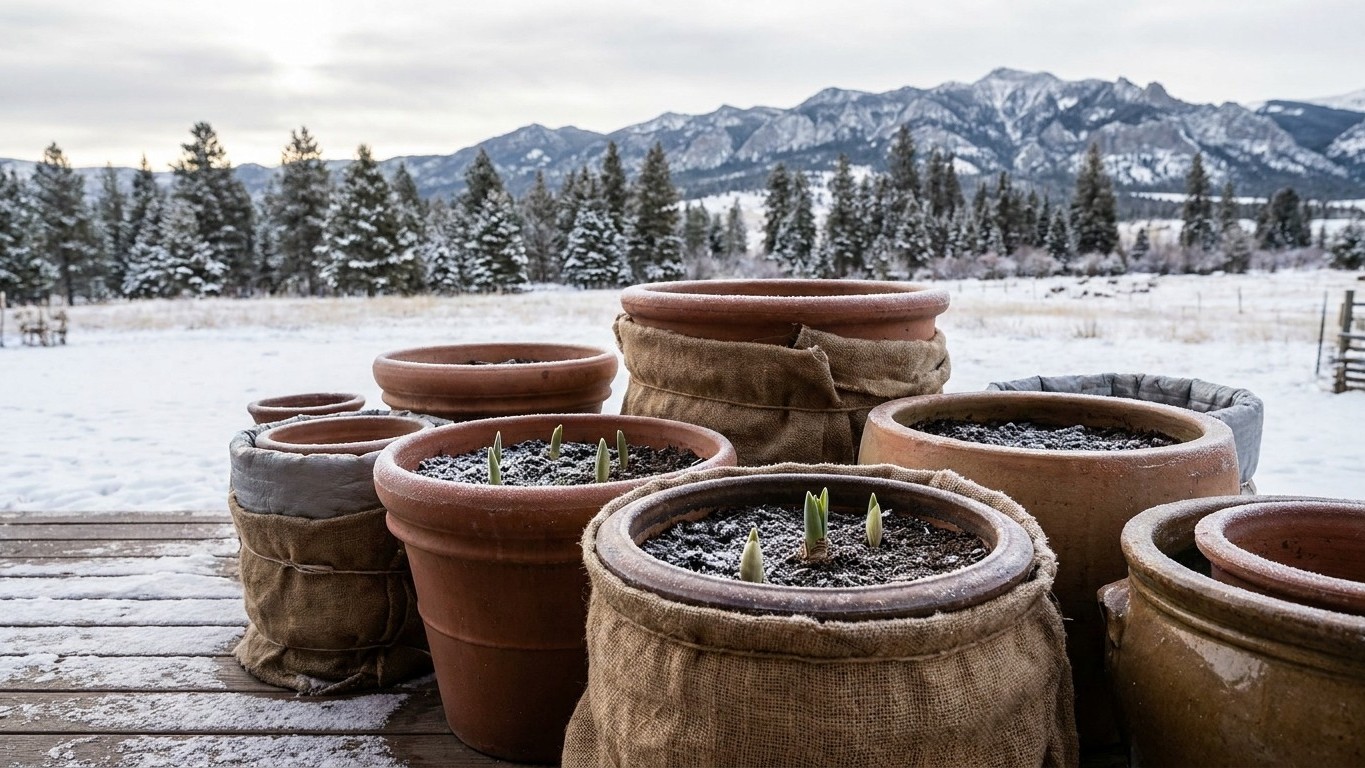

Spring bulbs grow well in containers across Wyoming, but the pot itself becomes the hazard, not the calendar. Garden soil insulates roots from the worst of winter; a container does not. With Cheyenne’s coldest month averaging a daily minimum of 18.1°F, and hardiness zones across the state ranging from 3a to 6a, a potted bulb needs protection that same bulb would never require if it were planted straight into a garden bed.
Why this matters in Wyoming

Cheyenne’s coldest month, typically January, averages a daily minimum of 18.1°F, according to NOAA NCEI Climate Normals for 1991-2020. That figure matters because it decides which of two very different problems a Wyoming gardener actually faces with spring bulbs.
The first problem is a missing winter. In places where the cold season is too short or too mild to give a bulb its required 12 to 14 weeks below 45°F, gardeners substitute an artificial cold spell, a refrigerator drawer or an unheated garage, to trick the bulb into blooming on schedule. That’s forcing, and it exists because the climate falls short.
Wyoming’s winter falls short of nothing. An 18.1°F mean minimum for the coldest month, combined with a statewide hardiness range of 3a to 6a, means the ground delivers far more cold, for far longer, than any spring bulb needs to break dormancy properly. Forcing has no real job to do here for bulbs planted in the ground. That’s the situation this territory is not in.
The second problem is the one that actually applies: a container has none of the thermal mass that garden soil has. Ground several feet deep holds residual summer warmth and rarely lets the frost line reach true root depth, even during a hard cold spell. A pot sitting on a patio, porch, or deck has no such buffer underneath it or around its sides. Its entire soil volume tracks the surrounding air temperature within hours, not weeks. That means a bulb rated hardy for a zone 5 garden bed in Cheyenne can still die in a container exposed to that same zone’s winter, because the pot delivers the full 18.1°F minimum directly to the bulb’s roots with nothing standing in the way.
That gap between a garden bed rating and a container’s real exposure is the whole reason container bulb-growing in Wyoming needs its own rules rather than borrowing the ones written for in-ground planting. The hardiness zone printed on a bulb bag assumes soil that insulates. A pot doesn’t insulate. Everything that follows in this guide exists to close that gap.
How to do it here
Growing spring bulbs in containers here means working around the freeze-through problem directly, step by step, rather than trusting the zone label on the package.
- Pick bulbs rated at least two USDA zones hardier than your local zone. If you garden in or near Cheyenne, that means shopping as if you were planting in a colder zone than the one printed on the state map, since the pot will expose roots to more cold than the ground ever would.
- Use a container with real drainage holes. Bulbs that sit in wet, unfrozen soil in fall rot before winter cold even becomes an issue.
- Plant at the depth recommended for the bulb type, water thoroughly, and let the pot sit outside through early fall while daytime temperatures are still mild.
- Once nighttime temperatures start dropping toward freezing on a consistent basis, move the container into an unheated garage or shed that stays above freezing but still well below 45°F. This keeps the chilling clock running (the bulb still needs its 12 to 14 weeks of cold) while sparing the roots from a freeze that would otherwise pass straight through the pot.
- If a garage or shed isn’t available, sink the whole pot into an empty garden bed up to its rim, or pile 12 to 18 inches of mulch or straw completely over and around it. Either method borrows the ground’s insulation for a container that has none of its own.
- Check the soil every few weeks over winter. It should stay barely moist, not soaked and not bone dry. Roots that dry out completely during the chilling period won’t recover once spring arrives.
- Once overnight temperatures reliably stay above freezing in spring, bring the container back out to its display spot and resume normal watering.
Skip the refrigerator entirely for this territory. That trick exists for gardeners whose winters can’t supply enough cold on their own. Wyoming’s problem is protecting roots from too much cold, not manufacturing more of it.
Which bulbs are worth it
Some spring bulbs take to container life in a cold state without complaint. Others fight the format from the start, usually because of height, root depth, or how long they need to sit in the cold before they’ll bloom.
- Crocus, short-stemmed and satisfied with a shorter chill period, rarely struggles in a pot
- Snowdrops (Galanthus), small and low to the soil, stay stable in wind and don’t need deep root runs
- Species tulips such as Tulipa tarda or Tulipa clusiana, short and wiry rather than tall and top-heavy
- Grape hyacinth (Muscari), compact and reliable in a shallow pot
- Miniature or dwarf daffodils, proportioned to a container’s size in a way full-size trumpet varieties aren’t
- Darwin hybrid and other tall tulips topple in wind once the flower opens, since a lightweight pot can’t anchor a heavy bloom the way garden soil does
- Fritillaria imperialis, very tall and top-heavy, also resents the root disturbance that container life involves
- Large trumpet daffodils in anything but a heavy, wide pot tend to lean or tip once fully open
- Tall alliums with large globe flower heads catch wind the same way tall tulips do
Tulips deserve a separate note. Even in-ground, many tulip varieties rarely rebloom well after their first spring, so treating a container of tulips as a one-season display costs nothing extra. The bulb was unlikely to perform again regardless of how it spent the winter.
What goes wrong, and when you can still fix it
Leaves but no flowers
This means the chilling period was cut short, either because the pot came out of the cold too soon or because it never reached a full 12 to 14 weeks below 45°F. There’s no fix this season; the bulb has already committed its energy to leaves instead of a flower bud. Next fall, track the weeks more carefully and leave the container in its cold spot longer before bringing it back out.
Flower stem too short to see the bloom
A stunted stem with the flower buried in foliage usually means the pot was warmed too quickly after its chilling period, before the stem had time to elongate normally. This one can’t be corrected once it’s happened. For next year, move the container into gradually warmer conditions over a week or two rather than shifting it straight from cold storage into full spring sun.
Bulbs rotting in the pot
Soft, mushy bulbs almost always trace back to drainage. Water sat in the container instead of moving through it, and the bulb suffocated or rotted before it ever got the chance to use its cold period. Rotted bulbs are done for the season. Before replanting, check that the pot has functioning drainage holes and that the potting mix drains freely rather than staying saturated for days after watering.