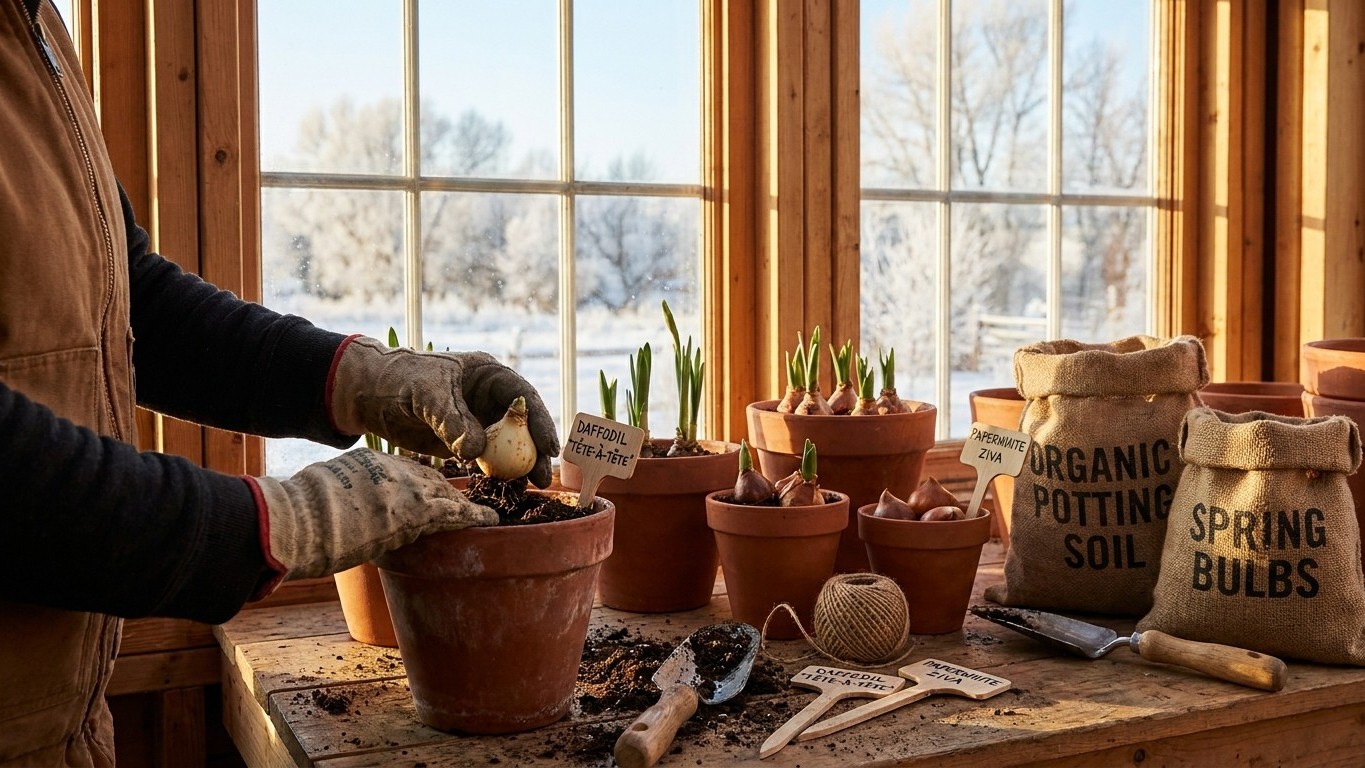

Forcing bulbs indoors in Wyoming isn’t about making up for a winter that’s too mild to chill them. Wyoming’s winters do that job themselves, and then some. What forcing solves here is timing bloom for the long indoor season, and keeping container bulbs alive through a freeze that goes all the way through a pot.
Why this matters in Wyoming

Start with the number that changes everything: in Cheyenne, the average nightly low during the coldest month sits at 18.1°F, according to NOAA NCEI Climate Normals for 1991-2020. A spring bulb needs roughly twelve to fourteen weeks below 45°F to break dormancy and set up a flower. Do the math and Wyoming’s winter delivers that requirement several times over before January is done.
That fact rules out the usual reason gardeners force bulbs indoors in warmer states. In places where winter never gets reliably cold enough, forcing means putting bulbs in a refrigerator or unheated space because the outdoors won’t do the work. In Wyoming, the ground bulbs get plenty of chill without any help at all. The state isn’t short on cold. It’s got more than most spring bulbs know what to do with.
What Wyoming does have is a container problem. Ground insulates roots even when the surface crusts over, so a bulb planted a few inches deep can ride out a hard winter even when the air above it drops well below freezing. A pot has no such buffer. Soil in a container freezes through, roots and all, at temperatures the same bulb would shrug off in a garden bed. That’s the situation this territory falls into: not a shortage of cold, but a container threshold that’s harsher than the ground threshold for the exact same plant.
The USDA Plant Hardiness Zone Map (2023 revision, based on 1991-2020 normals) puts Wyoming across a wide band, from zone 3a to zone 6a. That’s a state-wide range, not one number, and it matters which end a reader is standing in. Cheyenne, on the milder side of that range, is the reference city here. Higher elevations and the northwest corner of the state run colder than Cheyenne, so a container rule that works in Cheyenne needs padding elsewhere.
Put those two facts together and the practical answer is this: outdoor beds in Wyoming don’t need forcing to supply missing cold, but potted bulbs left outside unprotected are at real risk, and forcing indoors becomes a tool for controlling both timing and survival rather than compensating for a weak winter.
How to do it here
The sequence below assumes a Wyoming setting, which means treating the state’s cold as an asset to manage rather than a gap to fill.
- Buy firm, disease-free bulbs as the cool season starts. Soft spots or mold on the bulb surface won’t improve in storage.
- Pot them up in shallow containers with drainage holes, using standard potting mix, noses just above the soil line, bulbs set close together for a fuller display later.
- Water once after potting, then move the containers to wherever the cold will happen. Don’t leave them exposed outdoors unprotected; an outdoor pot in a state where the coldest month averages 18.1°F overnight will freeze solid long before the chilling requirement is met, and freezing solid can kill the bulb outright.
- Use an unheated garage that stays above freezing, if one is available. Many attached garages hold in the high 30s to low 40s through the coldest stretch of winter even when the outside air is far colder. Check with a thermometer rather than guessing.
- Or use a refrigerator crisper drawer, kept well away from ripening fruit. Apples and pears give off ethylene gas as they ripen, and that gas kills the flower bud inside a bulb before it ever has a chance to show.
- Chill for the number of weeks the specific bulb requires (see the next section for which bulbs need how much), checking the soil monthly and adding a little water so it doesn’t dry out completely.
- Watch for roots at the drainage holes and a pale shoot an inch or two tall. That’s the sign the cold requirement has been satisfied.
- Move the pot to a cool room, 60 to 65°F, out of direct sun for about a week before shifting it somewhere warmer and brighter to finish and bloom.
- If a container is going to spend its cold weeks outdoors instead of a garage or fridge, the pot itself needs to be rated at least two hardiness zones colder than the bulb, or be sunk into a garden bed and mulched heavily, or moved into an unheated structure. A bare pot on a porch anywhere near Cheyenne’s winter numbers will freeze through well before the ground beneath it does.
Which bulbs are worth it
Not every bulb rewards the extra steps. Some finish their cold requirement quickly and stay compact enough for an indoor pot; others drag out the wait or grow tall and unstable once forced into early bloom.
A shorter cold requirement means a shorter wait before the payoff, which matters when the whole point is controlling timing. A tall, thin stem forced ahead of its natural schedule is also more likely to flop over in a pot than it would outdoors, where wind and its own root system give it something to lean on. And for bulbs that were only ever going to be planted once anyway, forcing costs nothing in the long run, since there was no return bloom being sacrificed.
- Crocus: compact growth, short stems, forces reliably.
- Hyacinth: sturdy stems that hold up well after forcing.
- Paperwhite narcissus: needs no chilling period at all, making it the fastest route to bloom.
- Grape hyacinth (Muscari): small and stable, rarely topples.
- Dwarf tulip varieties: short stems handle forcing better than tall types.
- Tall trumpet daffodils: stems often topple once forced ahead of schedule.
- Darwin hybrid and other tall tulips: top-heavy blooms on long stems, prone to leaning or snapping.
- Fritillaria: uneven results, finicky about chilling duration.
What goes wrong, and when you can still fix it
Leaves but no flower
Green growth with nothing but leaves usually means the cold period was cut short. The bulb had enough chill to wake up but not enough to finish forming a flower bud. This isn’t fixable this season. The flower simply never developed. A hardy bulb can go into an outdoor bed once the ground is workable and try again next year; a paperwhite, which was never coming back anyway, is done.
A flower on a stem too short to see
A bloom that opens low and stubby, barely clearing the pot’s rim, points to warming the bulb too fast after chilling instead of letting it green up gradually in a cool room first. Once the stem has already finished elongating at that short length, there’s no way to stretch it out. The bulb has already spent what it had. The fix applies to the next round, not this one.
Rot in the pot
A soft, mushy bulb with a sour smell means the soil never drained. Waterlogged roots suffocate and the tissue breaks down from the inside. There’s no saving a bulb once it’s gone soft like this. Drainage holes and lighter, less frequent watering during the chilling period are what prevent it the next time around.
Related guides
- Growing Spring Bulbs in Containers in Wyoming
- Forcing Spring Bulbs Indoors in Yukon