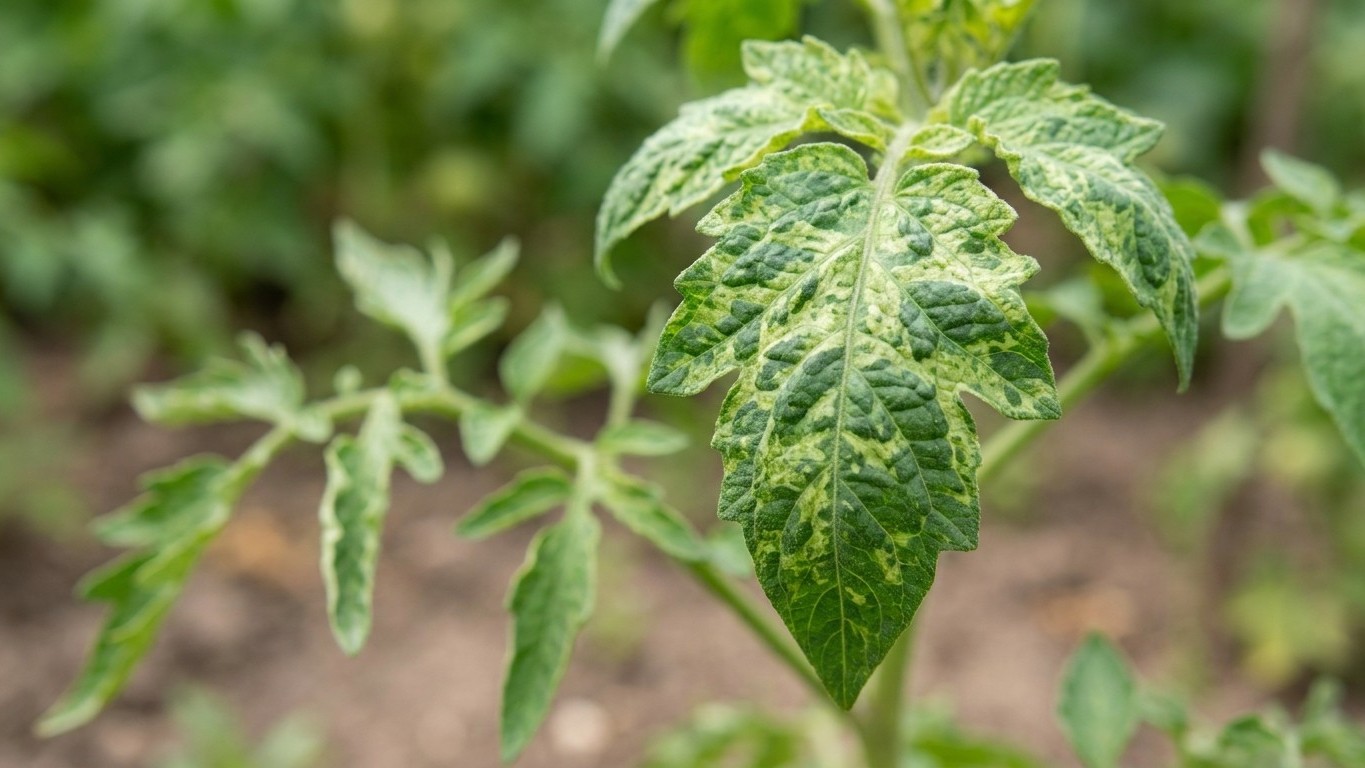

Mottled leaves in patches of light and dark green, some puckering, some narrowing into strap-like shapes: that combination points to Tomato Mosaic Virus. It rarely kills a plant outright, but it caps yield and quality for the whole season. No spray reverses it. The only real response is recognizing it early and containing the spread.
What you are looking at

Tomato Mosaic Virus (ToMV) shows up first on the newest growth at the top of the plant, not on the older lower leaves. It moves fast in the sense that once a leaf shows symptoms, that tissue stays affected for good, but the plant itself can limp along for months. It’s a chronic condition, not a sudden collapse. Fruit yield and size drop, but the plant usually survives to the end of the season.
Mottled mosaic pattern on young leaves
The signature symptom is a blotchy mix of light green, yellow-green, and normal dark green patches across a single leaflet, giving it a mottled or marbled look rather than a uniform color. The lighter patches often follow the leaf veins loosely, without forming sharp rings or defined spots.
Leaf distortion and fern-leaf narrowing
On badly affected plants, new leaflets grow narrow and pointed, sometimes reduced to little more than a thin midrib with almost no leaf blade on either side. Gardeners call this “fern-leaf” or “shoestring” growth. The whole leaflet looks stretched and thin instead of broad and flat.
Stunted growth and internode shortening
Infected plants often stay shorter than healthy neighbors, with the space between leaves (the internodes) compressed. Growth looks bunched and stiff rather than open and vigorous.
Fruit symptoms: internal browning and blotchy ripening
Tomatoes from infected plants can develop uneven ripening, with yellow or brown blotchy patches on the surface, and internal browning of the flesh near the core when cut open. Fruit set is often reduced overall, and any fruit that does form tends to run smaller than normal.
What it is not
Three other problems get mistaken for Tomato Mosaic Virus constantly, and mixing them up leads gardeners either to give up on a plant that could still produce, or to keep nursing one that’s a lost cause and a source of contamination for everything else in the row.
Cucumber Mosaic Virus
Cucumber Mosaic Virus (CMV) produces a similar patchy leaf color, but it usually pushes leaf narrowing much further, sometimes down to thread-thin leaflets across the whole plant rather than just the newest growth. Vein clearing (veins turning pale and translucent before the rest of the leaf mottles) is also more common with CMV. The distinction matters mostly for source control: CMV arrives on aphids and often from nearby weeds, while ToMV spreads by contact and contaminated seed. The management response differs even though neither has a cure.
Herbicide drift
Drift from a broadleaf herbicide applied nearby causes leaf twisting and narrowing that can look like virus damage at a glance. The giveaway is uniformity: herbicide injury tends to affect every plant in a row the same way, on the same side facing the source, and it shows up on leaves that were already expanding at the time of exposure, not exclusively on new growth. There’s also usually no mottled color pattern, just distortion and sometimes a yellow or bleached cast. Treating drift injury as a virus means pulling and destroying a plant that would have grown out of the damage on its own once new, unaffected leaves emerge.
Nutrient deficiency (magnesium or manganese)
A magnesium or manganese shortage causes interveinal yellowing, meaning the tissue between the veins turns pale while the veins themselves stay green, usually on the older, lower leaves first. There’s no leaf distortion, no fern-leaf narrowing, and no internal fruit browning. A soil test or a foliar feed resolves a nutrient problem within a couple of weeks; a virus does not respond to feeding at all. Confusing the two means either wasting money on fertilizer that won’t help, or missing a genuine and correctable nutrient issue while blaming a virus that isn’t there.
Where it comes from and when it strikes
Tomato Mosaic Virus belongs to the tobamovirus group, closely related to Tobacco Mosaic Virus, and it’s one of the most physically durable plant viruses known. It doesn’t need an insect to travel. It spreads through direct contact: hands, pruning shears, stakes, clothing, and even tobacco products carried by a gardener who smokes or chews, since the related tobacco virus can cross over. Seed can carry the virus on its coat, meaning an infected mother plant can pass it to the next generation before a single true leaf appears.
Once the virus is in a leaf, soil, or piece of plant debris, it stays infectious for a long time, surviving dried plant material and contaminated soil across seasons far longer than most other plant pathogens manage. That durability, not any dramatic weather event, is what keeps it circulating in a garden year after year.
Warm growing conditions favor visible symptom development and faster plant-to-plant spread through routine handling: tying up vines, removing suckers, harvesting. Cool weather can suppress symptoms without eliminating the virus, so a plant can look fine for a stretch and then show mottling again once conditions warm. There’s no single humidity or rainfall trigger the way there is for many fungal diseases; contact and mechanical transmission drive this one, not leaf wetness.
What to do about it now
There’s no cure. No fungicide, no bactericide, no home remedy changes a virus once it’s inside plant tissue, and any product marketed to reverse mosaic symptoms is not doing what it claims. The only useful moves are containment and damage limitation.
Remove and destroy any plant with a confirmed mottled, fern-leaf pattern, especially early in the season before it has a chance to spread to healthy neighbors through routine handling. Bag the plant and put it in household trash rather than the compost pile, since composting doesn’t reliably kill this virus. If only a portion of a large planting is affected and pulling everything isn’t practical, at minimum stop handling infected and healthy plants in the same session, and work the unaffected rows first.
Wash hands and tools with soap and water between plants, and between infected and healthy sections of the garden. A dip in a dilute bleach solution or a wash with trisodium phosphate (TSP) between cuts is a standard sanitation step used to break the chain of mechanical transmission on pruning shears and stakes. Anyone who uses tobacco products should wash hands thoroughly before touching plants, since the related tobacco virus survives on hands and can cross-infect tomatoes.
Fruit from an infected plant is safe to eat. The virus affects plant tissue and appearance, not food safety; internally browned or blotchy fruit can simply be trimmed and used, or discarded for quality reasons if the flesh looks unappetizing. There’s no health risk to people from handling or eating tomatoes off a mosaic-affected plant.
Keeping it out next season
Because the virus survives so long in dried debris and contaminated soil, standard crop rotation offers only partial protection here compared to soil-borne fungal problems. Clearing out all plant debris at the end of the season, rather than tilling it under, does more to break the cycle than waiting out a rotation schedule alone.
Seed packets and catalogue descriptions mark resistance to Tobacco/Tomato Mosaic Virus with the letter “T” in a disease-resistance code string, often seen alongside other letters as “VFNT” (Verticillium, Fusarium, Nematode, Tobacco Mosaic Virus). Varieties carrying the Tm-2 or Tm-2a resistance genes are widely available in commercial seed lines and are worth seeking out if mosaic has shown up in a garden before. Buying certified disease-free seed, or starting from a reputable supplier rather than saving seed from a garden with a history of mosaic, closes off the seed-borne route entirely.
Sanitize stakes, cages, and ties between seasons rather than reusing them straight from storage; a wipe-down with a bleach solution or TSP is enough. Mulch around the base of plants creates a physical barrier that reduces soil splash reaching lower leaves, which helps with several tomato diseases even though it’s not the primary transmission route for this one. Give plants enough spacing to avoid brushing against each other constantly, since dense, tangled foliage means more incidental contact and more chances for the virus to move from a symptomatic plant to a healthy one during normal garden work like tying and pruning.
Common questions
Can Tomato Mosaic Virus spread to other vegetables in the garden?
Yes, within reason. Peppers and some other solanaceous crops can host related tobamoviruses, and contaminated hands or tools moving between tomato and pepper plants can carry infection across. Cucumbers, squash, and unrelated crops are not typically susceptible to this specific virus.
Will a plant with mosaic symptoms ever produce a normal harvest?
Some fruit, yes, though usually reduced in size and number, and sometimes with internal browning or blotchy ripening. The plant doesn’t die from this virus in most cases; it just underperforms for the rest of the season.
Is it worth testing a plant to confirm Tomato Mosaic Virus versus Tobacco Mosaic Virus?
For a home garden, usually not necessary, since the management response (rogue the plant, sanitize tools, avoid tobacco contact) is the same for both. Commercial growers sometimes send samples for lab confirmation when disease pressure is high across many acres.
Does removing just the affected leaves save the plant?
No. The virus is systemic, meaning it’s already distributed through the plant’s vascular tissue by the time leaves show symptoms, not confined to the leaves you can see. Pruning off mottled foliage doesn’t remove the infection, though it can slightly slow visible spread on that individual plant.
Related guides
- Tomato Spotted Wilt: Bronze Rings, and the Thrips That Bring Them
- Southern Blight: The White Fan at the Base of the Stem
- 148 Tomato Varieties for the Home Garden, With Days to…
- 148 Tomato Varieties for the Home Garden, With Days to…
- Tomato Hornworm
- Septoria Leaf Spot: The One People Mistake for Blight