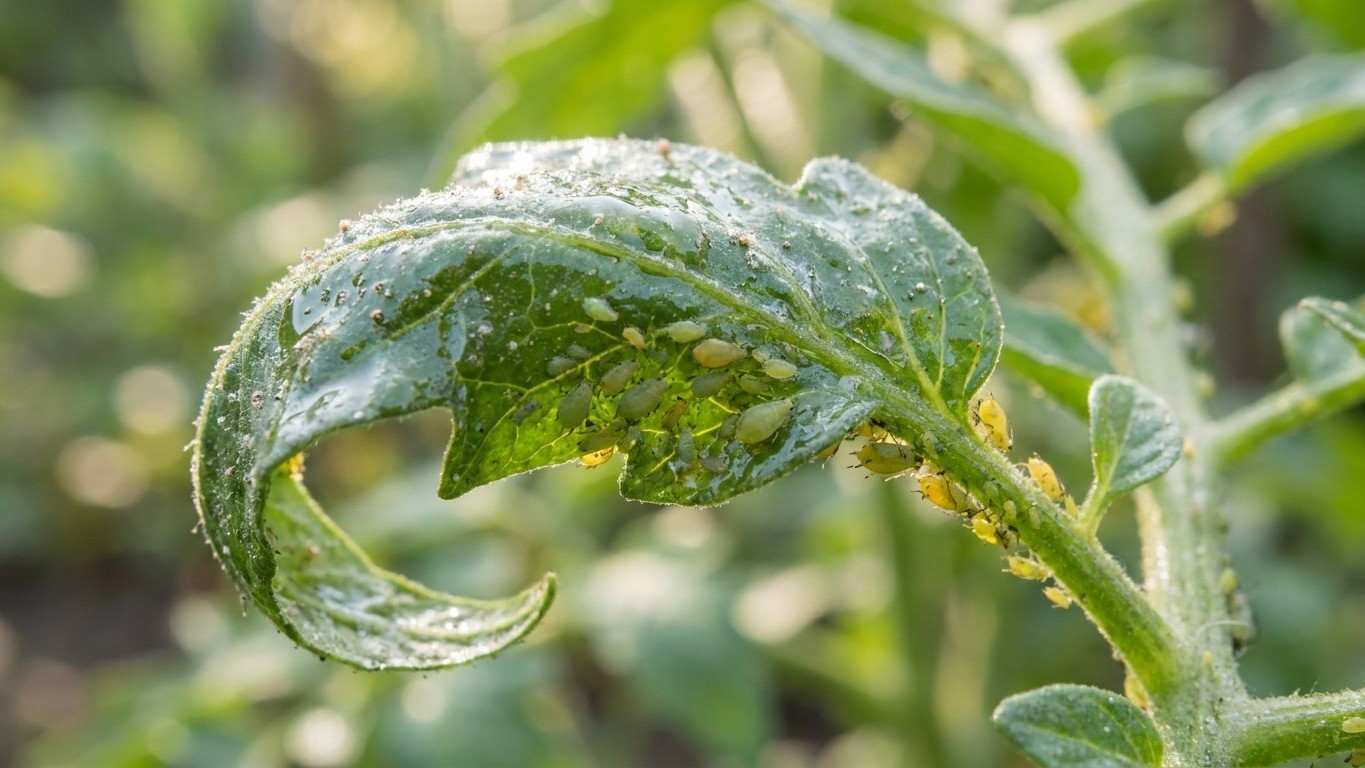

Sticky, shiny leaves on a tomato plant, especially near the growing tips, are almost always the first sign of an aphid colony, not the aphids themselves. The insects are often small enough to miss until the leaf surface below them turns tacky and starts collecting dust. On an established plant this is mostly cosmetic. On a seedling or a fresh transplant, it can stunt growth fast enough to matter.
What the damage looks like

The detail that separates aphids from almost everything else on a tomato plant is the residue, not the insect. Aphids feed by tapping into the sap-carrying tissue of the plant and excreting the sugary excess as honeydew. That honeydew drips onto the leaves below the feeding site, coating them in a thin, glossy film that feels tacky between your fingers. Leave it long enough in warm, humid weather and a black, powdery fungus called sooty mold grows on top of it, turning the sticky sheen into a dull soot-like coating. None of that is the plant rotting. It’s a fungus living on sugar water, and it wipes off with a damp cloth once the aphids are gone.
Look at the actual feeding site and you’ll find clusters of small, soft-bodied insects, usually green but sometimes yellow, pink, or nearly black depending on the species, packed tightly on the undersides of young leaves and along the tender stem just behind the growing tip. They don’t move much when disturbed. A hand lens shows a pear-shaped body with a pair of short tailpipe-like structures near the rear end, called cornicles, that no other common tomato pest has.
The plant’s response shows up a few inches away from the colony. New leaves curl downward or pucker, growth at the tip slows or stalls, and older leaves nearby can yellow and drop. On a mature, fruiting plant this rarely goes further than cosmetic stress, the lower stems and set fruit are usually untouched because aphids favor the tender new growth. On a seedling with only a few true leaves, the same feeding pressure hits the entire growing point at once, and that’s the case where the damage is worth acting on right away rather than watching.
Ants moving in steady lines up and down the stem are a strong secondary clue. They farm aphids for the honeydew and will actively defend the colony from predators, which is a detail worth remembering later when it comes to control.
Making sure it is this and not something else
The honeydew and the visible cluster of soft insects together are close to diagnostic, but a few other pests on tomato plants can produce something similar enough to warrant a second look.
Whiteflies
Whiteflies also cluster on leaf undersides and also leave honeydew, sometimes with the same sooty mold following behind. The test is simple: brush the leaf. Whiteflies erupt into a small cloud of tiny white moth-like insects that scatter and resettle within a minute. Aphids stay put.
Spider mites
Spider mite damage shows up as a fine, dry stippling on the leaf surface and, in heavy infestations, delicate webbing between leaves and stems. There’s no honeydew and no sticky residue, because mites don’t excrete sugar the way aphids do. A sheet of white paper tapped under a leaf will show mites as moving specks, not soft clustered bugs.
Scale insects
Scale can produce honeydew too, but the insects themselves look like small, immobile bumps fused to the stem or leaf midrib rather than a loose, mobile cluster. Try to move one with a fingernail. Scale doesn’t budge easily; aphids do, and they’re soft enough to smear.
Thrips
Thrips cause silvery, streaky scarring on leaves and flowers but produce no honeydew at all. If the leaf is dry and streaked rather than sticky, aphids aren’t the cause.
When in doubt, the honeydew is the fastest sorting tool: sticky and glossy points toward aphids or whiteflies, dry and stippled or streaked points elsewhere.
When it shows up
Aphids track new growth, not a date on the calendar. They show up heaviest whenever the plant is pushing soft, tender tissue: right after transplanting, during a flush of new leaves following a heavy feeding, or anytime nitrogen fertilizer has been applied generously and the plant responds with fast, lush, sappy growth. That soft tissue is easier for aphids to pierce and richer in the nutrients they’re after, so it draws them in disproportionately compared with older, tougher leaves.
Warm, humid stretches with little wind speed up reproduction sharply, since female aphids can produce live young without mating and populations build fast once conditions are favorable. A dry spell followed by rain, or a run of overcast humid days, is often when a colony that was a handful of insects becomes a visible cluster within a week.
Plant stage matters more than anything else for how seriously to take an infestation. On a seedling with just a few sets of true leaves, aphids concentrated at the single growing tip can stunt the whole plant, because there’s no reserve of mature foliage to compensate. On an established, fruiting plant with a full canopy, the same colony on one shoot tip is a small fraction of the plant’s total leaf area and rarely affects yield unless it’s allowed to spread unchecked across multiple stems. That distinction should drive how urgently you respond.
What to do now
- Blast them off with water. A firm spray from a garden hose aimed at the undersides of infested leaves physically knocks aphids off the plant. Most can’t climb back up, and this alone controls light infestations on established plants with no cost and no chemicals involved.
- Encourage the predators already nearby. Ladybugs, lacewing larvae, and parasitic wasps feed heavily on aphids and can bring a colony down within days once they find it. Avoid any broad-spectrum insecticide at this stage, since it kills those predators along with the aphids and often makes the problem worse over the following weeks by removing natural control.
- Prune out the worst of it. If one shoot tip is heavily curled and coated, cutting it off and disposing of it removes a large share of the colony in one step, especially useful on a plant where the infestation is localized to a single stem.
- Deal with the ants. If ants are farming the colony, they’ll fight off ladybugs and lacewings to protect their food source. A band of sticky barrier product around the base of the stem stops ants from reaching the aphids and lets predators do their work unbothered.
- Insecticidal soap or horticultural oil. Both are available at any garden center, work by smothering the soft-bodied insects on contact, and break down quickly with minimal residual effect on beneficials once dry. Spray thoroughly on leaf undersides, since these products only work on direct contact.
- Neem oil is a step up in persistence and also disrupts feeding and reproduction, useful for a colony that keeps rebounding after soap or oil treatments.
- Pyrethrin-based products labeled for vegetable gardens are the last resort for a heavy infestation on a young or stressed plant that isn’t responding to anything above. Read the label fully. Several formulations are restricted or require specific application timing in individual states, and pyrethrins are also toxic to bees and beneficial insects, so they should never be sprayed on open flowers.
Stopping it coming back
- Go easy on nitrogen fertilizer once the plant is established. Fast, soft growth is exactly what draws aphids in, and a plant growing at a moderate, steady pace is naturally less attractive to them.
- Plant flowering companions like alyssum, dill, or yarrow near the tomato bed. They draw in ladybugs and parasitic wasps before aphids ever build a visible colony, so predators are already on site when a new infestation starts.
- Cover young seedlings and fresh transplants with floating row cover until they’ve built up several sets of true leaves and tougher stems, since that early stage is when a small colony can do the most damage.
- Check new transplants and any nursery starts closely before planting them out. Aphids hitch rides on purchased seedlings more often than gardeners expect, and a single infested transplant can seed the whole bed.
- Keep ant populations near the garden in check, since they actively protect aphid colonies from predators in exchange for the honeydew.
- Clear weeds and volunteer plants near the tomato bed at season’s end, since several common weeds host aphids over winter and give the colony a head start the following season.
Common questions
Do aphids kill tomato plants? Rarely on an established plant. They stress new growth and can reduce vigor if left unchecked for weeks, but a mature tomato plant with a full canopy usually outgrows a moderate infestation. Seedlings are the exception, where a heavy colony on the single growing tip can stall the whole plant.
Does honeydew hurt the fruit? Not directly. Honeydew and the sooty mold that follows it are cosmetic issues on leaves and stems. Fruit set and ripening aren’t affected unless the infestation is severe enough to weaken the whole plant before flowering.
Can I eat tomatoes from a plant that had aphids? Yes, once the fruit is washed. Aphids feed on leaves and stems, not the fruit itself, and any honeydew residue rinses off easily.
Will ladybugs I buy actually stay and eat the aphids? Store-bought ladybugs often fly off within a day or two if the garden doesn’t already have enough food and shelter to hold them. Planting flowering companions that support them long-term works better than a one-time release for lasting control.