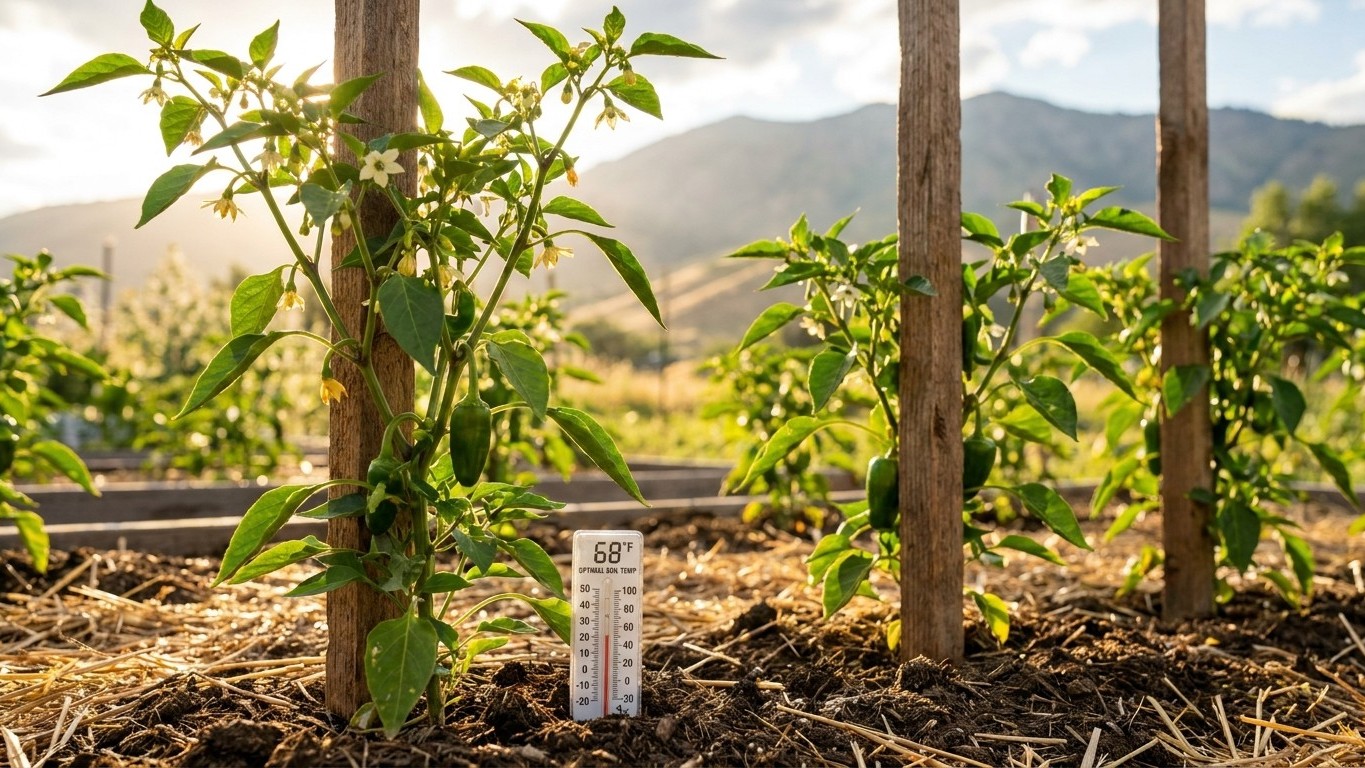

Wisconsin gardeners don’t need an exotic pepper to get a harvest. What decides success is timing: starting seed early enough indoors, transplanting once soil and air cooperate, and watching the two temperature extremes that stop fruit set no matter what variety sits in the ground. Get those three right and most garden pepper types will ripen before the season closes.
The short answer

Start with the heat side of the equation, because it’s the one this site can measure precisely. At the Milwaukee reference station, NOAA’s 1991-2020 Climate Normals put the average count of days reaching 90 F or higher at 7.0 days a year. That’s a modest heat load compared to states further south or west. For pepper flowers, that matters directly: fruit set stalls when daytime temperatures climb above 90 F, because pollen becomes less viable and blossoms drop instead of setting fruit. With only about a week of that kind of heat in a typical Wisconsin summer, the hot-end failure mode is real but limited. A single stretch of 90s during peak flowering can still knock out a batch of blossoms, so it’s worth watching the forecast during July, but it isn’t the dominant threat the way it is in hotter climates.
The other end of the fruit-set window is cooler nights, and this is where Wisconsin growers need to pay closer attention on their own. Pepper flowers also fail to set fruit when nighttime temperatures drop below 55 F. This site tracks daytime heat extremes by station, but it does not carry summer night minimums for Wisconsin locations. That’s not a gap to guess around. Night temperatures vary by elevation, distance from Lake Michigan, tree cover, and even which side of a valley a garden sits on, so a countywide average or a latitude-based estimate would be misleading. The practical move is to keep a thermometer in the garden, or check a weather station close to your specific plot, during the cooler stretches of early June and late August, since those are the periods most likely to slip under 55 F even while daytime highs still feel like summer.
Put together, the short answer is that Wisconsin’s pepper-growing window is defined less by extreme heat and more by a narrow band of nights and days that stay warm enough, consistently enough, for blossoms to actually set. Variety choice matters less than protecting that window at both ends.
When to start seed here
Because pepper transplants need real lead time indoors, working out a start date means counting backward from two anchor points: the last frost and the point when soil warms enough to receive transplants. Utah State University Extension recommends starting pepper seed 8 to 10 weeks indoors before transplanting, and transplanting only after frost has passed and soil has reached 60 F. Here’s how that arithmetic plays out for a Wisconsin garden, and how to redo it for your own county.
- Find your local last spring frost date. NOAA’s 1991-2020 Climate Normals put the 32 F freeze probability window for the reference station (USW00014839) between April 16 and April 29. That’s a range, not a single day, because freeze risk is expressed as a probability band; gardens further from Lake Michigan’s moderating effect, or at higher inland elevations, can sit on the later end of that range or beyond it.
- Add time for soil to warm to 60 F. Air temperature crossing the frost threshold doesn’t mean soil is ready. Soil typically lags behind air temperature by one to several weeks depending on how wet, shaded, or mulched it is. Check soil temperature directly with a probe thermometer rather than assuming a fixed number of days after frost, since a cold, wet spring can push that date well past the frost line.
- Count back 8 to 10 weeks from your expected transplant date. If soil and air conditions suggest a transplant date in late May, for example, that means starting seed indoors sometime in mid to late March, adjusting earlier or later depending on how quickly your specific garden’s soil warms.
- Build in a buffer for a late cold snap. Because the frost window itself spans nearly two weeks in the Climate Normals data, and because inland areas of southern Wisconsin often see later frosts than the lakeshore, holding transplants indoors an extra week rather than rushing them out is usually the safer bet.
This same math works for any Wisconsin address: pull the local last-frost data, check your own soil temperature in spring rather than relying on a calendar date, and count back 8 to 10 weeks from whichever transplant date those two checks produce.
What goes wrong here
- Blossom drop from a hot spell. Even with only about 7.0 days a year at or above 90 F on average, a single hot stretch during flowering can cause blossoms to drop before they set fruit. The remedy is shade cloth over the row during a forecasted heat spike, and consistent watering so plants aren’t fighting both heat stress and drought stress at once.
- Blossom drop from a cool night. The flip side: an unseasonably cool night, particularly in early June or late August, can push nighttime lows under 55 F and stop fruit set just as effectively as heat does. Since this site doesn’t track summer night minimums for Wisconsin, the fix starts with watching your own garden’s overnight lows during those shoulder periods, and using row cover on nights that look likely to dip low.
- Sunscald on exposed fruit. When foliage thins out from disease, wind damage, or over-aggressive pruning, fruit left exposed to direct sun can develop pale, papery patches that eventually turn into soft rot. Keeping the plant’s leaf canopy intact, and avoiding heavy pruning during the hottest weeks, protects fruit from direct sun exposure.
- Blossom-end rot. This shows up as a sunken, dark patch on the bottom of the fruit and traces back to inconsistent watering disrupting calcium uptake, not a soil calcium shortage in most cases. Even, regular watering, particularly during dry stretches in July and August, is the most reliable fix.
Common questions
Do all pepper varieties stop setting fruit at the same temperatures?
Utah State University Extension’s guidance on fruit set applies broadly to garden peppers: nights below 55 F and days above 90 F both interrupt the process. The source lists several varieties suited to home gardens but does not publish a heat rating, days-to-maturity figure, or fruit size for any individual one, so there’s no published basis for saying one variety tolerates the extremes better than another.
Can I transplant peppers before the last frost date if I use row cover?
Row cover protects against a light frost event but doesn’t address the soil temperature side of the equation. Extension guidance ties transplanting to both frost passing and soil reaching 60 F, so even with cover, transplanting into cold soil ahead of that mark tends to stall plant growth rather than save time.
Why did my peppers flower heavily but produce almost no fruit?
That pattern usually points to a fruit-set failure rather than a pollination problem. Check whether a stretch of nights fell below 55 F or days climbed above 90 F during the flowering period; either extreme causes blossoms to drop without setting fruit, even when the plant looks otherwise healthy.
Is the lakeshore different from inland Wisconsin for pepper timing?
Lake Michigan delays the first fall freeze along the shoreline, which can extend the ripening window there compared to inland southern Wisconsin, where freeze typically arrives in early October, or the northern part of the state, where it arrives considerably earlier. Spring frost dates and soil warming should still be checked locally rather than assumed from a regional average.