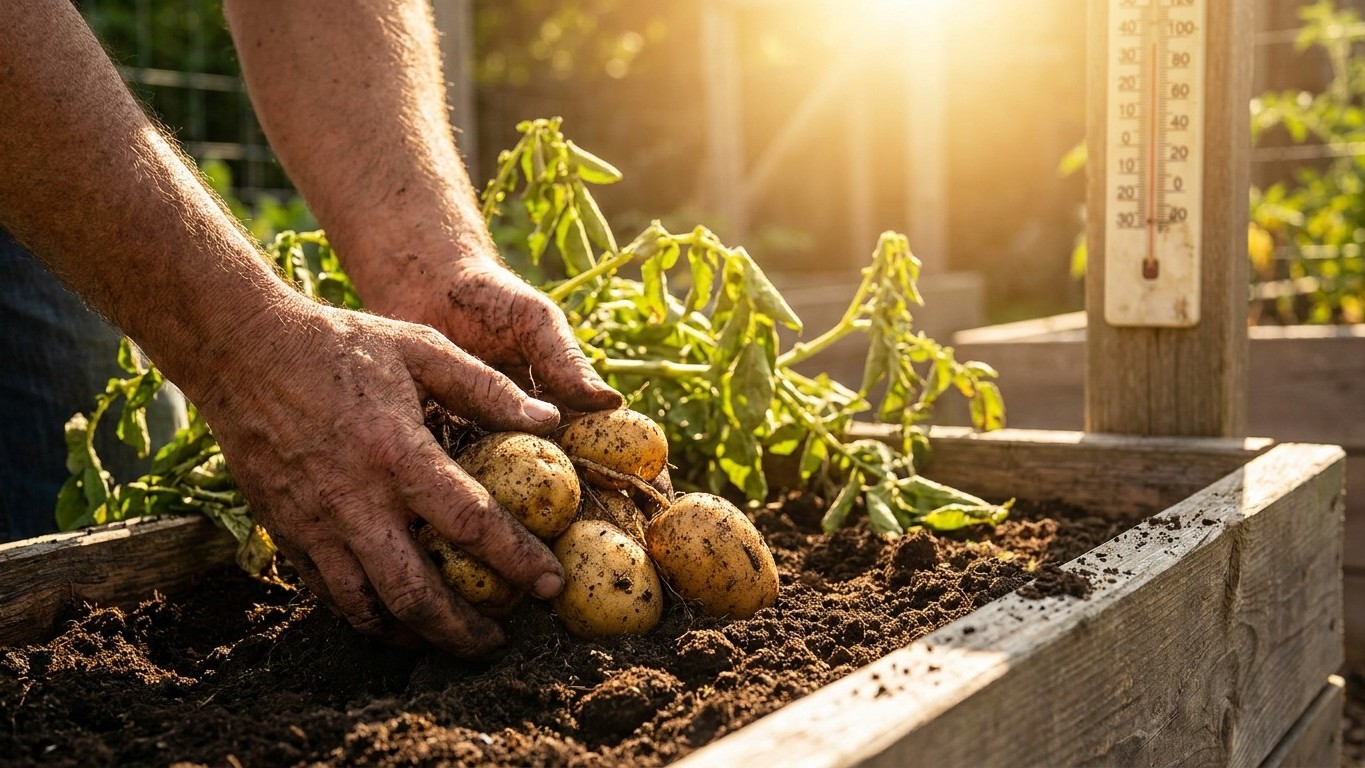

Missouri gardeners get one clear signal here: at the Kansas City reference station, the year averages 32.7 days at or above 90 F, and the last spring frost falls somewhere between April 6 and April 20, depending on where in the state you sit. That heat load is high enough that potatoes need to size up before summer locks in, not during it.
The short answer

Two numbers decide how this crop goes in Missouri. The first is 32.7, the mean number of days per year that reach 90 F or higher at the Kansas City reference station, per NOAA NCEI’s 1991-2020 Climate Normals. The second is the last spring frost window for that same station, April 6 to April 20. Neither number alone tells you what to do. Together, they say that Missouri sits in a state where tuber set and fill have to happen before the hottest stretch of summer arrives, not through it.
Utah State University Extension’s potato fact sheet is blunt about the mechanism behind that: soils above 90 F inhibit tuber set and fill. That’s not a Missouri-specific rule, it’s a physiological ceiling that applies wherever potatoes grow. What makes Missouri’s answer different from, say, a northern state with a handful of 90-degree days a year is how often the soil actually crosses that line here. With nearly 33 days a year at or above 90 F air temperature at the reference station, soil temperatures follow closely behind through most of July and into August. A crop still trying to bulk up tubers during that stretch is fighting a losing battle no amount of irrigation solves.
That pushes the practical answer toward a spring-planted crop that finishes its bulking before the heaviest heat lands, rather than a summer-long planting that tries to push through it. Season class matters here too. Early-season and mid-season classes, the kinds typically grown for boiling or general table use versus baking, tend to complete their tuber fill earlier in the season, which lines up better with Missouri’s heat calendar. Late-season classes, which keep bulking later into summer, run a bigger risk of hitting that 90 F soil ceiling before they’re done sizing. Neither Utah State nor the University of Maine Cooperative Extension publishes a days-to-maturity count for any variety, so the useful distinction to plan around is the season class itself, not a specific number of days; for help narrowing that down, see this guide to Potato Varieties That Suit Missouri.
What this means for planning
In practice, that means treating Missouri’s potato crop as a race against the calendar: get the plants in early enough, using the 50 F soil rule below, that most of the bulking work is finished before the year’s 90-degree days start piling up, and for guidance on timing the other end of the season, see this guide to Harvesting and Storing Potatoes in Missouring up. For exact timing, see this guide on When to Plant Potatoes in Missouring up in earnest.
When to plant here
Timing works backward from two anchors: your local last frost date, and the requirement that soil reach 50 F before seed potatoes go in the ground. Here’s the arithmetic, spelled out so it can be redone for any county in the state.
- Find your last spring frost date. At the NOAA NCEI reference station, that falls between April 6 and April 20. Northern Missouri counties tend to sit closer to the later end of that range; southern counties often see it earlier.
- Confirm soil temperature, not just the calendar. Potatoes go in once the soil itself reaches 50 F, checked with a soil thermometer a few inches down, not once the air simply feels warm enough.
- Count back 14 to 21 days from the last frost date. If your local last frost is April 6, that puts the planting window between March 16 and March 23. If your last frost runs closer to April 20, the window shifts to between March 30 and April 6.
- Plant within that window once soil hits 50 F, whichever comes first between the calendar count and the actual soil reading. A cold, wet spring can push the safe date later even if the calendar says otherwise.
That gives a statewide planting range roughly from mid-March to early April, narrowing depending on where a given county falls inside the April 6-20 frost band. It’s a starting point, not a fixed date, because soil temperature is the real trigger, not the calendar page.
What the heat does to the crop
The mechanism is straightforward once you see it: potato plants set tubers and fill them out during a window of moderate soil temperature, and Utah State University Extension identifies 90 F soil temperature as the point where that process stalls. Above that line, the plant doesn’t stop growing entirely, but it stops putting energy into the tubers underground. Foliage may look fine while the crop underneath quietly loses its window.
Missouri’s 32.7 average days per year at or above 90 F, measured at the Kansas City reference station, means that ceiling isn’t a rare event here. It’s a recurring feature of most Missouri summers, concentrated in July and August. For a potato crop planted in mid-March to early April and given roughly a season class’s worth of growing time, that timing largely front-loads the tuber-bulking period into late spring and early summer, before the heaviest run of 90-degree days sets in.
The part gardeners get wrong most often is assuming water solves it. It doesn’t. Irrigation keeps the plant hydrated and can moderate soil temperature somewhat through evaporative cooling, but it doesn’t undo the biological switch that high soil temperature flips. A well-watered potato plant sitting in 92 F soil is still not putting on size the way it would at 70 F. The fix isn’t more water at that point, it’s timing the whole crop so tuber fill happens before the soil gets there in the first place. That’s the practical case for treating Missouri’s main potato crop as a spring-timed planting rather than something carried deep into summer.
What goes wrong here
- Planting uncertified seed potatoes. Uncertified seed carries a real risk of viral disease that saved grocery-store potatoes or leftover seed from a previous season won’t show right away but will spread through the row. Certified seed potatoes, sold as such, are the one input worth not skimping on.
- Planting into cold, wet soil before it reaches 50 F. Seed pieces set into cold, waterlogged ground are prone to rot before they ever sprout. Waiting for an actual soil temperature reading, rather than a warm-feeling afternoon, avoids losing seed pieces before the season starts.
- Skipping hilling and ending up with green tubers. Tubers that push up near the soil surface and catch sunlight turn green and develop solanine, making them unsuitable to eat. Hilling soil up around the base of the plants as they grow keeps developing tubers covered and out of the light.
- Digging too early. Pulling potatoes before the plant has finished its natural die-back means smaller tubers and skins that haven’t set, which makes them bruise and rot faster in storage. Letting the foliage yellow and die back before digging gives the crop its full sizing window within the season it has.
Checking this against your own county
A statewide frost window and a single reference station’s heat count are a starting point, not a fixed instruction for every backyard in Missouri. Elevation shifts frost dates, and the difference between the state’s northern counties and its southern edge can move both the last frost date and the count of 90-degree days by real margins, sometimes weeks on the frost side. The Kansas City reference figures used here are a benchmark, not a guarantee for a specific county.
The most reliable next step is checking local data directly. University of Missouri Extension maintains county-level guidance that accounts for these regional differences, and it’s worth confirming local frost dates and planting timing against that resource before locking in a date based on statewide averages alone.
Common questions
Can potatoes handle Missouri’s summer heat if I just water more?
No. Once soil temperature climbs above 90 F, tuber set and fill are inhibited regardless of how much water the plant receives, according to Utah State University Extension. Watering helps the plant survive heat stress generally, but it doesn’t restore tuber bulking once that threshold is crossed.
What’s the actual planting window for most of Missouri?
Counting 14 to 21 days back from a last frost date that ranges from April 6 to April 20 across the state puts most plantings somewhere between mid-March and early April, with the exact date depending on local soil temperature reaching 50 F.
Should I choose an early, mid-season, or late variety here?
Early and mid-season classes finish their tuber fill earlier in the season, which fits better around Missouri’s heat calendar. Late-season classes keep bulking later into summer and run more risk of overlapping with the state’s 90-degree stretch, since neither Utah State nor the University of Maine publishes a specific days-to-maturity figure to plan around beyond that season-class distinction.
Why does certified seed matter so much?
Uncertified seed potatoes can carry viral disease that reduces yield and quality without obvious symptoms early on. Certified seed is grown and inspected specifically to avoid that risk, which makes it the more reliable starting point for a home crop.