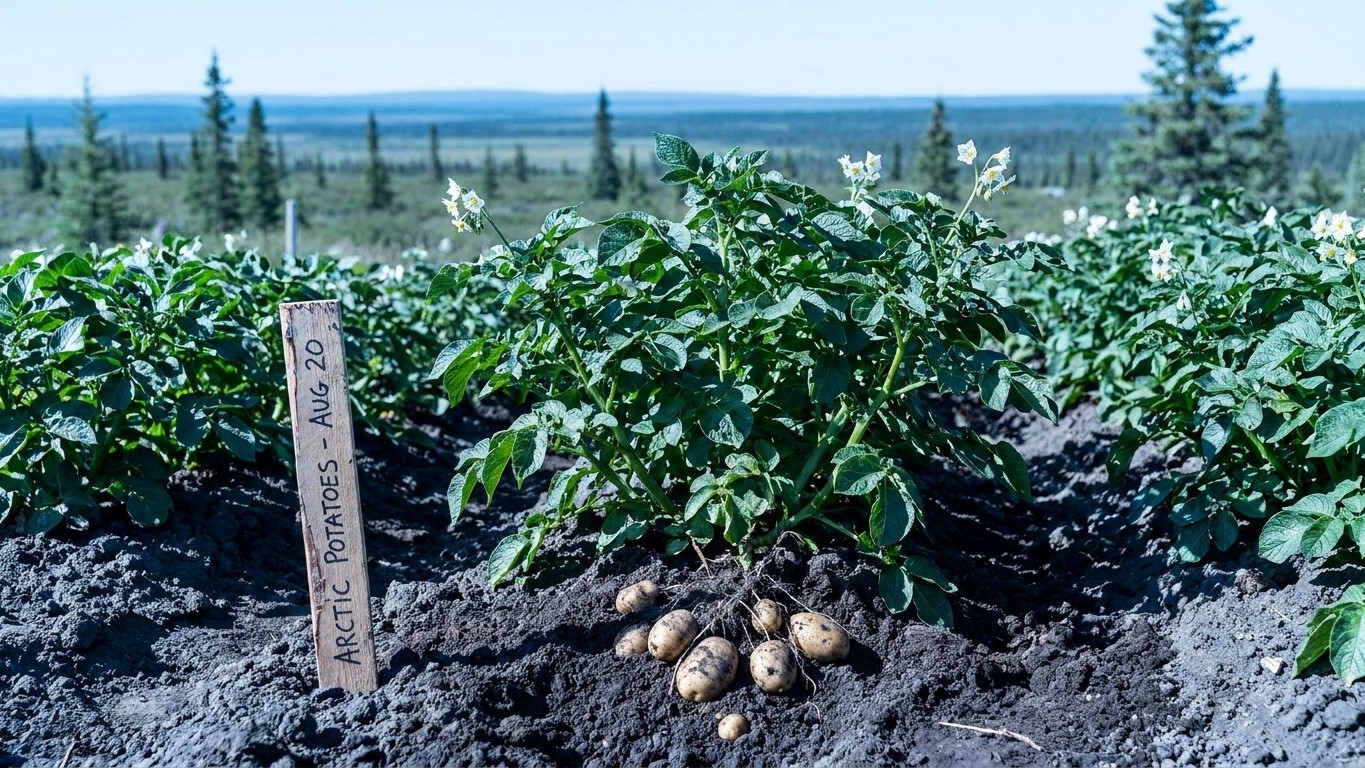

In Northwest Territories, summer heat is not what limits your potato crop, the calendar is. With zero days a year averaging 90 F or above at Yellowknife, tubers never face the heat stress that stops sizing farther south. The real constraint here is a short window between the average last frost, May 25, and the return of cold in fall.
The short answer

Two numbers decide how you grow potatoes here, and both point the same direction. Utah State University Extension puts the heat ceiling for tuber set and fill at soil temperatures above 90 F. Yellowknife averages 0.0 days a year reaching that mark, according to Environment and Climate Change Canada’s Canadian Climate Normals for 1981 to 2010. That means the mechanism that ruins potato crops in hot states, tubers stalling because the ground is too warm, essentially does not apply in this territory. You are not racing to dig a spring crop before summer heat arrives, because that heat never arrives.
What you are racing instead is the season itself. The average last spring frost at the Yellowknife A station is May 25. That date is a mean, not a guarantee: in roughly half the years on record, frost falls later than that. Treat May 25 as the midpoint of a range, not a line you can plant right up against. For a fuller breakdown of dates and timing, see When to Plant Potatoes in Northwest Territories. Add to that a growing season that closes early in fall, and the arithmetic in Northwest Territories is about stretching a narrow, cool window rather than dodging heat.
The practical result is that gardeners here get to run potatoes through the whole season without worrying about a heat-driven yield collapse in July or August, something growers in warmer states cannot count on. The tradeoff is that there is less slack on either end. A frost that arrives on schedule, or a cold snap that lingers into early June, eats directly into the days your plants have to bulk up tubers. There is no cushion of extra warm months to make up for a late start the way there might be in a longer, hotter growing region, which makes knowing how and when to bring in your crop, covered in Harvesting and Storing Potatoes in Northwest Territories, just as important as getting the planting date right.
This changes how you think about variety choice too. Because heat is not going to cut the season short from above, the limiting factor is almost entirely how much cool-season growing time you can capture from below, meaning how early you can get seed potatoes into ground that has actually warmed up. Season class, early, mid-season, or late, matters more here than it would in a state where a mid-season variety might get pushed into heat stress before it finishes. In Northwest Territories, choosing among Potato Varieties That Suit Northwest Territories often means favoring an early or mid-season type simply because it asks for less total time in a season that does not offer much to spare.
None of this is published as a days-to-maturity figure by either Utah State University Extension or the University of Maine Cooperative Extension, and neither source publishes one for a reason: maturity length shifts with soil temperature, moisture and daylight, not just the calendar. What both sources do publish is season class, and that is the number worth planning around here.
When to plant here
Work backward from the frost date instead of forward from a spring urge to get planting. The University of Maine Cooperative Extension and Utah State University Extension both point to the same rule: potatoes go in the ground once soil temperature reaches 50 F, which typically falls 14 to 21 days before the last frost date. Here is how that plays out using the Yellowknife average.
- Start with the mean last frost date. For the Yellowknife A station, that is May 25, drawn from the 1981 to 2010 Canadian Climate Normals. Remember this is a mean, so frost lands later than this in roughly half of all years.
- Count back 14 to 21 days. That places a soil-temperature-ready planting window somewhere between roughly May 4 and May 11, depending on how much margin you want to keep.
- Confirm with a soil thermometer rather than the calendar alone. Push it 4 inches down in the bed you intend to plant, check it a few mornings in a row, and wait for a steady 50 F reading before you commit seed potatoes to the ground.
- Build in a frost buffer for foliage. Because the May 25 average means frost can arrive later in many years, expect to protect emerged sprouts with row cover or extra hilling if a cold night threatens after planting.
You can run this same four-step math for any county or community once you know its own last-frost figure. Swap in the local date, count back 14 to 21 days, verify with a soil thermometer, and keep a frost buffer in your plan. The steps do not change. Only the dates do.
One thing worth resisting: the temptation to plant early simply because the ground looks workable. Cold, wet soil is exactly the condition that invites seed piece rot before a sprout ever emerges, and a soil thermometer reading is a better guide than how the surface looks on a sunny afternoon.
What the heat does to the crop
The mechanism that governs potato yield in most of the country barely applies in Northwest Territories, and understanding why is the most useful thing on this page. Above 90 F in the soil, Utah State University Extension notes that tuber set and fill are inhibited: the plant essentially stops adding to the potatoes already forming underground, and no amount of extra watering reverses that. It is a temperature problem, not a moisture problem, and irrigation cannot compensate for it.
In a state where that 90 F threshold gets crossed dozens of times a summer, gardeners are pushed toward digging a spring crop before the heat sets in, then possibly starting a second planting for fall. Northwest Territories does not need that workaround. With an average of 0.0 days a year reaching 90 F at Yellowknife, the soil essentially never gets hot enough to trigger that shutdown. Plants set in the ground in May can keep sizing tubers straight through summer without hitting a heat ceiling.
That does not mean warmth is irrelevant here, only that it works in the opposite direction from most of the country. Instead of managing a crop through excess heat, growers in this territory are managing a crop through a compressed window of adequate warmth. The plant still needs enough soil warmth to grow at all, it just never risks getting too much of it. If your potatoes underperform here, the more likely culprit is a soil that stayed too cold too long in spring, or a growing season that closed with fall cold before tubers had time to bulk up, not heat stress in July.
Watering habits should follow that reality. Consistent moisture still matters for tuber development, but there is no need to chase extra water as a defense against heat-driven stalling, because that particular stress simply is not part of the local climate picture.
What goes wrong here
- Uncertified seed potatoes. Seed that has not been certified disease-free can carry viruses that reduce vigor and yield before the plant ever has a chance in a short season. Buying certified seed each year is the single easiest way to protect the limited growing window this territory gives you.
- Planting into cold, wet soil. Getting seed pieces into ground before it reaches 50 F, especially soil still holding spring moisture, invites rot rather than sprouting. Check with a soil thermometer instead of guessing from air temperature or the calendar.
- Skipping the hilling. Tubers that develop too close to the surface turn green when exposed to light, and green tubers develop solanine, making them unfit to eat. Regular hilling as the plants grow keeps developing tubers covered and protected.
- Digging too early. Pulling potatoes before the plant has finished using the season’s limited warmth cuts yield short. In a climate where the growing window is already narrow, giving the crop every available day before harvest matters more than it would somewhere with a longer season to spare.
Checking this against your own county
The Yellowknife figures on this page are a starting point, not a promise for your own yard. Elevation, latitude within the territory, and how close a community sits to open water can all shift both the last-frost date and the count of warm days by weeks in either direction. A community farther north or at higher elevation should expect a later safe planting window than the Yellowknife average suggests.
For a reading specific to your own area, the Government of the Northwest Territories agriculture program, reachable through the Department of Industry, Tourism and Investment’s agriculture services, is the right place to check local conditions and planting guidance before you commit seed to the ground.
Common questions
Does heat ever limit potato yield in Northwest Territories?
Rarely, based on the data available. With an average of 0.0 days a year reaching 90 F at Yellowknife, the soil temperature threshold that stalls tuber set and fill, as described by Utah State University Extension, is essentially never crossed here. The limiting factor is season length, not heat.
How early can I safely plant potatoes here?
Aim for soil at a steady 50 F, which typically falls 14 to 21 days before the last frost date. Using the Yellowknife average last frost of May 25, that points to roughly early May, but confirm with a soil thermometer rather than relying on the calendar alone, since frost falls later than May 25 in about half of all years.
Should I choose an early, mid-season, or late variety?
Season class matters more here than exact days to maturity, which neither Utah State University Extension nor the University of Maine Cooperative Extension publishes. Given the short window between soil warm-up and fall cold, early or mid-season varieties are generally a better fit for capturing enough growing time before the season closes.
Why does my seed catalog list a potato as good for baking versus boiling instead of describing its texture?
Utah State University Extension and the University of Maine Cooperative Extension describe potato varieties by their culinary use, baking or boiling, rather than by texture terms. That use classification reflects how the starch and moisture in a given variety behave when cooked, and it is the guidance actually published, so it is more reliable to plant by than an unsourced texture label.