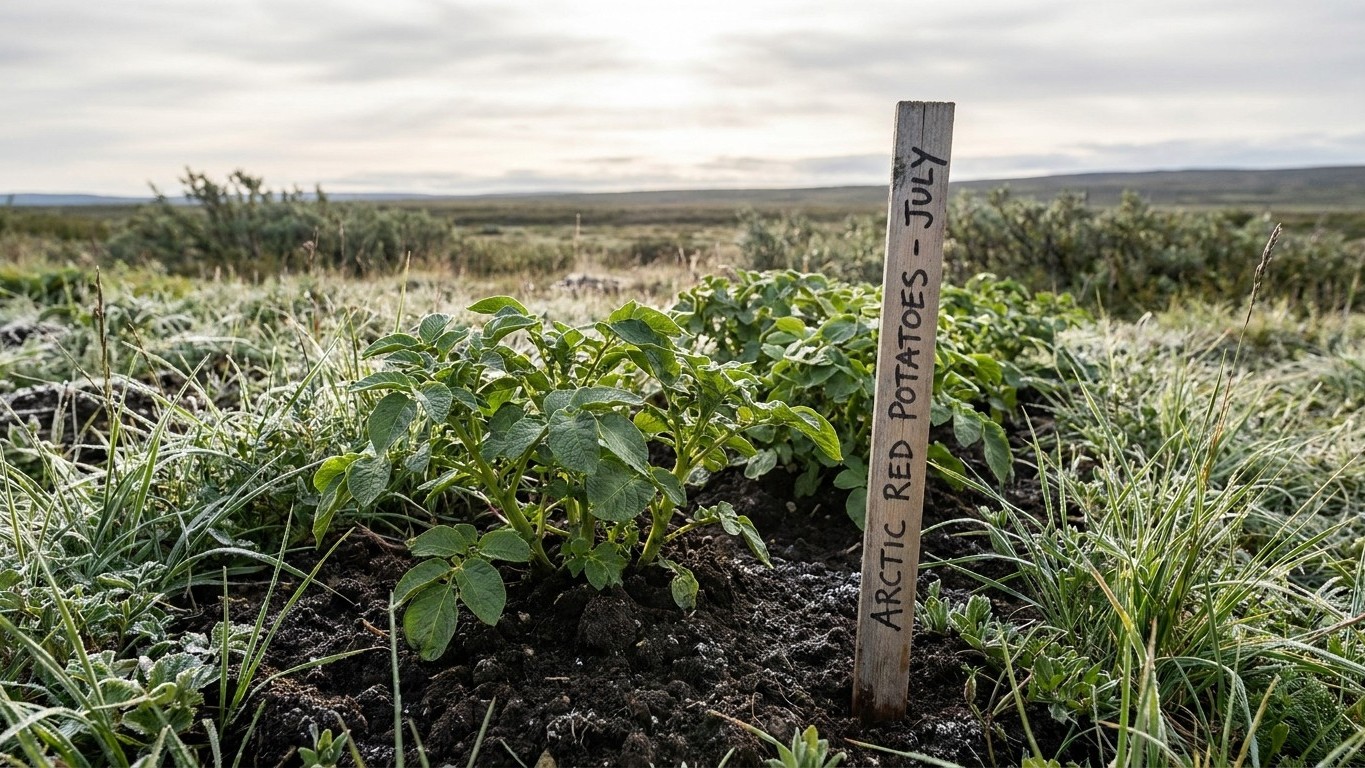

Nunavut never gets hot enough to hurt a potato crop. At the reference station, Rankin Inlet, the mean count of days reaching 90°F or higher is 0.0 a year. The problem here isn’t heat, it’s cold: the average last spring frost falls around June 19, and that single date compresses the whole growing calendar into a narrow window that a gardener has to plan around, not fight through.
The short answer

Two numbers decide almost everything about growing potatoes in this territory, and neither of them points toward heat stress. The first is the 90°F day count from Environment and Climate Change Canada’s Climate Normals for Rankin Inlet: zero. Not “close to zero,” not “a handful in a hot year,” but a flat 0.0 across the 1981-2010 normal period at that station. The second is the mean last spring frost date, also from Rankin Inlet’s record: June 19. That date is not a guarantee, it’s a midpoint, meaning in roughly half of all years frost lingers past it.
Compare that to the concern that dominates potato growing across most of the continental United States. Utah State University Extension identifies 90°F soil temperature as the ceiling above which tuber set and fill stop cold, regardless of how much water or fertilizer a gardener applies. In hot states, that threshold shapes the entire strategy: race to get a crop in and dug before the soil crosses that line, or accept a shortened, spring-only harvest. In Nunavut, that ceiling is almost academic. With a 90°F day count of zero at the reference station, tubers here are never at risk of that particular failure mode.
What replaces heat as the limiting factor is the opposite problem: not enough warm days, packed into a season that opens late and closes early. A last frost date sitting in mid-to-late June already eats into the calendar that gardeners further south take for granted starting in April or May. Add to that the fact that this is a mean, not a safe cutoff, and the real planning window shrinks further, because a cautious gardener has to treat the June 19 figure as the center of a range rather than a hard line.
None of this means potatoes can’t be grown in Nunavut. It means the entire approach flips from “beat the heat” to “capture every available warm day,” starting with knowing When to Plant Potatoes in Nunavut and choosing Potato Varieties That Suit Nunavut. The mechanism that matters elsewhere, the 90°F soil ceiling described by Utah State University Extension, simply doesn’t come into play at this reference station. What comes into play instead is frost, both at the start of the season and, just as important, at the end of it, which is why Harvesting and Storing Potatoes in Nunavut deserves just as much planning as the planting date itself.
When to plant here
Potato planting timing is worked out backward from the frost window, not forward from a calendar date picked at random. The logic is the same one University of Maine Cooperative Extension and Utah State University Extension both describe: get the seed potato into soil once that soil reaches 50°F, and that point typically falls 14 to 21 days before the last frost date. Here’s how that arithmetic runs for Nunavut, using Rankin Inlet’s mean last frost of June 19.
- Start from the mean last frost date. Rankin Inlet’s Canadian Climate Normal puts it at June 19. Treat that as a midpoint, not a promise: in about half of all years, frost arrives later.
- Count back 14 to 21 days. From June 19, that lands the target window somewhere between roughly May 29 and June 5, depending on how much buffer a grower wants to build in for a colder-than-average spring.
- Confirm soil temperature, not just the calendar. The 14-to-21-day rule is a shortcut for one real condition: soil at 50°F. In a territory where spring warmth arrives slowly and unevenly, a thermometer pushed a few inches into the bed tells the truth better than any date on a chart.
- Hold if the soil is still cold and wet. If the target window arrives and the ground hasn’t reached 50°F, wait. Planting into cold, wet soil invites rot and poor emergence regardless of what the calendar says.
This is a starting-point calculation, not a fixed date to circle. Given how much later frost can linger in a bad year, and how much the mean date itself already sits in late spring, growers in Nunavut are working with one of the shortest and most compressed planting windows anywhere covered in this series.
What the heat does to the crop
The mechanism itself doesn’t change just because a place is cold most of the year: Utah State University Extension and the University of Maine Cooperative Extension both describe the same physiological ceiling. Once soil temperature climbs above 90°F, tuber set and fill are inhibited. The plant keeps growing leaves, but the underground work of forming and sizing tubers stalls. Watering more doesn’t reverse it, because the constraint is heat in the root zone, not moisture.
What that means for a gardener in Nunavut is straightforward: this ceiling is effectively a non-issue. With a 90°F day count of 0.0 at Rankin Inlet, the soil here almost never approaches the temperature that shuts tuber development down elsewhere. A grower in a hotter state has to plan a spring-only crop, dug before that ceiling arrives, or accept reduced yield if the season runs long and hot. That calculation simply doesn’t apply at this reference station.
The flip side is less forgiving. Instead of racing a heat ceiling, a Nunavut grower is racing the calendar in the other direction, trying to squeeze enough warm days between a late spring frost and an early fall one to let tubers form and size at all. The mechanism that matters most here isn’t a soil temperature maximum, it’s simply accumulated warmth over a short window. A cool, damp summer with few genuinely warm days will limit tuber bulking just as surely as excess heat does farther south, just through a completely different pathway. There’s no shortcut for that: extra watering, extra fertilizer, none of it substitutes for warm soil and daylight hours the plant simply doesn’t get in a short northern season.
What goes wrong here
- Planting uncertified seed potatoes. Uncertified seed carries virus loads that stunt plants and cut yield before the short season even gets a fair chance. Certified seed is treated and tested, and in a growing window this compressed, there is no time to recover from a weak or diseased start.
- Planting into cold, wet soil before it reaches 50°F. With a mean last frost as late as June 19, the temptation to get an early start is real, but pushing seed potatoes into ground that hasn’t warmed invites rot rather than a head start. Wait for the soil, not just the calendar.
- Skipping hilling and ending up with green tubers. Hilling soil up around the stems keeps developing tubers covered and out of sunlight. Skip it, and exposed tubers turn green and develop solanine, making them unsafe to eat. This is a simple mechanical step, and it matters just as much in a short season as a long one.
- Digging too early out of anxiety about the season ending. A short frost-free window creates pressure to harvest early “just in case,” but pulling tubers before they’ve had their full run of warm days sacrifices size and storage quality for no real gain, since the plant itself signals readiness through die-back of the foliage.
Checking this against your own county
Every figure above comes from one reference station, Rankin Inlet, and a territory this size holds real variation across it. Elevation, latitude, and proximity to open water all shift frost dates and warm-day counts by days or weeks in either direction. A community farther north or at higher ground will see a later effective last frost than the June 19 mean quoted here, and fewer accumulated warm days on top of that.
Treat the Rankin Inlet figures as a starting framework, then check them against a local source. Because the provincial-level site could not be verified directly, the federal Agriculture and Agri-Food Canada site is the best-verified public reference point for growers looking to confirm regional detail before committing seed to the ground.
Common questions
Is heat ever a problem for potatoes in Nunavut?
Not based on the reference station data. Rankin Inlet’s mean count of days at or above 90°F is 0.0 a year, so the soil-temperature ceiling that limits tuber set elsewhere essentially doesn’t occur here.
What actually limits the potato season in Nunavut?
A short, cool growing window bounded by a late mean last frost, around June 19 at Rankin Inlet, and an early return of frost in fall. The limiting factor is accumulated warm days, not excess heat.
Should I plant early to get ahead of a short season?
Only once soil reaches 50°F, generally 14 to 21 days before the last frost date. Planting earlier than that, into cold wet soil, causes rot and poor emergence rather than gaining useful time.
Does a specific potato variety’s maturity length matter more here?
Season class matters more than any specific days-to-maturity figure, which neither Utah State University Extension nor the University of Maine Cooperative Extension publishes. In a short-season territory, early-season types generally give the best chance of reaching harvest before fall frost returns.