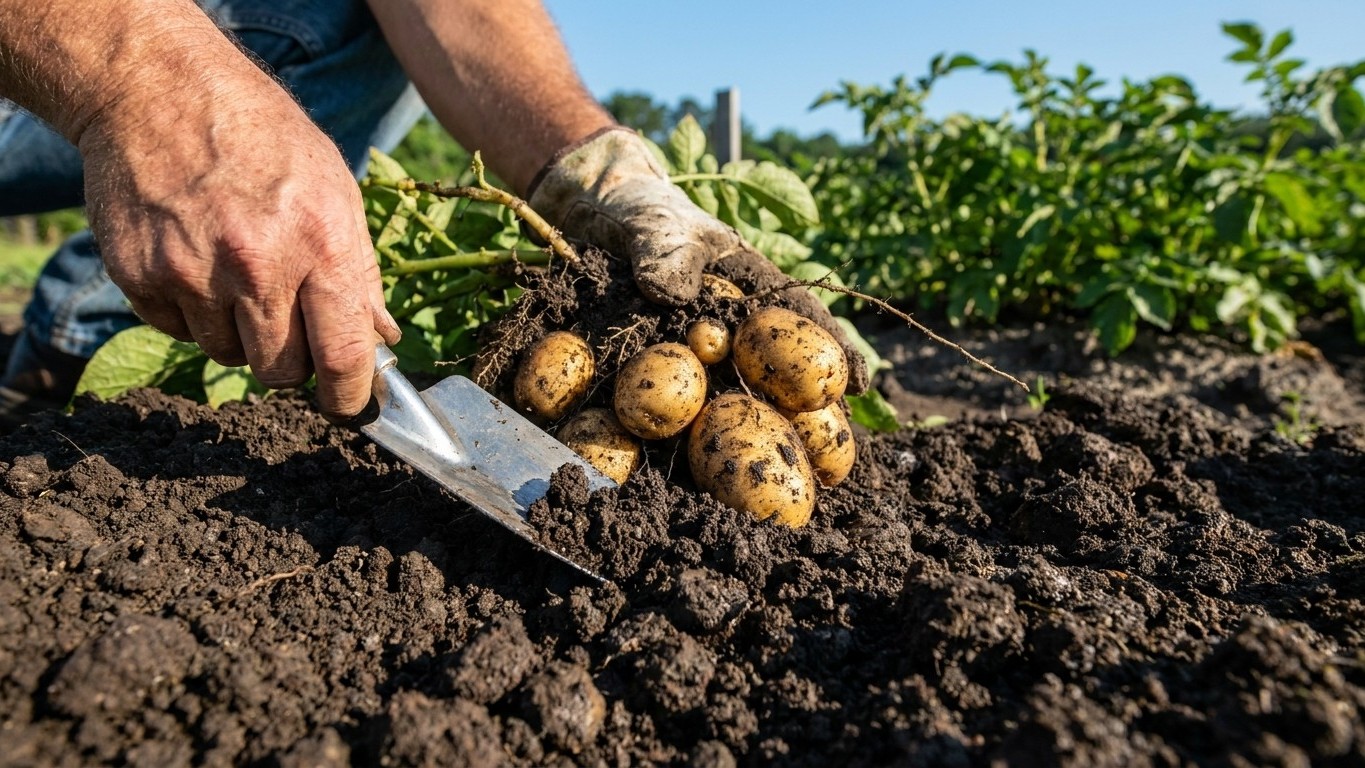

South Carolina gardeners get one real shot at potatoes each year, and it’s in spring. Charleston’s reference station logs 55.1 days a year at 90°F or hotter, per NOAA NCEI’s 1991-2020 Climate Normals, and Utah State University Extension’s potato fact sheet says soil above that mark stalls tuber set and fill outright. The last spring frost at Charleston falls between February 28 and March 17. Plant early, dig before the heat closes in, and don’t try to push a crop through summer.
The short answer

Fifty-five days. That’s how many days a year Charleston’s official weather station hits 90°F or hotter, according to NOAA NCEI’s 1991-2020 Climate Normals. Spread across a South Carolina growing season, that heat load lands right on top of the weeks a potato plant would otherwise spend filling out its tubers underground. Utah State University Extension’s fact sheet on potatoes is direct about the consequence: soil temperatures above 90°F inhibit tuber set and fill. Not slow it. Stop it.
That single mechanism explains why South Carolina growers run one potato crop, timed for spring, and pull it before the ceiling shuts down. There’s no realistic summer potato in this climate, and a fall crop rarely pays off here either, since the ground doesn’t cool back into safe tuber-forming range until most gardeners have already moved on. The last spring frost at the Charleston station falls somewhere between February 28 and March 17, based on NOAA NCEI’s freeze-probability data for that station. That’s a three-week band, and it tightens considerably once you leave the coast. For a closer look at timing your planting date, see When to Plant Potatoes in South Carolina, and for guidance on when to pull the crop and how to keep it afterward, see Harvesting and Storing Potatoes in South Carolina.
Matching variety to the season class
Because the window is short and heat-limited, the variety question comes down to season class rather than any days-to-maturity number, a figure neither Utah State University Extension nor the University of Maine Cooperative Extension publishes for home gardeners. Both group potatoes as early, mid-season, or late, and both point growers toward matching that class to how much cool weather the garden actually has before the 90°F days start stacking up.
For South Carolina, that favors early and mid-season types over late ones. A late-season potato simply needs more of the cool window than this state reliably offers before summer heat shuts down tuber sizing. For specific cultivar picks, see Potato Varieties That Suit South Carolina.
| Season class | What it’s used for | Why it fits here |
|---|---|---|
| Early | Boiling, salads | Bulks up before the heat arrives |
| Mid-season | Baking, all-purpose use | Fits a spring planting dug ahead of peak heat |
| Late | Baking, long storage | Needs more cool weeks than the state reliably gives |
When to plant here
Work backward from your own last frost date instead of a calendar month, and the planting window sets itself. Here’s the arithmetic, using Charleston’s frost data as the example.
- Start with the last spring frost window for your station. At Charleston, per NOAA NCEI, that’s February 28 to March 17.
- Subtract 14 to 21 days from the earliest date in that window. That’s the mechanism Utah State University Extension and the University of Maine Cooperative Extension both describe: potatoes go in the ground 14 to 21 days before the last frost date, not after it.
- Count from February 28 backward 21 days and you land in early February; count back only 14 days and you’re in mid-February. That spread gives you the realistic planting range for the Charleston area.
- Confirm soil temperature directly rather than trusting the calendar alone. Both extension sources set the planting trigger at 50°F soil, measured a few inches down, not air temperature.
- Plant once soil hits 50°F within that window, even if a light frost is still possible. Potato foliage that gets nipped by a late frost usually regrows from the seed piece; cold, waterlogged soil before planting is the bigger risk.
The same math works anywhere in the state. Pull the last frost window for your county, subtract 14 to 21 days, and check soil temperature before committing seed to the ground. Upstate gardeners will find their whole window shifted later and tighter than Charleston’s, since inland and higher-elevation areas run several weeks behind the coast on both frost and soil warm-up.
What the heat does to the crop
The mechanism is the whole story here, and it’s simpler than most garden problems. Once soil temperature climbs past 90°F, Utah State University Extension’s fact sheet states plainly that tuber set and fill are inhibited. The plant isn’t dying of thirst. It’s not short on nutrients. The biological process that turns sunlight into starch packed inside a tuber slows and then stops once the soil itself runs too hot, regardless of how much water sits in that soil.
That distinction matters because the instinct when a garden struggles in summer is to water more. With potatoes above the 90°F soil threshold, extra water doesn’t reopen tuber set. It can even make things worse by keeping soil saturated and inviting rot in a crop that’s already stalled. The fix isn’t more water. It’s timing the crop so it never has to cross that threshold in the first place.
Given Charleston’s 55.1 days a year at 90°F air temperature (and soil temperature tracking close behind on exposed garden beds), South Carolina falls squarely into the group of states where the only workable strategy is a spring crop dug out before the heat load builds. That’s not a matter of picking a tougher variety or babying the bed through July. It’s a matter of getting the crop planted early enough, per the 14-to-21-day rule ahead of last frost, that tubers have already set and sized before the soil crosses 90°F. Mulching helps buffer soil temperature by a few degrees at the margins, and hilling keeps tubers shaded and cooler than bare exposed soil, but neither technique defeats a sustained run of 90°F-plus days. They buy a little time. They don’t change the ceiling.
What goes wrong here
- Uncertified seed potatoes. Seed saved from a grocery-store potato or a neighbor’s bin often carries viruses that stunt the plant before heat ever becomes a factor. Buy certified seed potatoes from a garden supplier; certification is the only real check against that risk.
- Planting into cold, wet soil. Getting seed pieces in the ground before soil reaches 50°F invites rot rather than an earlier harvest. Wait for the soil itself to hit that mark, checked with a thermometer, not the calendar or the air temperature.
- Skipping the hilling. Tubers that push up near the surface and catch sunlight turn green and develop solanine, making them unsafe to eat. Hill soil or mulch over the row as plants grow so tubers stay covered the whole season.
- Digging too early or too late. Digging before foliage has died back costs yield, since tubers are still sizing. Waiting too long into the season risks running the crop straight into the soil-temperature ceiling described above. Dig once the foliage has yellowed and died back, and don’t stretch the harvest into the hottest stretch of the calendar hoping for extra size.
Checking this against your own county
A statewide frost window is a starting point, not an instruction you can follow blind. Charleston’s February 28 to March 17 range describes a mild coastal station; Upstate South Carolina, at higher elevation and farther from the moderating ocean, runs its frost dates and soil warm-up several weeks tighter on both ends. Elevation alone can shift a last-frost date by two or three weeks over a fairly short distance.
Before finalizing a planting date, check current soil temperature and local frost data through the Clemson Cooperative Extension, which covers county-level conditions across the state. That’s the source to confirm your own numbers against, rather than assuming Charleston’s window applies statewide.
Common questions
Can you grow potatoes twice a year in South Carolina?
Not realistically. The soil-temperature ceiling that stalls tuber set above 90°F, combined with Charleston’s 55.1 days a year at that mark, leaves too narrow a cool window for a second crop to size properly before summer heat and again before winter.
What potato varieties do best in South Carolina heat?
Early and mid-season types fit better than late-season ones, since they need less of the cool window before soil temperatures climb. Neither Utah State University Extension nor the University of Maine Cooperative Extension publishes a days-to-maturity figure, so season class, not a specific count, is the number to plant around.
How do you know when soil hits 50°F?
Use a soil thermometer inserted a few inches into the bed, checked in the morning before the day heats up. Air temperature and calendar dates are not reliable stand-ins for an actual soil reading.
Does mulching prevent heat damage to tubers?
Mulch and hilling can shave a few degrees off soil temperature and shade tubers from direct sun, which helps at the margins. Neither technique overrides a sustained run of 90°F-plus soil, which is why timing the crop to finish before that heat arrives matters more than any in-season fix.