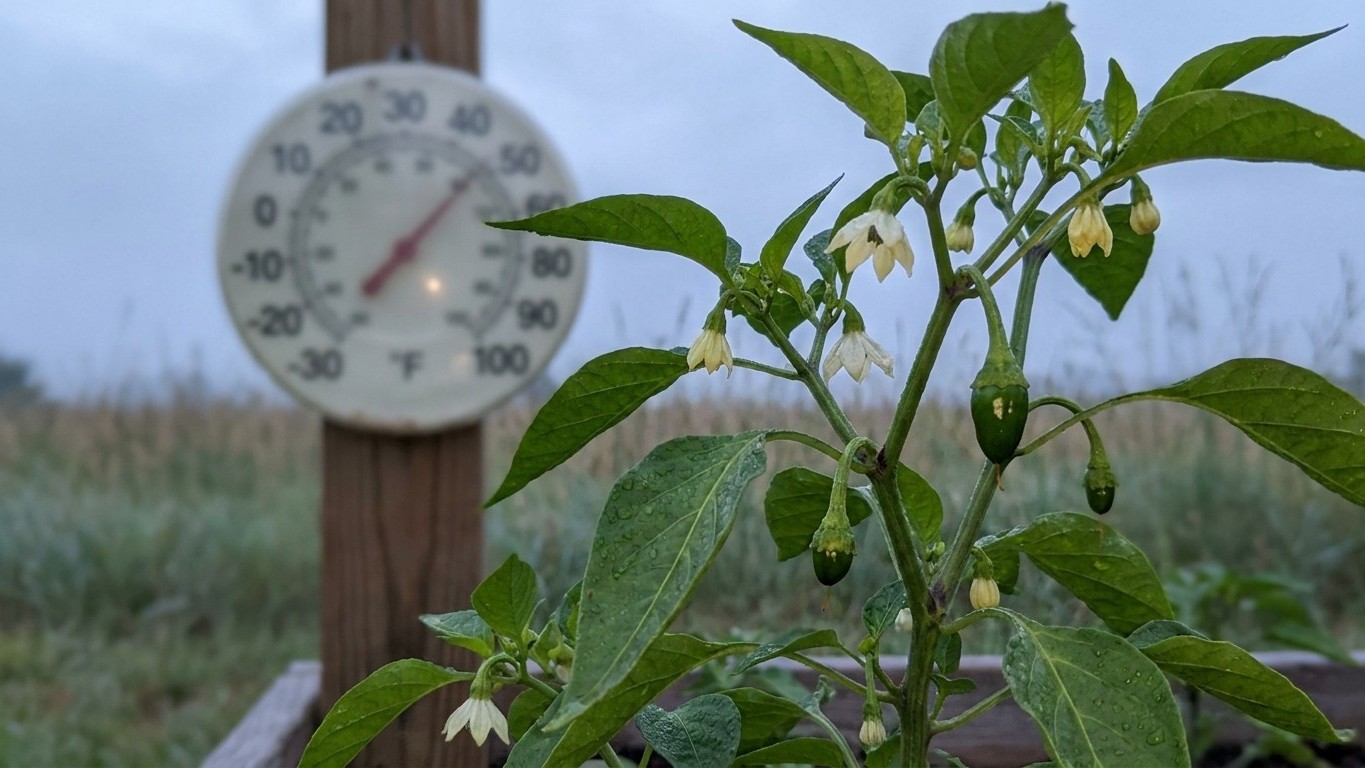

Alberta averages zero days a year at or above 90°F, so pepper fruit set rarely fails from heat here. The bigger risk is the cool end: nights under 55°F stall pollen and drop blossoms, and this site doesn’t track summer night lows, so you’ll need to watch your own thermometer through July and August.
The short answer

Start with the number that matters most for Alberta growers: 0.0 days a year at or above 90°F, measured at the Calgary reference station under the 1981-2010 climate normals. That’s not a rounding error. It means the hot-end failure that plagues pepper growers in warmer states, where blossoms abort because daytime heat scrambles pollen viability, almost never shows up here. If you’re growing peppers in Alberta, you can largely stop worrying about the plant cooking its own flowers off in a July heat dome. That threat is real elsewhere. It isn’t the one you’re fighting.
The other end of the fruit-set window is the one that actually bites in this province, and it’s the one this site can’t hand you a number for. Utah State University Extension is clear that pepper fruit set fails when nights drop below 55°F, just as surely as it fails above 90°F on the hot side. Alberta’s summer nights can slip under that mark even in the middle of the growing season, especially at elevation or in low-lying frost pockets, and there’s no published territory-level figure here for summer night minima the way there is for daytime heat.
That gap isn’t an oversight. Night low temperatures vary enormously by microsite, by elevation, by how close you are to a river valley or an open field that radiates heat away after sunset, and no single station reading captures that for an entire province. Guessing from latitude or from how cold January gets won’t help either; a location’s coldest winter month tells you nothing reliable about its coolest summer nights. The only fix is direct observation, starting with getting your timing right in the first place — see When to Start Pepper Seed in Alberta — and then keeping a min-max thermometer in the pepper bed itself, not on a porch or near a wall that holds heat, checking it through the flowering weeks. If you’re seeing readings drop into the low 50s overnight while your plants are setting fruit, that’s very likely why pods aren’t forming even though the plants look otherwise healthy.
Put those two pieces together and you get a fairly clear picture for the province: heat-driven blossom drop is a minor concern, cold-driven blossom drop is the dominant one, and the second problem is invisible unless you’re actually measuring it yourself. Growers who blame “bad luck” or a weak variety for poor fruit set often haven’t checked their own night temperatures at all; for a deeper look at the mechanics involved, see Why Peppers Fail to Set Fruit in Alberta, and choosing from Pepper Varieties That Ripen in a Alberta Season can help offset the risk those cool nights pose to fruit set.
When to start seed here
Utah State University Extension’s guidance gives you the whole calculation in three pieces: peppers need 8 to 10 weeks indoors before transplanting, transplants go out only after frost has passed, and the soil itself needs to have reached 60°F, not just the air. Alberta growers can run this arithmetic themselves using one benchmark this site does carry.
- Anchor on the frost date, with a caveat. The Calgary Int’l A station puts the average last spring frost at May 21, based on Environment and Climate Change Canada’s 1981-2010 climate normals. That’s a mean, not a guarantee. In roughly one year out of every two, frost arrives later than that date, so treat May 21 as the midpoint of a risk window, not a green light.
- Don’t confuse frost-free with soil-ready. Soil warms more slowly than air, especially clay or compacted ground that’s shaded much of the day. Even once the air is reliably above freezing, the soil may still be well under the 60°F threshold peppers need before transplant shock stops being a risk. Check soil temperature directly with a probe thermometer a few inches down rather than assuming it tracks the calendar.
- Count backward 8 to 10 weeks from your real transplant date. If your own county typically lets you set out transplants safely somewhere around the frost-free window and once soil has caught up, count 8 to 10 weeks before that date to know when to start seed indoors. Growers further north or at higher elevation than Calgary should expect that window to land later, not earlier, since colder ground and later frosts push the whole schedule back.
- Rebuild the math every season using your own conditions. The Calgary station is one point in a large province. A grower in the Peace Country or in a river-bottom microclimate should not assume the same dates apply; the arithmetic (frost date, plus soil at 60°F, minus 8 to 10 weeks) is the transferable part, not the specific calendar day.
This is why two Alberta gardeners a few counties apart can have completely different “right” seed-starting dates while using the exact same method.
What goes wrong here
- Blossom drop from a cool night or a sudden hot spell. Pepper flowers abort when nights fall below 55°F or when daytime heat spikes above 90°F, and either can knock blossoms off without warning. Since Alberta almost never sees the hot version but can see the cold one even in summer, growers should suspect a cool overnight stretch first. The remedy is protective row cover or a cold frame pulled over plants on nights when a dip is forecast, keeping the microclimate around the flowers a few degrees warmer than open air.
- Sunscald where the sun is strong. Fruit and foliage exposed to intense direct sun, particularly after a plant has lost leaf cover from wind, hail, or over-pruning, can develop pale, papery patches on the pepper skin that later rot. Leaving enough foliage in place to shade developing fruit is the simplest fix, along with avoiding hard pruning during the peak of summer light.
- Blossom-end rot from uneven watering. This shows up as a sunken, dark, leathery patch on the bottom of the fruit and traces back to inconsistent soil moisture disrupting calcium uptake, not usually a lack of calcium in the soil itself. Even, regular watering, especially through dry stretches, does more to prevent it than any fertilizer application.
Checking this against your own county
Everything above is built from provincial and station-level data. Real growing decisions come down to your own yard: your soil, your microclimate, your exposure to wind and frost pockets. Alberta’s Ministry of Agriculture and Irrigation is the named authority to check next, and its site is at alberta.ca/agriculture-and-irrigation. It’s the right place to confirm local frost patterns, soil conditions, and pest pressure specific to your district before locking in a planting date based on province-wide averages alone.
Common questions
Does Alberta ever get hot enough to hurt pepper fruit set?
Rarely. The province averages 0.0 days a year at or above 90°F at the Calgary reference station, so the heat-driven failure that affects warmer states is not the typical risk here.
Why do my peppers drop flowers even though the plants look healthy?
The most likely cause in Alberta is a cool night below 55°F during flowering. This site doesn’t track summer night lows by territory, so checking your own overnight temperatures directly is the only reliable way to confirm it.
Can I use the May 21 frost date to plan my transplant day exactly?
No. That date is a long-term average from Environment and Climate Change Canada, meaning frost arrives later than May 21 in about half of all years. Treat it as a planning midpoint, not a safe cutoff.
How far apart should seed-starting and transplanting be?
Utah State University Extension recommends starting seed 8 to 10 weeks before transplanting, with transplant timed to when soil has reached 60°F and frost risk has passed, not simply when the calendar says spring has arrived.