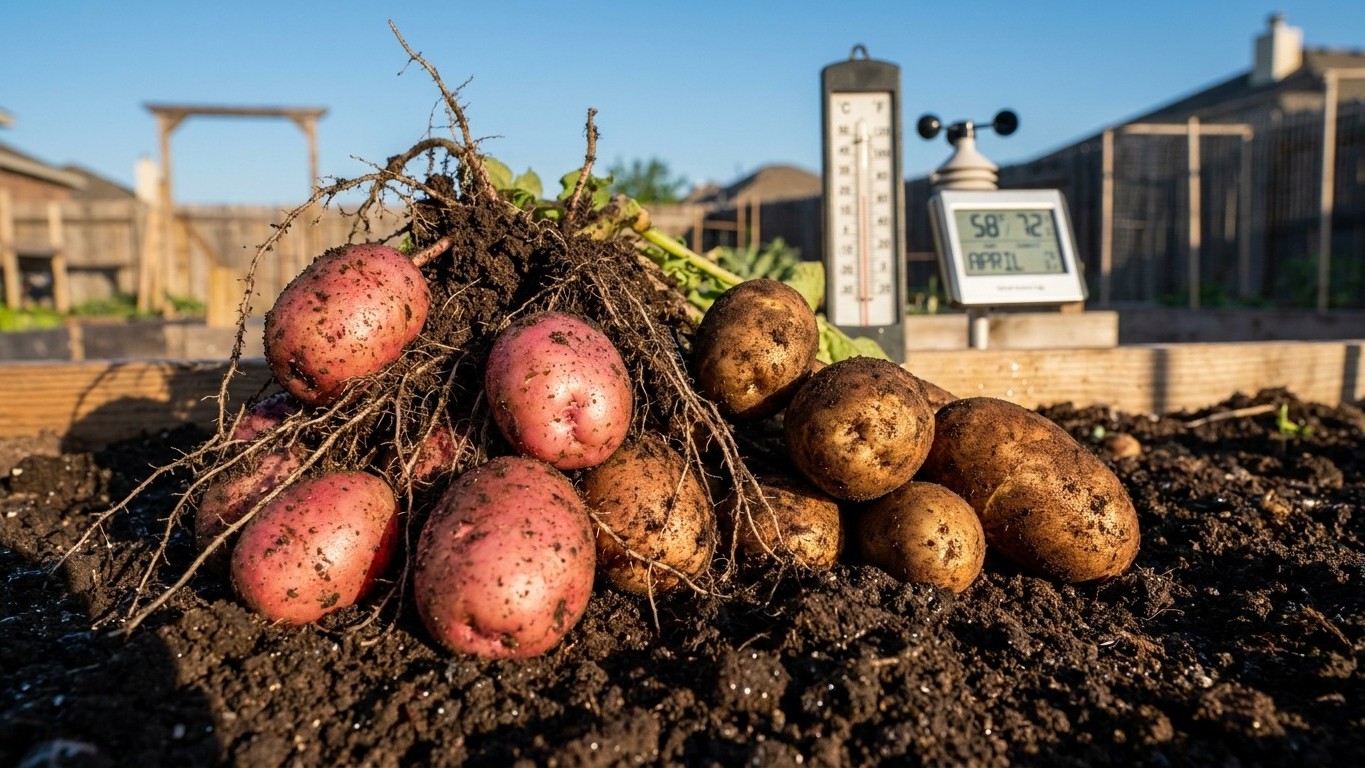

In the Houston area, the growing season is short by potato standards: a spring crop planted in deep winter, dug well before summer heat locks in. Wait for warm soil and this crop runs straight into 102.4 days a year above 90 F. Plant early, dig early, and skip any hope of a second planting once June arrives, a timing rule detailed further in Harvesting and Storing Potatoes in Texas.
The short answer

Two numbers decide how a Texas potato season plays out, and neither of them is the calendar month most gardeners reach for first. The first is 102.4, the average number of days a year the Houston reference station hits 90 F or higher, according to NOAA NCEI Climate Normals covering 1991-2020. The second is the last spring frost window for that same station, February 4 to March 1, drawn from the same NOAA dataset’s freeze-probability records at station USW00012960 (Houston Intercontinental, IAH).
Put those two figures side by side and the shape of the season becomes obvious. Frost clears out in early to late February. Heat that stalls tuber growth shows up on well over a hundred days a year, starting as early as May in most seasons. That leaves a narrow lane, roughly ten to fourteen weeks, where soil temperatures sit in the range potatoes actually want. Miss the front end of that lane and there is no back end to fall into: Texas gardeners do not get a fall potato crop the way growers farther north sometimes do, because the heat load never really lets up until late in the year.
This is why the answer to “can I grow potatoes here” is yes, but only as a spring crop planted for an early summer harvest, not as a season-long project. Utah State University Extension’s fact sheet on home garden potatoes is the source most growers lean on for the mechanism behind that limit: tuber set and fill shut down once soil temperatures climb above 90 F, and that ceiling does not care how much water goes into the bed.
Season class matters more here than variety name recognition. Utah State and the University of Maine Cooperative Extension both publish season classes, early, mid-season, and late, rather than fixed days-to-maturity counts, because maturity speed shifts with soil temperature and daylight. In a heat-ceiling climate like Houston’s, an early-season type gives the crop the best odds of sizing tubers before the 90 F days pile up, and a closer look at Potato Varieties That Suit Texas can help narrow the list before ordering seed. Whether a variety is described as good for baking or good for boiling is also published information worth checking before buying seed, since that’s a more reliable label than guessing at texture from the skin color.
When to plant here
For a full breakdown of dates by region, see When to Plant Potatoes in Texas. Counting forward from a frost date invites error, because the number that actually matters is soil temperature, not the calendar. Counting backward from the last frost window is the more reliable method, and it is simple arithmetic once the local frost date is known.
- Start with the last spring frost window. For the Houston reference station, NOAA NCEI’s 1991-2020 normals put that window between February 4 and March 1, depending on which end of the 30-70 percent freeze-probability band is used.
- Subtract 14 to 21 days. Utah State University Extension and the University of Maine Cooperative Extension both describe planting as soon as soil reaches 50 F, which lands 14 to 21 days before the last frost date, not after it. Applied to the Houston window, that arithmetic points to a planting stretch running from roughly mid-January into mid-February, depending on which end of the frost window a grower is working from.
- Confirm with a soil thermometer instead of the calendar alone. A cold snap or a mild stretch can shift actual soil temperature by a week or more in either direction, and a $10 probe thermometer settles the question faster than any date range can.
- Treat late February as the outside edge, not the target. Waiting past the frost window narrows the gap between planting and the arrival of 90 F soil days later in spring, cutting into the tuber-fill period before it starts.
What the heat does to the crop
The mechanism is worth understanding on its own terms, because it explains why extra irrigation cannot rescue a potato bed once summer sets in. According to Utah State University Extension, tuber set and tuber fill are both inhibited once soil temperatures rise above 90 F. Below that threshold, the plant is actively pushing carbohydrate into developing tubers underground. Above it, that process slows and then stops, regardless of how much water is available at the roots.
Houston’s 102.4 average days a year above 90 F is not a mild statistic to work around. It means the region spends nearly a third of the year at or past the point where tuber growth halts, and those days are not scattered randomly through the calendar. They cluster from late spring through early fall, which is exactly the stretch a slower-planted or late-started potato crop would need to finish sizing tubers.
This is the difference between a spring crop and a full-season one in a climate like this. A spring crop planted in January or early February, using the backward count from the frost window, gets its tuber-fill period done in April and May, before the 90 F days start showing up in force. A crop planted later, or one that runs long because of a late-season variety, walks straight into the heat ceiling with tubers still small. Watering more at that point does not restart tuber growth. It just keeps the plant alive above ground while nothing useful happens below it.
Shade cloth and extra mulch can buy a soil a few degrees of relief, but they do not offset a season where the heat threshold is crossed for months at a stretch. The realistic move in this climate is timing the whole crop to finish before the ceiling closes in, not trying to engineer around the ceiling itself.
What goes wrong here
- Uncertified seed potatoes. Seed sold without certification carries a real risk of virus, which shows up as stunted, low-yielding plants with no visible cause until the harvest disappoints. Certified seed potatoes, sold specifically as seed stock rather than grocery-store tubers, cost more for a reason and remove this risk entirely.
- Planting into cold, wet soil before it reaches 50 F. Seed pieces sitting in cold, waterlogged ground rot before they sprout, especially in Gulf Coast clay that drains slowly. A soil thermometer, not the calendar, should decide the planting date.
- Skipping hilling, which lets tubers green up in sunlight. Green potato skin means solanine exposure, and those tubers should be discarded, not eaten. Hilling soil or mulch over the developing tubers every couple of weeks keeps them covered and prevents this waste.
- Digging too early, out of excitement or fear of the heat arriving. Pulling tubers before the foliage has died back naturally sacrifices size and skin toughness, both of which affect how well the harvest stores. Waiting for the vines to yellow and collapse, within the window before heavy heat sets in, gives the crop its best shot at full size.
Checking this against your own county
The Houston figures used throughout this page describe one reference station, and Texas is large enough that they do not travel well. The state spans four USDA hardiness zones, and elevation alone can shift a frost date by weeks between the Gulf Coast and the Panhandle or Hill Country. Even within the Houston metro area, Hobby Airport typically runs about two weeks milder than the IAH station used for the figures above, which shows how much local variation exists inside a single city.
Before locking in a planting date, check local frost and soil-temperature guidance through Texas A&M AgriLife Extension, which maintains county-level offices across the state. That local office will have a frost window specific to a given county rather than the statewide average, and that number is the one worth planning a planting date around.
Common questions
Can potatoes handle a light frost after planting?
Potato foliage that emerges before a late frost can be damaged, but the seed piece underground is generally insulated enough to survive and resprout. That said, the frost figures on this page come from NOAA NCEI’s 1991-2020 normals and describe a probability window, not a guarantee, so a hard freeze outside that window is always possible.
Is a fall potato crop possible in Texas?
Given 102.4 average days a year above 90 F at the Houston reference station, the heat load runs deep into the calendar, leaving little room for a second planting to size tubers before winter. Growers focused on a single, well-timed spring crop generally get more reliable results than those attempting a fall repeat in this climate.
Does mulch lower soil temperature enough to keep growing through summer?
Mulch and shade can shave a few degrees off soil temperature, but they do not offset a threshold crossed for months at a time. Utah State University Extension’s fact sheet ties tuber set and fill directly to the 90 F soil threshold, and no amount of surface cooling changes that mechanism once ambient heat pushes soil past it for extended stretches.
Why does seed certification matter more than the price difference?
Uncertified seed potatoes carry a meaningful risk of virus that shows up as reduced vigor and lower yield, with no way to detect the problem until harvest. Certified seed stock is inspected specifically to avoid that risk, which makes the price difference a form of insurance on a short, unforgiving growing window.