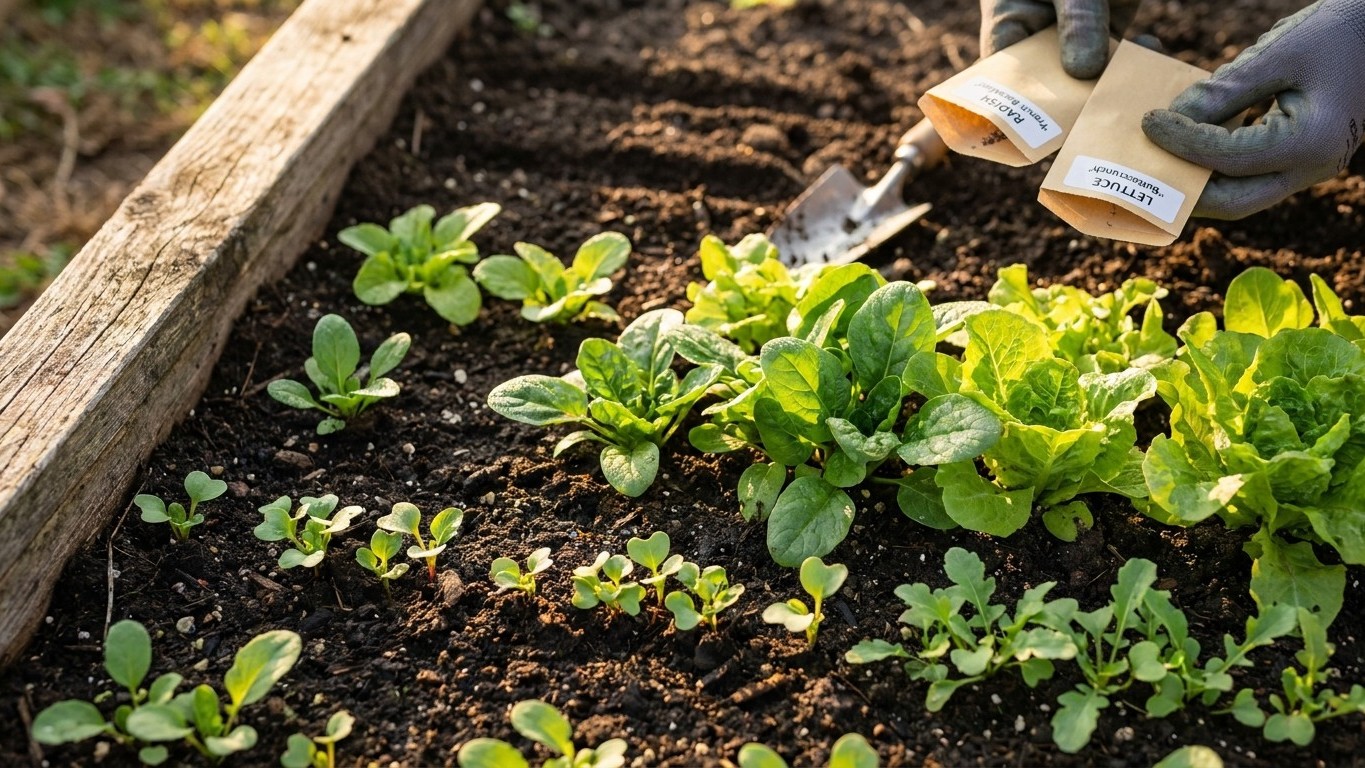

September in Connecticut still leaves a real planting window open: fall greens, radishes, turnips, and mesclun can go straight into the ground, cover crops go down toward month’s end, and garlic prep begins for the coming weeks. First frost doesn’t arrive until late October at the earliest along the coast, later inland is a different story, so the calendar still has room to work with.
What goes in the ground in September

The number that actually matters this month isn’t the date on the calendar, it’s the gap between today and the first freeze. At the Bridgeport station, NOAA’s 1991-2020 Climate Normals put the first fall freeze between October 28 and November 10. That’s a coastal reading, the mildest spot in the state. Inland counties and the northwest hills typically see that freeze line arrive earlier, sometimes by two or three weeks, so a gardener in Litchfield County should treat late September as their real planning horizon, not early November.
With six to nine weeks left before that freeze window in most of the state, quick-maturing crops are still a safe bet. Radishes, arugula, and mesclun mixes finish in 25 to 35 days, which means even a planting in the third week of September has a fair shot at a full harvest before the ground locks up. Spinach, lettuce, and baby kale run closer to 40 to 50 days and are best sown in the first half of the month if you’re inland.
Crops that still make sense
- Spinach and lettuce — sow early in the month for a fall harvest, or later for overwintering under cover
- Radishes, turnips, and mesclun — fast enough to go in through the third week
- Garlic cloves — soil needs to cool down first, so hold off until the very end of the month or into the following one
- Cover crops like winter rye or crimson clover — best seeded once summer crops are cleared, to hold soil through winter
What doesn’t belong in the ground now: anything warm-season. Tomatoes, peppers, squash, beans, and corn need a full season ahead of them, not the tail end of one. A gardener tempted by a warm afternoon and an empty bed is better off sowing a cover crop than gambling on a crop that won’t mature before the first hard frost.
What to start under cover
Cold frames and low tunnels change the arithmetic. A crop that would normally need 50 days in open soil can often finish in 60 to 65 days under row cover, because the fabric or glazing buys back several degrees on cold nights and slows the moisture loss that stresses young plants. Counting backward from the earlier end of the frost window (October 28 for coastal areas, two to three weeks sooner inland) gives a rough sowing deadline: subtract the crop’s days-to-maturity, then subtract another week or two as a buffer for the shorter, cooler days of late fall, when growth slows even if the thermometer hasn’t dropped yet.
Mâche, spinach, and baby kale sown under cover in the second or third week of September have a realistic shot at overwintering and producing through the colder months, especially in a cold frame that traps ground heat. Arugula and other quick greens sown a bit later can still fill a low tunnel through fall before the light gets too short to push new growth.
The two ways this goes wrong are almost opposite. Sow too early under cover, and the enclosed heat pushes plants into leggy, rootbound growth before the weather even turns cold, the plastic or glass acting like a mild oven rather than protection. Sow too late, and there isn’t enough daylight left for the plants to size up before growth stalls for the season, leaving small, disappointing plants that never really recover even once spring light returns.
What is ready to pick
September is the month the garden pays back the whole season’s work. Tomatoes are still ripening, though the pace slows as nights cool. Peppers and eggplant keep producing until a real chill sets in. Sweet corn planted mid-season is finishing up, and dry beans left on the vine are drying down for storage.
Winter squash and pumpkins are the crop to watch closely. They’re ready when the rind resists a fingernail press and the stem has started to dry and harden. Cut them with a few inches of stem attached; a squash with a broken or missing stem rots fast in storage no matter how good it looked coming off the vine.
Signs of ripeness worth knowing
- Apples — a gentle twist should separate the fruit from the branch without tearing
- Grapes — taste is the only real test; color change happens before sugar does
- Potatoes — dig a test hill once the foliage has died back, skins should be firmly set, not sloughing off with a rub of the thumb
- Onions — tops falling over on their own is the signal to pull and cure, not a sign something went wrong
Anything already in storage from earlier harvests deserves a check this month too. A single soft potato or onion in a bin can spread rot to its neighbors within days, so a quick sort now saves a lot more than it costs in time.
The jobs that matter this month
Soil prep tops the list, because a bed cleared and reseeded to a cover crop now holds its structure through winter rain far better than one left bare. Mulching comes right behind it: a two- to three-inch layer over any bed that’s finished for the season cuts down on winter weed germination and keeps the freeze-thaw cycle from heaving soil and roots.
Tomato and pepper plants still producing need their stakes and cages checked, not added fresh. By this point in the season a sprawling, top-heavy plant loaded with green fruit is one strong wind away from snapping at the base, and there’s still enough season left for those fruits to ripen if the plant stays upright.
Watering rhythm shifts as days shorten and evaporation slows, so beds that needed water every two or three days in midsummer often stretch to once a week without stress. Succession sowing of quick greens can continue right up until the days-to-maturity math stops working, which is really just an extension of the frost countdown covered above.
Pest scouting matters more now than it did a month ago, not less. Squash vine borer damage shows up as sudden wilting at the base of the vine, and cabbage worms tend to multiply fast on any brassica left unprotected as their competition dies back elsewhere in the garden. A floating row cover over fall brassicas solves both problems without a single spray.
What not to do in September
The classic mistake is trusting the air temperature over the soil temperature. A warm, sunny stretch in early September can feel like an invitation to squeeze in one more round of beans or squash, but the soil is already cooling from the nights, and warm-season seed germinates slowly, if at all, once soil temperatures start their fall slide. The plant that does sprout usually runs out of season before it produces anything worth the space.
Uncovering cold frames or row tunnels too readily after a mild afternoon is the second recurring error. The point of the cover isn’t the daytime temperature, it’s the overnight low, and a frame left open on what looked like a warm day can lose all its stored heat right before an unexpectedly cold, clear night.
Fertilizing with a high-nitrogen feed this late in the season pushes soft, leafy growth at exactly the moment plants should be hardening off for the cold ahead. That tender new growth is the first tissue damaged by an early frost, and it can drag the rest of the plant down with it. A low-nitrogen, higher-potassium feed, or none at all, suits most beds far better from this point forward.
Letting overripe fruit or split squash sit in the garden is a smaller mistake with outsized consequences: it draws yellowjackets, slugs, and rot organisms that spread to nearby healthy plants. A five-minute walk-through to clear anything past its prime does more good than another round of watering.
Checking this against your own county
A statewide frost window is a starting point, not an instruction. Connecticut’s USDA Hardiness Zones run from 6a to 7b, and that range alone tells you the coastal shoreline and the northwest hills are not on the same schedule. Elevation, distance from Long Island Sound, and even proximity to a lake or river can shift a frost date by two or three weeks in either direction. A garden in Fairfield County near the water is working with a different calendar than one in Litchfield County at higher elevation.
The most reliable next step is checking local data directly rather than relying on a single statewide figure. The UConn Extension publishes county-level guidance and planting calendars that account for these regional differences far than any single frost date can.
Common questions
Is it too late to plant a vegetable garden in Connecticut in September?
Not for fast-maturing crops. Radishes, arugula, mesclun, and spinach can still go in and finish before frost in most of the state, especially along the milder coastal areas where the first freeze often holds off until early November.
Can I still plant garlic in September in Connecticut?
Early September is generally too warm for garlic; the cloves need cooler soil to root well without pushing top growth too early. Waiting until the very end of the month, or into the following weeks, usually gives better results.
What’s the biggest risk to plants left outdoors in September?
An unexpected early frost, particularly inland where the first freeze can land well ahead of the coastal window of October 28 to November 10. Row covers or a simple sheet thrown over tender crops on a clear, still night can buy a few extra weeks of harvest.
Should I fertilize my garden in September?
Sparingly, if at all. High-nitrogen fertilizer this late encourages soft new growth that’s the first thing damaged by cold, so most beds do better with reduced feeding or a potassium-focused product as the season winds down.