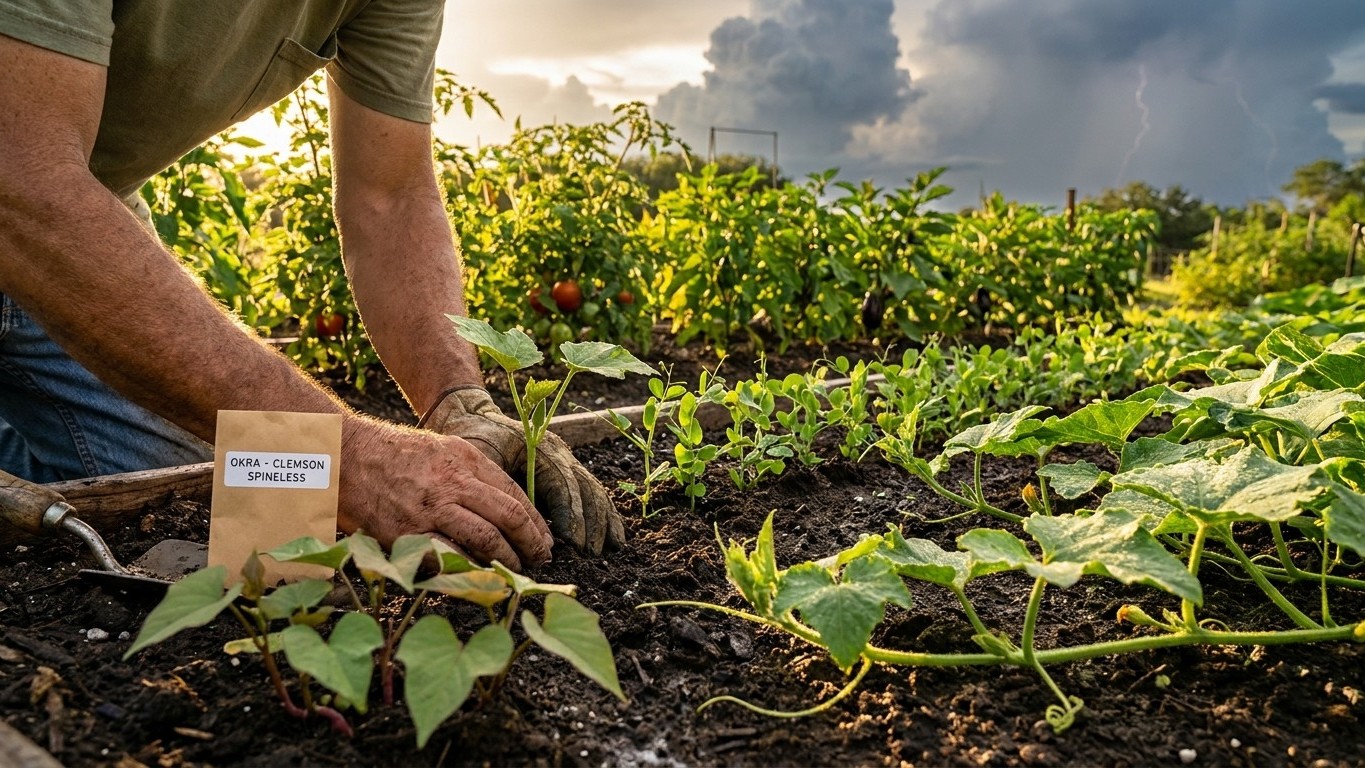

July across Florida is not about frost. It is about heat, humidity, and the daily thunderstorms that mark the start of the wet season. In north Florida, safe bets are okra, southern peas, sweet potato slips, and seminole pumpkin. Tomatoes and peppers are a gamble outdoors now. In central and south Florida, the growing calendar flips: winter is the main season, and July is mostly a month to prep and start seed under cover for fall.
What goes in the ground in July

The frost dates that matter for north Florida, a last spring freeze window of February 16 to March 7 and a first fall freeze window of November 26 to December 13 at the Jacksonville station (NOAA NCEI 1991-2020 Climate Normals, station USW00013889), sit months away in either direction. Neither one drives a July decision. What decides whether a seed or a transplant survives this month is soil temperature, air temperature, and how much standing water the afternoon storms leave behind.
North Florida still has a real outdoor planting list, but it is a short one built for heat. Okra, southern peas (cowpeas), sweet potato slips, seminole pumpkin, calabaza, and malabar spinach all tolerate the combination of high heat and wet soil that defines this month. Boniato and heat-tolerant eggplant varieties can also go in. Tomatoes, peppers, and most cucurbits are a gamble: blossoms drop in sustained high heat and fungal disease spreads fast once humidity climbs, so anything set out now needs disease-resistant varieties and a bet on an early break in the heat.
Central and south Florida sit on the other side of the calendar entirely. The USDA Plant Hardiness Zone Map (2023, built on 1991-2020 normals) places the Jacksonville area around zone 8b to 9a, while the peninsula runs warmer into zone 10b and 11b toward the coast and the Keys. In those warmer zones, summer is effectively the off-season: the main growing window runs through the cooler months, and July is closer to a rest period for the vegetable garden than a planting month.
| Region | July status | Safe to plant | Gamble or avoid |
|---|---|---|---|
| North Florida | Peak heat, active growing season | Okra, southern peas, sweet potato slips, seminole pumpkin | Tomatoes, peppers, most melons |
| Central Florida | Off-season for vegetables | Okra, roselle, tropical greens | Cool-season crops, direct-sown tomatoes |
| South Florida | Off-season, rainy and humid | Malanga, boniato, tropical fruit care | Nearly all temperate vegetables |
What to start under cover
The arithmetic for north Florida runs backward from that first fall freeze window of November 26 to December 13. A fall tomato needs roughly six to eight weeks from seed to a sturdy transplant, then another 60 to 80 days to first ripe fruit depending on variety. Starting seed indoors, under fans and shade cloth rather than a hot window, in July puts transplants ready to go out in August once the worst of the midday heat starts to ease, with enough runway to set and ripen fruit before that fall freeze window arrives.
Peppers follow the same logic with a slightly longer runway, since many varieties take closer to 70 to 90 days to first harvest after transplanting. Broccoli, cabbage, and other fall brassicas can also start under cover this month in north Florida, timed to move outside once nighttime temperatures drop into a range where they will not bolt or stall.
In central and south Florida, there is no fall freeze to count backward from, but the same logic still applies in a milder form: the fall vegetable season there typically opens once the punishing summer heat breaks, often in the October window. Starting tomato, pepper, and brassica seed under cover in July gives those transplants size and root strength before the ground becomes plantable again.
The two failure modes are the same everywhere. Start too early and seedlings sit rootbound in trays through weeks of heat they were never meant to tolerate, stalling before they ever reach the garden. Start too late, particularly in north Florida, and the fall crop runs out of warm days before it reaches maturity, caught by that November freeze window with green fruit still on the vine.
What is ready to pick
July is a genuine harvest month across most of the state. Okra planted earlier in the season is now producing pods that should be cut every day or two while still tender, generally at three to four inches; leave them longer and they turn woody fast in this heat. Southern peas fill their pods through the month and can be picked green for shelling or left to dry for storage.
Summer squash and cucumbers planted earlier in the season are often finishing their run by mid-July as vine borers and humidity-driven mildew catch up with them, so pick anything usable before pulling spent vines. Sweet corn planted in spring should be tasseling or filling ears; check by peeling back a small section of husk and pressing a kernel, it is ready when the juice runs milky rather than clear or watery.
Eggplant and peppers set earlier continue to produce through the heat if kept picked, since a plant left to hold mature fruit slows down new flowering. In central and south Florida, this is also prime season for several tropical fruits: mango and avocado harvests run through summer depending on variety, and muscadine grapes in the warmer parts of the peninsula often start ripening by month’s end. Check stored winter squash and onions from earlier harvests for any that have softened or sprouted, and use those first.
The jobs that matter this month
Mulch is the single job that does the most work in July. A thick layer, three to four inches of straw, pine bark, or leaf mulch, keeps root zones several degrees cooler and slows the moisture swings between a heavy afternoon storm and the next dry stretch, which is exactly what triggers blossom end rot in tomatoes and peppers.
Watering rhythm needs adjusting for the rainy season rather than switched off entirely. Daily thunderstorms can trick a gardener into skipping irrigation, but a fast-moving downpour often runs off before it soaks in, especially on beds with a mulch layer that sheds water. Check soil moisture at a few inches depth before assuming the rain did the job, and water early in the day if it did not, so foliage dries before evening and fungal disease gets less of a foothold.
Staking and caging cannot wait once okra, southern peas, and any remaining tomato vines start putting on rapid growth in the heat; a plant that sprawls in wet soil for even a week picks up rot and pest pressure that a properly staked plant avoids. Pest scouting matters as much as watering this month: hornworms, stink bugs, and whiteflies build up fast in the heat, and catching an infestation on one or two plants beats treating a whole row two weeks later.
Succession sowing of okra and southern peas every two to three weeks keeps a continuous supply through the heat rather than one glut followed by a gap. And with tropical storm season active across the state through summer and fall, this is a reasonable month to check that stakes, trellises, and any garden structures are secured before a storm rolls through.
What not to do in July
The most common mistake is planting a tender transplant, tomato or pepper especially, directly into full midday sun in July heat. The shock of a hot afternoon on a root system still settling in often kills it outright or stunts it for weeks. Transplant in the early evening instead, when soil and air temperatures have started to drop, and give new plants a few days of afternoon shade cloth if the forecast calls for a clear, blazing stretch.
A second mistake is treating this month as a cold-weather month at all. The frost windows for north Florida run from February 16 to March 7 in spring and November 26 to December 13 in fall; neither has any bearing on July, so covering plants against imaginary cold or delaying warm-season planting out of frost caution wastes effort that should go toward heat and moisture management instead.
Overwatering is easy to fall into once the rainy season starts, since a gardener used to a dry spring keeps the irrigation running on the same schedule even as daily storms add their own water. The result is waterlogged roots and root rot in crops like tomatoes and peppers that need drainage more than volume. And feeding a high-nitrogen fertilizer to a plant that is trying to set fruit, rather than a lower-nitrogen, higher-potassium feed, pushes lush leafy growth at the expense of the okra pods or peppers the gardener actually wants.
Checking this against your own county
A state-wide July is a starting point, not an instruction. Florida runs from a genuine cool-season climate near the Georgia line to a nearly frost-free tropical climate in the Keys, and elevation, coastal proximity, and simple distance south move these windows by weeks rather than days. A property forty miles inland behaves differently than one on the coast even at the same latitude.
For a planting calendar built around a specific county, the University of Florida’s IFAS Extension network is the reference to check. Local extension offices adjust recommendations for soil type, local pest pressure, and the real microclimate on the ground, which a state-wide guide cannot capture.
Common questions
Can tomatoes still be planted in Florida in July?
Outdoors in north Florida it is a gamble because sustained heat causes blossom drop and disease pressure climbs with the humidity. Starting seed under cover this month for an August transplant, timed against the fall freeze window, is the more reliable approach.
Why is July considered an off-season month in central and south Florida?
Those regions are largely frost-free, so their main vegetable season runs through the cooler months rather than summer. July’s heat and humidity make it a rest and preparation period for most temperate crops there.
What vegetables tolerate Florida’s July heat best?
Okra, southern peas, sweet potato slips, seminole pumpkin, and malabar spinach are among the most heat-tolerant options for direct outdoor planting statewide during this month.
Does the July rainy season change how much I should water?
Yes. Daily storms can run off rather than soak in, especially through mulch, so check soil moisture before skipping irrigation, and water early in the day to let foliage dry and limit fungal disease.