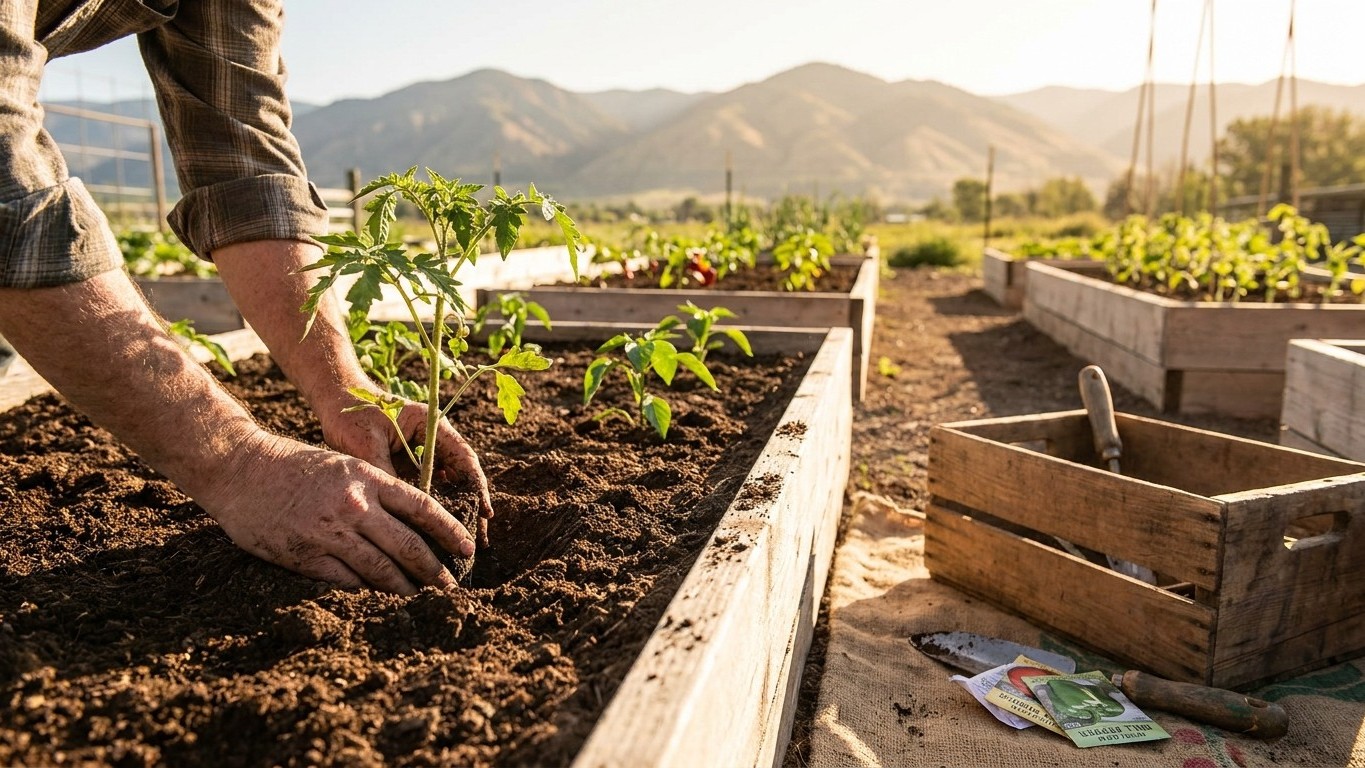

June is the green light for Idaho gardens in the valleys, once the last frost window of April 23 to May 7 has passed at low elevation. Tomatoes, peppers, squash, beans, corn, and melons can go into the ground now, alongside continued sowings of lettuce, carrots, and beets. Higher up, wait for soil, not the calendar, to tell you it’s time.
What goes in the ground in June

Soil temperature, not the date on the wall, decides what survives this month. In Boise’s valley, the average last spring frost falls between April 23 and May 7, which means by June the freeze risk has typically passed and the ground has had weeks to warm. That’s the mechanism that matters: a 32-degree freeze doesn’t care what month it is, and neither does a tomato root sitting in 50-degree soil. Warm-season crops need soil in the 60s to grow instead of sulk.
For gardeners in the low valleys, June is the month to commit. Bush and pole beans, sweet corn, cucumbers, summer squash, winter squash, pumpkins, melons, and transplanted tomatoes, peppers, and eggplant can all go in once nighttime temperatures stay reliably above the mid-50s. This is also prime time to keep succession-sowing the cool-season crops that don’t mind the heat coming: lettuce (choose heat-tolerant varieties), carrots, beets, chard, and radishes all still work from direct seed.
Idaho’s hardiness zones range from 3b to 7b under the USDA Plant Hardiness Zone Map, and that range is the whole story here. Boise sits toward the milder end. Mountain valleys and towns at higher elevation, McCall, Stanley, and similar high-country spots, run much colder and their frost window closes far later than Boise’s. In those places, June can still carry real frost risk, and pushing tender transplants outside on the strength of a warm afternoon is a gamble, not a plan. The safer move at elevation: hold tender crops until soil consistently reads 60 degrees or warmer on a simple soil thermometer, and don’t trust air temperature alone.
Garlic and shallots planted the previous fall are bulking up underground now and need no new planting this month. If you missed a fall garlic planting, June is too late for a bulb crop, but it’s not too late to tuck in a few shallot sets in cooler, higher gardens where the growing season still has months left to run.
What to start under cover
Work backward from your local frost window instead of forward from a date on a seed packet. In the Boise valley, since the last frost already sits behind you by June, starting warm-season transplants indoors now is mostly pointless, they’d outgrow their pots before the ground is ready anyway. Higher-elevation gardeners are a different story: if your area’s last frost typically lands weeks later than Boise’s April 23 to May 7 window, June may still be the right moment to start tomatoes, peppers, or squash indoors, counting six to eight weeks back from your own expected last frost.
The more useful backward count for most of the state runs off the fall frost instead. Boise’s average first fall frost falls between October 7 and October 21. Fall brassicas, broccoli, cabbage, and cauliflower destined for an autumn harvest need roughly 60 to 80 days from transplant to maturity, plus another few weeks of seedling growth before transplant. Counting back from mid-October puts the seed-starting window for these squarely in June, under cover or in a shaded seed tray, so they’re sturdy transplants by the time the summer crops start clearing out garden space.
Two failure modes bracket this window. Start too early and you get leggy, rootbound seedlings sitting in trays for weeks with nowhere to go, stressed before they ever touch soil. Start too late and the fall brassicas run out of daylight and warmth before they head up, leaving you with plants that never quite finish. Neither mistake is fixable once it happens, which is why the backward count matters more than any fixed date.
What is ready to pick
June rewards patience from earlier in the season. Rhubarb stalks are thick and ready for cutting, and the first strawberries are ripening in beds that were established in prior seasons. Garlic planted last fall is sending up scapes, the curling flower stalks that are worth snapping off both to eat and to redirect the plant’s energy into the bulb below ground.
Spring-sown lettuce, spinach, and radishes planted in the earliest weeks of the growing season are hitting harvest size now, and they need picking promptly, spinach especially bolts fast once daytime heat climbs. Early peas, if sown as soon as soil was workable, are filling pods and ready for a first picking. Green onions and any overwintered leeks that made it through are ready to pull.
Check them by feel and by look rather than by guesswork: lettuce heads that feel firm and full, radishes with shoulders pushing up through the soil surface, pea pods that are plump but still bright green and snap cleanly. Anything left too long past ready, particularly spinach and radishes, turns bitter or woody fast in rising June heat, so a harvest missed by a week is often a harvest lost. If you’re carrying stored onions or potatoes from the previous season, this is the month to use them up, they’re at the end of their storage life and any soft or sprouting ones should be culled before they spread rot to the rest.
The jobs that matter this month
Staking and trellising can’t wait. Tomatoes, peas, and pole beans put on rapid growth in June, and a plant that sprawls unsupported for even two weeks develops a growth habit that’s hard to correct later, plus it invites rot and pests where foliage touches soil. Get stakes, cages, and trellis strings in place while plants are still small enough to train without breaking stems.
Mulching matters more in June than in any earlier month, because this is when soil moisture starts evaporating fast under longer days and rising heat. A two- to three-inch layer of straw or shredded leaves around vegetable beds cuts water loss significantly and keeps root zones from swinging between soaked and bone-dry, which is what actually cracks tomatoes and splits carrots later on.
Watering rhythm shifts too. Shallow, frequent watering trains roots to stay near the surface where they dry out fast; deep, less frequent watering pushes roots down where moisture lingers. Aim for the equivalent of about an inch of water a week, delivered in one or two soakings rather than a daily sprinkle.
Succession sowing keeps the harvest coming instead of arriving all at once. Sow another short row of bush beans, lettuce, or radishes every two to three weeks through June, and the July and August harvest stays steady instead of gapping.
Pest scouting pays off now because June is when populations build fast. Check the undersides of squash and cucumber leaves for aphid clusters and the base of squash plants for the flat, coin-shaped eggs of squash bugs. Catching an infestation at ten insects is a five-minute job; catching it at ten thousand is a lost crop.
What not to do in June
The classic June mistake is trusting the air instead of the soil. A run of 80-degree afternoons feels like permission to plant every warm-season crop at once, but if the soil underneath is still cool from a wet spring, tender transplants sit in place, roots stalled, susceptible to rot, while a week later a proper warm spell would have let them take off immediately. Check soil temperature directly rather than going by how the afternoon feels on your skin.
Uncovering too early after a mild stretch is the second trap, particularly at higher elevation where June frost is a real, if declining, possibility. Pulling row covers or cold frame lids off tender seedlings during a warm week can leave them fully exposed when a late cold night follows, and a single hard frost after hardening plants have lost their acclimation can undo weeks of growth in one night.
Nitrogen timing trips up a lot of tomato and pepper growers in June. A heavy nitrogen feed once plants are flowering pushes lush green foliage at the expense of fruit set, since the plant channels the extra nitrogen into leaf growth instead of blossoms. Once flowering starts, a lower-nitrogen, higher-phosphorus and potassium feed supports fruit development instead of working against it.
Overwatering newly set transplants is the quieter mistake. Wet, waterlogged soil around a young seedling’s stem invites damping-off and root rot, especially if the plant was just moved from a controlled indoor environment into variable outdoor conditions. Water in well at transplanting, then let the soil surface dry slightly between waterings rather than keeping it saturated.
Checking this against your own county
Everything above is a starting point built around Boise’s valley climate, not a fixed instruction for the whole state. Idaho’s hardiness zones span 3b to 7b, and elevation alone can shift a frost window by weeks between a low valley and a mountain town forty miles away. A garden in a river bottom that traps cold air behaves differently than one on a south-facing slope nearby, even at similar elevation.
Before committing tender transplants to open ground, check your own conditions against the University of Idaho Extension, which maintains region-specific guidance for the state’s varied growing zones.
Common questions
Is it too late to plant tomatoes in Idaho in June?
No, not in the valleys. With Boise’s last frost typically falling between April 23 and May 7, June transplants still have a full summer ahead of them. At higher elevation, June may in fact be the ideal window once local frost risk has cleared.
Can I still direct-sow beans and corn this month?
Yes, in low-elevation gardens where soil has warmed well past the last frost window. Both crops need consistently warm soil to germinate reliably, so a soil thermometer reading in the 60s is a better guide than the calendar date.
What should I start indoors in June for a fall harvest?
Broccoli, cabbage, and cauliflower seedlings started under cover now, counting back from Boise’s average first fall frost of October 7 to October 21, should be ready to transplant out in time to mature before autumn cold arrives.
Why do my June transplants sit still instead of growing?
Usually cold soil, not cold air. Warm afternoons can mask soil that’s still slow to warm from a wet spring, and tender transplants stall in cool root zones even when the air feels summery.