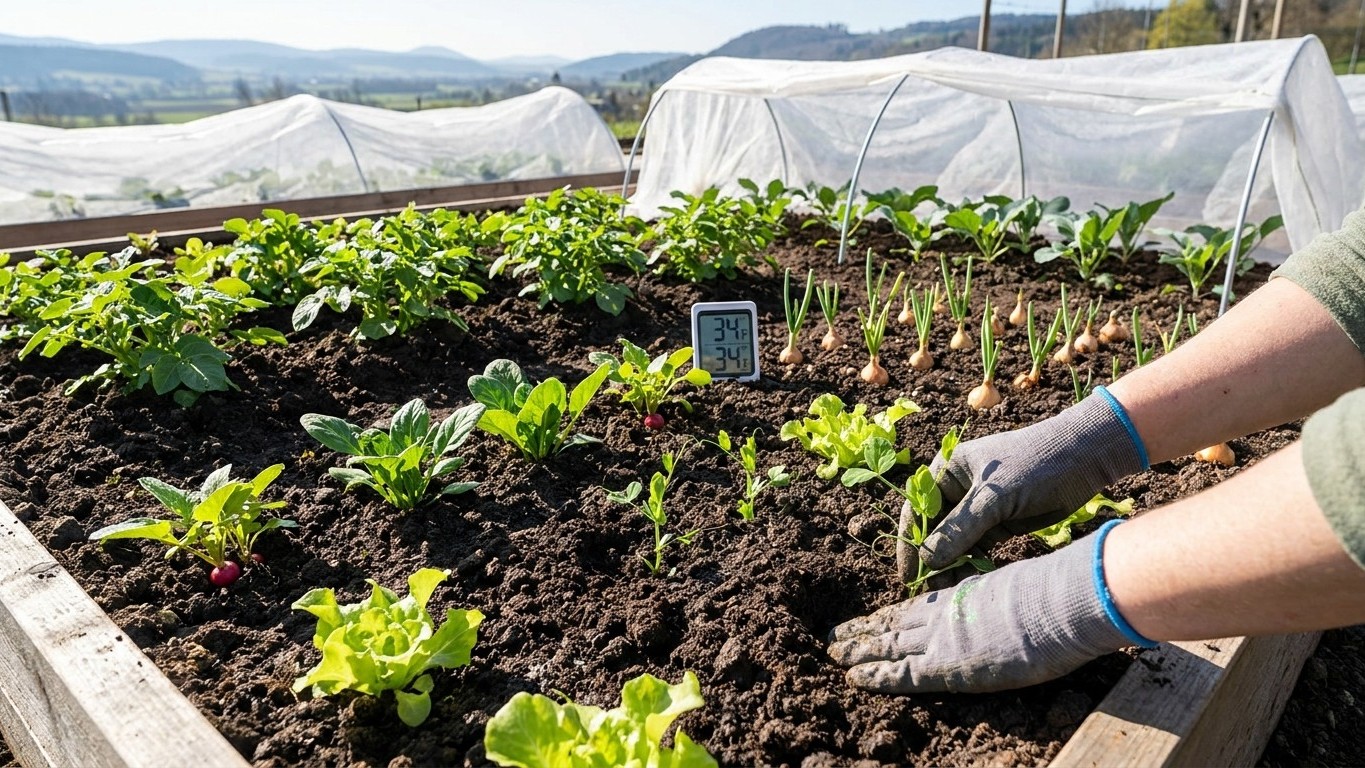

May is when Idaho’s growing season finally opens up for real. In the Boise valley, the frost window that runs April 23 to May 7 is winding down, so cool-season crops go in early in the month and warm-season transplants wait for the tail end of that window, or later. At higher elevations across the state, treat May as prep month, not planting month, until the ground itself says otherwise.
What goes in the ground in May

The calendar says May, but the soil doesn’t care what the calendar says. In the Boise area, the last spring frost falls somewhere between April 23 and May 7, based on NOAA’s 1991-2020 climate normals for station USW00024131. That means the first week or two of May can still carry a frost risk in the valley, and a lot longer at elevation. The decision about what to plant outdoors this month comes down to two things: has the frost window closed where you garden, and has the soil actually warmed, not just the air.
Early in the month, while frost is still plausible, direct-sow the crops that shrug off a light freeze. Peas, spinach, lettuce, arugula, radishes, carrots, beets and chard all tolerate a cold night better than a gardener’s nerves usually do. Onion sets and seed potatoes go in now too, since both handle a late frost without much drama. Brassica transplants, cabbage, broccoli, kale, cauliflower, can go outside under a floating row cover for insurance while nights are still uncertain.
Once the frost window closes
Once the local frost date has passed and the soil has actually warmed through, not just the air on a sunny afternoon, warm-season crops become safe to set out: tomatoes, peppers, squash, cucumbers, beans and corn. In the Boise valley that usually means the back half of May. At higher elevations, where the season runs weeks shorter, hold off, because a warm afternoon doesn’t mean the ground six inches down has caught up. Idaho’s USDA hardiness zones span 3b to 7b, and Boise sits toward the milder end of that range. A garden in a mountain valley or at higher elevation is working with a different, shorter calendar entirely, regardless of what the thermometer reads at noon.
What to start under cover
Counting backward from the frost window, rather than forward from a fixed date, is the only arithmetic that actually holds up from one garden to the next. Tomatoes generally need about six to eight weeks indoors before they’re ready to transplant, and peppers run closer to eight to ten. Anchored to Boise’s April 23-May 7 window, that puts ideal start dates back in late February through mid-March for anyone targeting a valley garden. If that window has already slipped by, the smart move for May is to start quick-maturing warm-season crops instead: bush beans, summer squash and cucumbers can still be started under cover for a transplant in a few weeks, without losing the season.
Melons and winter squash, both slow to size up, are worth starting indoors now if they haven’t gone in yet, since they need every extra week of warmth they can get before frost returns in fall. The first fall frost across the Boise area lands between October 7 and October 21, which sets the other end of the growing season and, indirectly, how much runway a slow crop actually has.
Two mistakes show up every May. Starting too early leaves transplants rootbound and leggy by the time the ground is finally ready, stunting them right when they should be taking off. Starting too late means a young, small transplant goes into the ground with too few weeks left before the season closes, especially rough at higher elevations where the growing window is already compressed. Neither is fatal, but both cost real yield.
What is ready to pick
Asparagus is the classic May harvest in Idaho, and it’s worth checking beds daily once spears start pushing, since a spear that looks perfect on Monday can turn woody by Friday. Cut or snap spears when they’re about six to eight inches tall and still tight at the tip; once the tip starts to loosen and fern out, that spear is past its best and should be left to feed the plant instead.
Rhubarb stalks are usually substantial enough to pull by May as well, once they’ve reached at least eight to ten inches, twisting rather than cutting to avoid leaving a stub that can rot. Anything sown under cold frames or low tunnels earlier in spring, spinach, lettuce, radishes, green onions, should be coming in steadily now, and cutting outer leaves rather than whole heads keeps the harvest going longer.
Stored crops from the previous fall deserve one more pass before they’re cleared out for the season. Winter squash with soft spots, potatoes that have started sprouting or gone green from light exposure, and onions that feel soft at the neck should all come out of storage and either be used immediately or composted. Letting one rotting squash sit among the others in a bin is how a single bad piece turns into a lost shelf.
The jobs that matter this month
Staking and caging tomatoes and other sprawling crops now, before they’ve put on real size, saves a lot of frustration later. Once a tomato plant has flopped over and tangled itself, working a cage around it damages roots and stems that a little earlier planning would have avoided entirely.
Hardening off transplants matters just as much as timing the transplant itself. Seedlings raised indoors or in a greenhouse need several days of gradually increasing outdoor exposure, sun, wind, and cooler night air, before they go into the ground permanently. Skipping this step is one of the most common ways gardeners lose transplants they spent weeks nursing along.
Succession sowing keeps a harvest coming instead of arriving all at once. Lettuce, radishes, and other quick crops planted every two weeks, rather than all in a single sitting, spread the harvest out over the season instead of dumping it into one overwhelming week followed by nothing.
Mulching pays off differently depending on timing. Applied once the soil has actually warmed, mulch holds moisture and suppresses weeds. Applied too early, over soil that’s still cold, it can trap that cold in and slow warm-season crops right when they need the ground heating up. Watering rhythm shifts too as temperatures climb: shallow, frequent watering on new transplants gives way to deeper, less frequent watering as roots establish, which encourages roots to grow down instead of staying shallow and vulnerable.
Pest scouting now catches problems while they’re still small. Aphids on new growth and flea beetles on young brassica leaves are both easier to knock back with a strong water spray or row cover in their early stages than after they’ve built up a real population.
What not to do in May
The most common mistake is planting warm-season crops into cold soil because a stretch of warm afternoons made it feel like summer had arrived. Air temperature is not soil temperature, and tomatoes or peppers set into ground that hasn’t caught up will sit and sulk, sometimes for weeks, even if they don’t die outright. Waiting until the frost window has genuinely closed, using Boise’s April 23-May 7 range as the reference point for valley gardens and adjusting later for elevation, is the more reliable read than judging by a warm week.
Uncovering frost-protected beds too early after a mild stretch is the same mistake from a different angle. A row cover or cold frame that comes off after a few nice days, only to get hit by a frost that falls back inside the documented window, can undo weeks of careful growing in a single night.
Nitrogen timing trips people up too. A heavy nitrogen feed early on pushes lush leafy growth, which sounds good until it comes at the expense of flowering and fruit set later in the season, particularly on tomatoes and squash. A modest, balanced feed at transplant, followed by a lighter hand once flowering starts, generally outperforms one big early dose.
Overwatering new transplants before their root systems have had a chance to establish is the last trap. Constantly soggy soil around a young plant encourages shallow roots and can invite rot, where letting the top inch or so dry out between waterings pushes roots to reach down and get established properly.
Checking this against your own county
A statewide frost window is a starting point, not an instruction. Boise’s April 23-May 7 range comes from a single valley station, and Idaho’s terrain swings from low desert valleys to high mountain basins within the same state, sometimes within the same county. Elevation alone can shift a frost window by weeks, and the difference between north and south Idaho adds another layer on top of that. The state’s hardiness zones span 3b to 7b, USDA’s system, and that range says plainly that no single planting date applies everywhere.
For a read specific to your own elevation and location, the University of Idaho Extension is the reliable source to check before setting a planting date in stone.
Common questions
Is May too late to plant tomatoes in Idaho?
Not in the Boise valley, where the frost window closes by May 7 and warm-season transplants typically go in through the back half of the month. At higher elevations, May is often still prep time rather than planting time, so check local conditions before setting tomatoes out.
Can I still plant potatoes in May?
Yes. Seed potatoes tolerate a light frost and are commonly planted early in the month, including in the window when frost is still possible in the Boise area.
Why did my seedlings stall after I moved them outside?
Skipping the hardening-off period is the usual culprit. Seedlings raised indoors need several days of gradual outdoor exposure before a permanent move, or they can stall or scorch in full sun and wind.
How do I know if my area’s frost window is different from Boise’s?
Elevation, and whether you’re in north or south Idaho, both shift the window meaningfully. The University of Idaho Extension is the best source for a location-specific estimate rather than relying on the Boise valley figures alone.