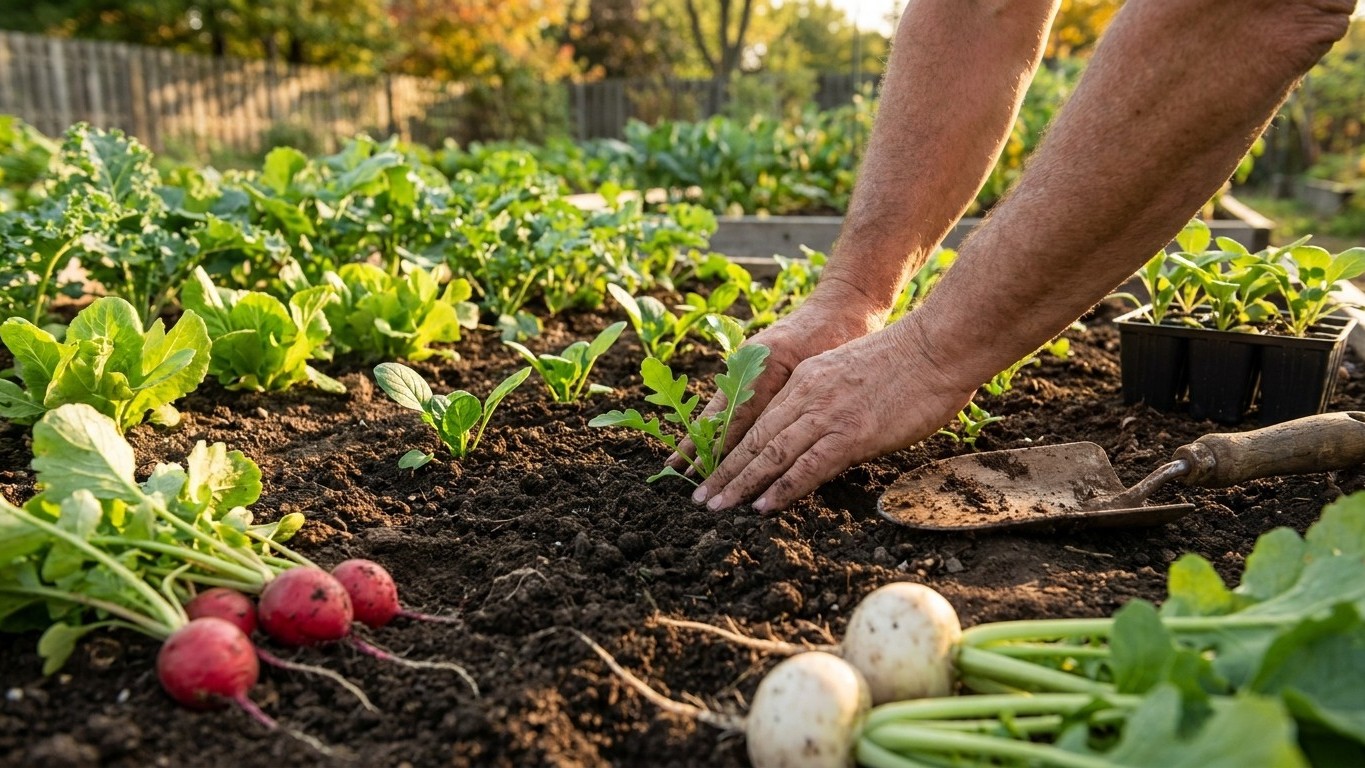

September is the second planting season for Illinois gardeners. Soil is still warm from summer, but the first fall frost (October 24 to November 3, per NOAA climate normals for the Chicago area) is close enough that only fast-maturing, cold-tolerant crops make sense now. Think leafy greens, root vegetables, and cover crops, not another round of tomatoes.
What goes in the ground in September

The decision this month hinges on subtraction, not the calendar. Count the days between now and that October 24 to November 3 frost window, then match that number against how long a crop actually needs to mature. A radish that finishes in 25 days is a safe bet on September 1. A crop that needs 70 days is not, even though the soil still feels like summer.
Direct-sown crops that work well through most of September include spinach, arugula, mache, mustard greens, and loose-leaf lettuce. These germinate fast in warm soil and tolerate the light frosts that show up before the true killing freeze. Radishes and turnips are another safe choice, since both size up quickly and actually sweeten after a cool night or two. Peas sown in the first week of the month can still produce a fall crop in much of the state, though later sowings run out of time.
Transplants are the better move for anything slower. Broccoli, cabbage, and kale seedlings started in July or August can go into the ground now and reach harvest before the hard freeze arrives, something direct-seeded versions of those same crops usually cannot manage this late.
What to hold off on
Garlic and shallots are the classic September temptation, and the classic September mistake. Most Illinois growers get better results waiting until soil temperatures drop further in October or into November, when the cloves root in without pushing top growth that winter will just kill back. Planting garlic too early in warm September soil often means weak bulbs the following summer. Warm-season crops (tomatoes, peppers, melons, summer squash) are an outright gamble at this point; none of them will mature before frost, no matter how mild the weather feels.
What to start under cover
Working backward from that October 24 to November 3 frost window is the only reliable method here, because a fixed date on a seed packet does not know what county you garden in. Take a crop like lettuce, roughly 30 days to a usable baby-leaf harvest. Sown in the first week of September, it has close to eight weeks of growing time before the earliest frost date, plenty of room. Sown in the last week, it has closer to four, still workable under a cold frame or row cover but with far less margin for a cool, slow stretch of weather.
This is where a cold frame or low tunnel earns its keep. Both raise the soil and air temperature enough to keep spinach, lettuce, and Asian greens growing several weeks past when they’d stall in open ground. A simple hoop of PVC and clear plastic sheeting over a bed does most of the same job for far less money than a built frame.
Two mistakes show up every year. Starting seedlings too early in the heat of early September, before the weather has broken, often produces leggy, stressed transplants that never recover. Starting too late, waiting past mid-month for cooler weather that never quite arrives, leaves too few days on the clock for the crop to size up before frost shuts things down. The sweet spot is sowing while it’s still warm enough to germinate quickly, then getting cover in place before the first real cold snap.
What is ready to pick
September is harvest month for a lot of what went in back in spring. Tomatoes and peppers, if they escaped early blight, are still producing steadily and will keep going until the first frost knocks them back. Summer squash and cucumbers slow down but rarely stop outright this early. Sweet corn planted for a late crop is often at peak in the first half of the month.
Fall apples and pears are ripening across much of the state’s hardiness range (USDA zones 5a to 7b), with timing shifting by a couple of weeks depending on variety and how far south the orchard sits. Winter squash and pumpkins are usually ready to come off the vine once the stem hardens and the skin resists a fingernail; leaving them a little longer for the skin to cure actually improves storage life.
Basil deserves special attention this month. It has zero frost tolerance, so a big harvest before the first cold night, even a mild one that doesn’t technically reach freezing, is the difference between a full batch of pesto and a mushy, blackened plant. Checking stored garlic and onions from the summer harvest for any that have gone soft is worth doing now too, before a couple of bad ones spread rot through the whole batch.
The jobs that matter this month
Succession sowing is the single most useful habit this month. Putting in a new short row of lettuce, spinach, or radishes every 10 to 14 days keeps something coming ready right up until frost, instead of one big harvest followed by empty beds. Skipping this is the most common way gardeners waste September’s growing window.
Soil preparation for anything going in now, or for garlic beds being readied for next month, pays off far more than it will later. Working in compost while the soil is still workable and biologically active gets nutrients cycling before the ground cools and slows everything down.
Watering rhythm needs adjusting as days shorten and temperatures drop. Plants need less water overall, but newly seeded fall crops still need consistent surface moisture to germinate, so a light, frequent watering schedule usually replaces the deep-soak routine of midsummer.
Pest scouting still matters. Cabbage worms and aphids often surge on fall brassicas just as they’re establishing, and catching an infestation early on a young transplant is far easier than trying to save a stripped plant two weeks later. Squash vine borer activity typically tapers off, which is one less thing to watch.
Clearing spent summer plants (finished bean vines, bolted lettuce, played-out squash) keeps disease and pest pressure from carrying into next season, and everything that isn’t diseased can go straight into the compost pile. It’s also a good month to order garlic if you’re planning that October or November planting, since good varieties from mail-order suppliers do sell out.
What not to do in September
The most common mistake is treating warm September air as permission to plant warm-season crops. A stretch of 80-degree days late in the month feels like summer, but tomatoes, peppers, and melons started now have no realistic path to harvest before that October frost window arrives. The air temperature is not the signal; the calendar math against the frost date is.
A related error is pulling row covers or cold frame plastic off too early after a warm spell, assuming the risk has passed. A single cool, clear night can still bring frost even in the middle of an otherwise mild stretch, and young fall seedlings have far less cold tolerance than the same plants would have once they’ve hardened off over several weeks.
Heavy nitrogen feeding is the third trap. Late-season nitrogen pushes soft, leafy growth on crops that need to be toughening up for cooler weather, not racing to put on new tissue. It also encourages the same soft growth that gets hit hardest by an early frost. A lower-nitrogen feed, or none at all for crops close to harvest, serves the plant better this late in the season.
Finally, resist planting garlic on the first cool morning of the month just because it finally feels like fall. Soil temperature lags behind air temperature by weeks, and garlic planted into still-warm ground tends to sprout top growth that winter simply destroys, weakening the bulb underground.
Checking this against your own county
Everything above is a starting point built from one reference weather station, not a guarantee for your backyard. Elevation, lake effect off Lake Michigan, and the simple distance between the northern and southern ends of Illinois can shift frost timing by two weeks or more in either direction. A garden in the far south of the state often has real weeks of extra growing time that a garden near the lakeshore doesn’t get. For a planting calendar tuned to your specific county, the University of Illinois Extension is the reliable next stop.
Common questions
Is it too late to plant tomatoes in Illinois in September?
Yes, in almost all cases. With the first fall frost typically arriving between October 24 and November 3, tomatoes started or transplanted in September don’t have enough time left to set and ripen fruit before the season ends.
Can I still plant garlic in September in Illinois?
It’s early. Most Illinois growers get stronger bulbs by waiting until soil temperatures drop further in October or November, so the cloves root in without pushing vulnerable top growth before winter.
What vegetables can I direct-sow outdoors in September?
Fast-maturing, cold-tolerant crops do best: spinach, arugula, mache, mustard greens, loose-leaf lettuce, radishes, and turnips. Peas sown early in the month can also produce a fall crop in much of the state.
How do I know when the first frost is coming to my specific area?
The October 24 to November 3 window comes from one airport weather station, and rural or elevated gardens often see frost one to two weeks earlier than that. Checking your local county extension office or a nearby weather station’s history gives a more accurate read than relying on a statewide average.
Gardeners who plant by the Moon can check the September 2027 moon planting calendar, a tradition rather than a proven method.