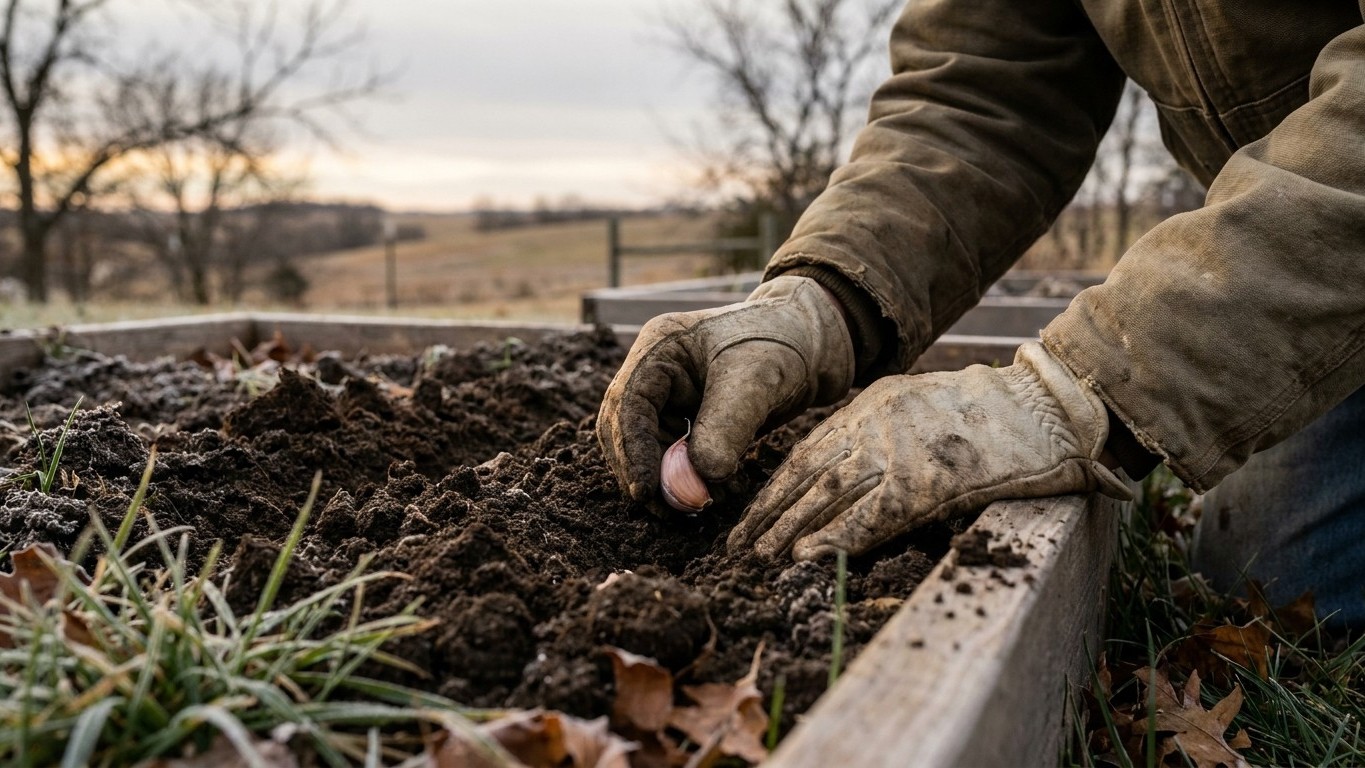

In Kansas, direct-sowing options in November are thin. The first fall frost window, Oct 23 to Nov 2 based on NOAA data, has usually already passed by the time this month opens, so open ground is closing fast. The one crop still worth planting outdoors is garlic, along with shallots, pushed into workable soil before it locks up for winter. Everything else happens under cover, in storage, or with pruning shears and seed catalogs, not in open rows of summer vegetables.
What goes in the ground in November

Soil temperature decides what survives outdoors, not the page of a calendar. The first fall frost in the reference city normally arrives somewhere between Oct 23 and Nov 2, based on NOAA National Centers for Environmental Information 1991-2020 climate normals for the airport weather station. By November that freeze has usually already happened, which means topsoil across most of the state is cooling into the 40s and dropping toward the 30s at night. Suburban and rural gardens away from that monitoring site tend to see the first frost even earlier, sometimes by a week or two, more at elevation, so treat this window as a starting point rather than a guarantee for a specific yard.
Garlic and shallots: the exception
Against that backdrop, one crop still belongs in open ground this month: garlic. Hardneck and softneck varieties both want a cold period to form proper bulbs, and pushing cloves into workable soil now, pointed end up, four inches deep, gives roots time to establish before the ground locks up hard. Shallots follow the same logic and can go in alongside garlic rows. Both should be mulched with straw once planted, one of the jobs covered further down.
Cold frames, bare-root stock, and forcing indoors
Cold frames and low tunnels extend the season for anything already established. Spinach, mâche, and hardy lettuce seeded earlier can keep producing under a layer of protection well past what open ground allows. Bare-root fruit trees, roses, and berry canes can also go in during dormancy if the ground is not yet frozen solid, since roots continue slow growth even in cold soil as long as it stays workable.
Indoors, this is the month for forcing rather than sowing. Rhubarb crowns dug and moved into a dark, cool space will push tender stalks within weeks. Chicory roots lifted from the garden and forced in a bucket of sand produce witloof, the pale, slightly bitter heads sold at a premium in grocery stores. Neither needs sunlight, and both give a landing spot indoors for a gardener since outdoor planting for anything tender is off the table across the state at this point in the season.
What to start under cover
Counting backward from the last spring frost, April 4 to April 18 at the reference station based on the same NOAA normals, most warm-season transplants would need to start indoors roughly six to eight weeks before that window opens, which lands in February, not November. Starting tomatoes, peppers, or squash under cover this month leaves them rootbound and leggy long before the ground is fit to receive them, one of the two failure modes that trips up gardeners eager to get a jump on spring.
Fast crops and cold-loving seed
The other failure mode runs the opposite direction: waiting so long that fast crops never mature before the season’s own limits catch up. Under cover in November, that argument favors two different kinds of seed. The first is anything with a days-to-maturity measured in days rather than months, microgreens and sprouts chief among them. A tray of radish or pea shoots sown indoors on a windowsill is ready to cut in one to two weeks, giving fresh greens through the darkest stretch of the year without waiting on a garden bed at all.
The second category is seed that actually needs cold to germinate. Many native perennials and some tree and shrub seeds require a period of cold, moist stratification before they will sprout, and a cold frame or an unheated cover outdoors does that job naturally. Sowing those seeds into pots or flats now, then setting them under cover for the coming cold months, saves a trip to the refrigerator crisper drawer later and lines up germination for when soil actually warms. Anything aimed at an April transplant date belongs on a seed-starting calendar for later winter, not this month’s task list.
What is ready to pick
Little comes out of open ground in November beyond what was already growing under cover or mulch. Kale and leeks left in place through the first fall frost actually improve, since cold exposure converts starches to sugars and takes the edge off kale’s bitterness. Both can be harvested as needed straight from the row even after snow, so long as the ground beneath is not frozen solid.
Cover crops and stored produce
Cold frames carry more of the harvest load this month than open rows do. Spinach, mâche, and hardy lettuce planted earlier in the fall keep producing at a slower pace under glass or plastic, and a light touch of ventilation on sunny days keeps them from cooking even when nighttime temperatures drop hard. Indoors, sprouts and microgreens sown in succession on windowsills fill the gap for anyone wanting fresh greens on a weekly rhythm rather than a seasonal one.
Storage crops need checking now more than picking. Squash, potatoes, and onions put up earlier in the fall should get a hands-on inspection: any squash with a soft spot or a sweet, fermenting smell should be used immediately rather than left to spread rot to its neighbors, and potatoes or onions showing sprouts or soft give should be pulled from the batch. A single compromised piece left in a bin of stored produce can take down the rest within weeks, so this check is worth repeating every couple of weeks through winter, not just once.
The jobs that matter this month
Dormant pruning tops the list for fruit trees and cane berries. Apple, pear, and stone fruit trees are easiest to shape once their leaves have dropped and their structure is visible, and cuts made during dormancy heal faster than cuts made mid-season, with less risk of attracting pests to fresh wounds. Raspberry and blackberry canes that fruited over summer can be cut to the ground now, clearing the way for new growth to take over.
Seed ordering belongs on this month’s list too, and not as an afterthought. Popular varieties, particularly heirloom tomatoes and specialty peppers, sell out from seed companies well before the packets would actually go into soil, so ordering now secures the varieties worth growing rather than settling for whatever remains on the shelf later in winter.
Soil, compost, and structure
A soil test taken now gives results in time to amend before spring planting, and lime, if the test calls for it, needs months to shift pH, making November amendments far more useful than ones applied in March. Compost piles built over the growing season benefit from one more turn before the coldest weather sets in, speeding decomposition while the pile still holds some residual heat.
Raised beds, fencing, and trellis structures are easiest to repair once the garden is empty and the ground is still soft enough to set a post. Waiting until spring means competing with planting deadlines for the same afternoon. Tools deserve the same attention: pruners, loppers, and shovels cleaned of sap and soil, then sharpened and lightly oiled, last longer and cut cleaner, and doing this once now beats doing it in a rush before the first warm planting weekend arrives.
What not to do in November
A stretch of unseasonably mild days tempts gardeners into planting warm-season crops outdoors, on the theory that if the air feels warm enough for a walk without a coat, it is warm enough for a seedling. Soil temperature lags behind air temperature by days or weeks, and a pepper or tomato transplant set into soil still holding the chill of last week’s freeze will simply sit and sulk, if it survives at all. Warm afternoons in November are for outdoor jobs, not for outdoor planting of anything tender.
Covers, timing, and fertilizer
The same mild spell causes a second common mistake: pulling row covers or cold frame lids off too early to let plants “breathe.” A few warm days do not mean the cold is finished, and uncovering hardy greens or newly mulched garlic during a brief thaw, only to have temperatures drop again a few days later, undoes weeks of protection. Covers earn their keep by staying in place through the swings, not just through the cold snaps.
Feeding nitrogen late in the season is a third trap. Nitrogen pushes soft, leafy growth, exactly the kind of tissue that freezes and dies back hardest when a real cold snap arrives. Perennials, fruit trees, and garlic beds are better served by finishing fertilizer applications well before this point in the season and switching instead to mulch, which insulates roots without encouraging new growth that the coming cold will only kill anyway.
Checking this against your own county
Every figure above comes from one weather station, and Kansas stretches across enough elevation and latitude that a single statewide month means something different in the northwest corner than it does in the southeast. Frost tends to arrive earlier in the northwest and later in the southeast, and low-lying yards away from that reference station typically see frost sooner than the airport does, sometimes by a week or two.
| Reference figure | Value | Source |
|---|---|---|
| First fall frost | Oct 23 to Nov 2 | NOAA NCEI 1991-2020 Climate Normals |
| Last spring frost | April 4 to April 18 | NOAA NCEI 1991-2020 Climate Normals |
| USDA Hardiness Zone | 5b-7a | USDA Plant Hardiness Zone Map, 2023 edition |
For a planting calendar tuned to a specific county, the Kansas State University Research and Extension service publishes local guidance worth checking before finalizing this month’s list.
Gardeners who plant by the Moon can check the November 2026 moon planting calendar, a tradition rather than a proven method.
Common questions
Can garlic still go in the ground in November in Kansas?
Yes, as long as soil is workable and not yet frozen. Garlic and shallots are the main direct-sown crops for this month, planted before the ground locks up for winter and mulched with straw afterward.
Is it too late to plant bulbs in Kansas by November?
Spring-flowering bulbs like tulips and daffodils can still go in if the ground remains workable, since they need a cold period underground before spring growth. Grass seeding works better earlier in fall, when soil temperatures still support root establishment, so a November seeding often stalls until spring germination instead.
What vegetables can survive a Kansas winter outdoors?
Kale and leeks under thick mulch, along with greens protected in a cold frame, can survive well into winter and even improve in flavor after frost. Anything without that protection, or anything warm-season, will not make it through a hard freeze.
When should seed starting for spring vegetables begin instead?
Counting back six to eight weeks from the last spring frost window of April 4 to April 18 puts most warm-season seed starting in February, not November. Cold-hardy crops like onions may start a few weeks earlier than that timeline.
Elsewhere? See what to plant in November in every state and province.