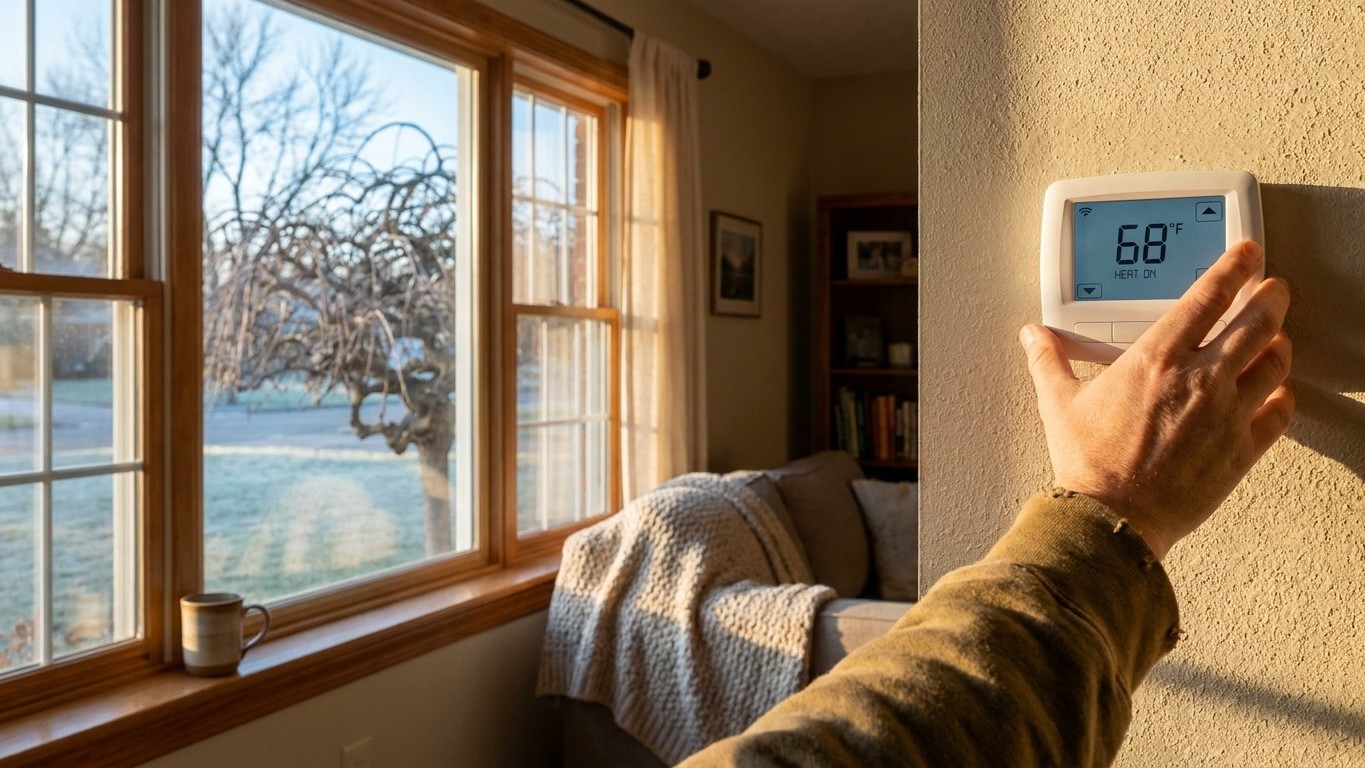

Kansas households start feeling the pull toward the thermostat in October, as mornings turn crisp across the Wichita area and the mean temperature slips below the 65 F mark that defines heating demand. The season runs roughly seven months, peaking hard in January, before spring finally pushes temperatures back above that threshold in May.
When the heating season starts in Kansas

The numbers behind that October start come from a specific threshold: NOAA counts a heating degree day every time the daily mean temperature falls below 65 F, because that’s roughly the point where a typical home needs supplemental heat to stay comfortable. At the Wichita reference station, October’s normal mean temperature is 59.0 F, which is why it’s the first month that registers real heating demand on the 1991-2020 Climate Normals record. January is the coldest month in that same 30-year average, racking up 986 heating degree days, more than any other month on the calendar. The season stretches for about seven months total, with the mean climbing back above 65 F by May.
That said, a monthly normal is a 30-year average, not a forecast for any particular week. Cold snaps don’t wait for the calendar to catch up. It’s common for a household in Wichita, Salina, or Dodge City to need a few hours of heat in late September, well before the “official” start of the season shows up in the climate record.
The table below lays out the full shape of the season, month by month, using the same 65 F base.
| Month | Heating Degree Days |
|---|---|
| January | 986 |
| February | 767 |
| March | 550 |
| April | 277 |
| May | 79 |
| June | 4 |
| September | 32 |
| October | 231 |
| November | 576 |
| December | 911 |
The table skips July and August: neither month registers any heating degree days at this station, since the summer mean stays well above the 65 F base. That’s the flip side of a Kansas winter that arrives fast and hits hard once it does.
How hard the winter works here
Wichita’s annual total comes out to about 4,414 heating degree days a year, measured against the same 65 F base. Degree days work as a rough stand-in for fuel use: a house that racks up twice as many degree days in a season will, all else being equal, burn roughly twice as much fuel to stay warm. That 4,414 figure gives Kansas households a way to think about their own heating load, separate from whatever the utility bill says in any given year, since fuel prices shift constantly while the climate underneath them doesn’t.
What the annual number can’t tell you is the shape of the season, and that’s exactly what the monthly table above fills in. Two places can share nearly identical yearly totals while feeling completely different to live through: one might spread a moderate chill across eight months, while another crams the same total heat demand into four brutal weeks. Kansas leans toward the second pattern. Roughly a third of the entire year’s heating degree days pile up in December and January alone, which means furnaces here aren’t idling gently through a mild winter, they’re working near full capacity for a compressed stretch, then backing off fast as spring moves in.
The same station also logs about 1,774 cooling degree days a year, a reminder that Kansas homes swing hard in both directions, cranking the AC through a hot summer and the furnace through a sharp winter, with comparatively little of the year spent needing neither.
What most homes in Kansas actually heat with
Federal survey data on how Kansas homes actually heat gives a clear picture of what’s installed on the ground, even if some categories are too small to report with confidence.
| Equipment or Fuel | Share of Homes |
|---|---|
| Furnace | 86% |
| Central heat pump | 6% |
| Steam or hot-water boiler | not reported |
| Natural gas | 71% |
| Electricity | 21% |
| Propane | 6% |
| Fuel oil or kerosene | none reported |
Two of those rows need a word of explanation. “Not reported” for boilers means the survey turned up too few Kansas households running one to publish a reliable estimate, not that the number is zero. “None reported” for fuel oil works the same way. Neither figure means nobody in the state heats that way, only that the sample size fell short of what the survey needed to publish a number.
The dominant pattern here is straightforward: a furnace burning natural gas is what most Kansas houses were built around, and that combination shows up in the vast majority of homes. But a share this large isn’t a recommendation, it’s a snapshot of what was cheap and available when these houses went up. A furnace paired with gas heats a house fast and evenly through a hard winter, and it tends to be less expensive to run than electric resistance heat given how the fuel and equipment costs typically compare. Where it struggles is efficiency loss through ductwork and, in older units, a steady decline in combustion efficiency as components age. The one maintenance item that quietly costs the most homeowners when skipped is the air filter. A clogged filter forces the blower motor to work harder, chokes airflow to every room, and in worse cases can cause the heat exchanger to overheat and shut the whole system down mid-January.
Run it once before you need it
Every heating system in Kansas seems to fail on the same night: the first real cold snap, when every HVAC technician in the county already has a full voicemail box. The fix is running the test weeks earlier, sometime in October, before the January squeeze arrives. Here’s the order that matters, cheapest and fastest steps first, professional help last.
- Turn the thermostat down, then back up a few degrees above room temperature, and listen for the furnace to kick on within a minute or two. A short cycle should run smoothly, without banging, squealing, or a burner that won’t stay lit.
- Expect a burnt-dust smell for the first few minutes. That’s normal: it’s just dust that settled on the heat exchanger over the summer burning off, and it should clear on its own.
- Check the air filter and swap it if it’s visibly gray or clogged. This is the single cheapest thing that keeps a furnace running efficiently all winter.
- Walk the house and clear anything blocking vents, registers, radiators, or the outdoor unit if there’s a heat pump involved. Furniture, curtains, and boxes stacked against a vent choke airflow and force the system to work harder.
- Test the carbon monoxide alarm and replace the battery if it’s due. Combustion appliances that aren’t venting properly can produce carbon monoxide, and a working alarm is the cheap insurance against that risk.
- If the system won’t start, cycles on and off rapidly, trips a breaker, or the alarm sounds, stop and call a licensed technician rather than troubleshooting further.
Even a furnace that passes every one of those checks can still be losing heat before it reaches a room. According to the U.S. Department of Energy, “in a typical house, about 20%-30% of the air that moves through the duct system is lost due to leaks, holes, and poorly connected ducts.” That’s not a flaw in the furnace itself, it’s what’s happening in the attic, crawlspace, or basement between the unit and the vent, and it’s worth having a technician check while they’re already out for the seasonal tune-up.
What turning it down is actually worth
The Department of Energy puts a specific number on the value of a thermostat setback: “You can save as much as 10% a year on heating and cooling by simply turning your thermostat back 7-10 F for 8 hours a day from its normal setting.” That figure covers a full year of heating and cooling combined, tied to a specific setback range held for a specific stretch of hours each day, not a per-degree formula anyone can scale up or down.
For a Kansas household, that setback has more hours to work with than it would somewhere with a short, mild winter. With roughly seven months of heating demand on the books here, an 8-hour setback at night or during the workday compounds across a much longer stretch of the calendar than it would in a place where the furnace barely runs. The math behind the DOE’s figure doesn’t change, but the number of days it applies to certainly does.