
Yes, insulation keeps a Kansas home cooler, and it matters more than most homeowners here assume. The state sits deep enough into the country’s hot half that a properly insulated attic isn’t a nice-to-have. It’s the difference between a house that fights its own roof all summer and one that doesn’t.
The short answer for Kansas

Yes, and it matters for a real chunk of the calendar. At the Wichita reference station, the average year brings 57.6 days that hit 90°F or higher. That’s not a handful of scorchers in late July. That’s nearly two full months where an attic without enough insulation is actively working against the air conditioner below it.
Kansas also straddles a real divide in how the country builds for climate. Under the 2021 International Energy Conservation Code, 88 of the state’s 105 counties sit in zone 4A, a mixed-humid zone where cooling season carries real weight in the energy bill. The other 17 counties fall in zone 5A, a cooler zone where winter typically does more of the work. That’s a county count, not a population share, so it doesn’t tell you which zone covers Wichita or Topeka specifically. What it does tell you is that Kansas isn’t a single-answer state. Most of its counties lean toward a climate where summer heat load is a serious design factor, while a smaller band leans colder.
What that split means in practice: a homeowner in the 4A majority is dealing with a longer, hotter cooling season layered on top of a real winter, so insulation earns its keep twice over. A homeowner in the 5A minority still gets those 90-degree days, just with a bit more of the year’s energy math tilted toward heating. Neither situation makes insulation optional. It changes which season does more of the paying back, not whether the investment holds up.
The 57.6-day figure is also worth reading correctly. It’s a count of days that reached 90°F or higher at one reference station, not a description of every square mile of the state, and not the average summer temperature. It’s the number that drives heat stress on people, plants, and roofing materials, and it’s the number that explains why an underinsulated ceiling in Kansas isn’t a minor inefficiency. It’s a direct pipeline for outdoor heat to reach the rooms you’re paying to cool.
What happens above the ceiling
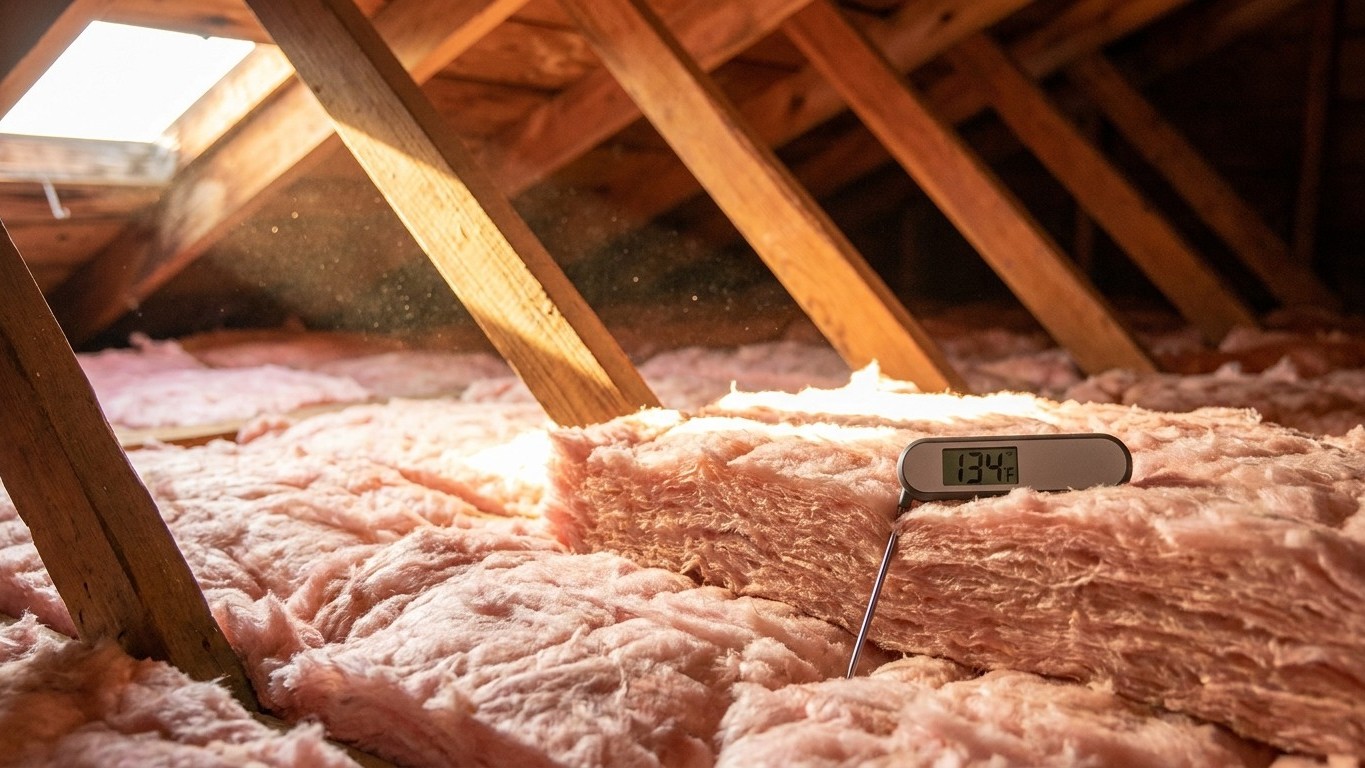
A roof deck baking under a Kansas sun in July doesn’t sit at outdoor air temperature. It runs well above it, sometimes dramatically so, because dark shingles and direct sun load the roof surface far past whatever the thermometer says at ground level. That heat doesn’t stay in the shingles. It radiates and conducts down into the attic space, and the attic becomes the hottest room in the house, whether anyone lives in it or not.
Everything below that superheated attic air feels it. The ceiling drywall absorbs heat from above and re-radiates some of it into the living space. Ductwork routed through the attic picks up heat before the cooled air ever reaches a supply vent. Boxes stored up there become an unintentional thermometer for just how hot that space gets. None of this requires a design flaw. It’s simply what an attic does under a hot roof, unless something is resisting the heat flow.
That something is insulation, and here’s the point that gets missed: the same attic insulation that keeps heat inside a house in January is what slows heat from moving downward in July. It isn’t a winter product that happens to help in summer. It’s a resistance to heat flow in either direction, and in the warm months that flow runs from the superheated attic toward the cooled living space below. More resistance up top means less of that heat ever reaches the ceiling.
What ENERGY STAR recommends for this territory’s zones
ENERGY STAR publishes retrofit levels for existing wood-framed homes, organized by climate zone. These are the two zone rows relevant to Kansas, based on the 2021 IECC climate map:
| Zone | Attic if uninsulated | Attic if you already have 3-4 inches | Floor |
|---|---|---|---|
| Zones 4A and 4B | R60 | R49 | R19 |
| Zones 6, 5 and 4C | R60 | R49 | R30 |
Those are retrofit targets for existing construction, not new-build code minimums, and the table isn’t three attic numbers. It’s an attic value for a bare attic, a separate attic value for one that already has a few inches of insulation, and a third column for the floor over unheated space. Finding which of Kansas’s two zones applies to a specific address means checking the county table or the ENERGY STAR zone map directly. No page can safely assign that from a distance.
What homes in Kansas cool with
Nationally, air-conditioning equipment of some kind runs in 93% of homes surveyed, and 85% of those homes rely on a central air-conditioning system, according to the U.S. Energy Information Administration’s Residential Energy Consumption Survey. Another 15% of households cool with an individual unit instead, a window box, a wall unit, a portable, or a ductless mini-split. Ceiling fans back up the mechanical cooling in 73% of homes. Those figures describe the households surveyed, not every house standing, but they’re the closest national read on how a typical Kansas home is actually keeping cool through those 57.6 above-90 days.
The central-air majority is exactly where the attic insulation story gets complicated. In a house where ductwork runs through the attic, those ducts are sitting in the hottest part of the entire structure, sometimes 30 or 40 degrees hotter than the rooms they’re supposed to be cooling. Ceiling insulation slows heat from reaching the living space below, but it does nothing to protect the ducts themselves, which are exposed to that superheated attic air along their entire run. That’s a separate problem with a separate fix, and it’s worth reading through in a dedicated guide to insulating ducts in the attic rather than assuming ceiling work covers it.
For the smaller share running window units, wall units, portables, or mini-splits, the math is different. There’s no attic duct run to worry about, but the room’s own walls, window seals, and the unit’s installation quality become the whole ballgame for how much cool air stays put. A room air conditioner working against a poorly sealed window frame is fighting a battle that insulation and weatherstripping can mostly win. That side of the equation gets its own treatment in a guide to room air conditioners and window units, since the fixes there look nothing like attic work.
What the heat asks for that the cold does not
Two tools belong specifically to hot climates, and neither one shows up on a winter checklist.
A radiant barrier is the first. It’s a reflective layer, usually foil-faced, installed in the attic to bounce radiant heat back toward the roof deck instead of absorbing and re-emitting it downward. It carries no R-value, which means it isn’t insulation in the technical sense and doesn’t replace the attic insulation levels above. It earns its place specifically under a sun-loaded roof, where radiant heat gain is the dominant problem. Given that Kansas averages 57.6 days a year above 90°F, with the majority of its counties in the warmer 4A zone, a radiant barrier is a legitimate consideration here, paired with adequate attic insulation rather than instead of it. In a territory with only a handful of hot days a year, that same product wouldn’t be worth the install. In Kansas, the summer load is real enough to justify it.
The second is about which direction moisture travels. In winter, warm moist air inside a heated house pushes outward toward the cold, which is why interior vapor retarders matter in cold climates. In summer, especially in a humid climate, that flow reverses: the damp air is often outside, working its way in through the wall assembly. It’s part of why the model energy code doesn’t require an interior vapor retarder in its warmest, most humid zones. Kansas’s mix of zone 4A and zone 5A counties means this isn’t a one-line answer for the whole state, and it’s worth settling separately on this territory’s dedicated vapor barrier guide rather than here.
What the work is worth
ENERGY STAR’s own estimate is specific, and it’s worth quoting exactly rather than rounding: “EPA estimates that homeowners can save an average of 15% on heating and cooling costs (or an average of 11% on total energy costs) by air sealing their homes and adding insulation in attics, floors over crawl spaces, and accessible basement rim joists.”
Both numbers matter, and they answer different questions. The 15% applies specifically to heating and cooling costs combined. The 11% applies to total energy costs, which includes water heating, appliances, lighting, everything else on the utility bill alongside heating and cooling. Neither number stands alone without its denominator, and neither should be blended with other savings figures floating around the same topic.
The reason that combined 15% figure matters for a page about Kansas summer heat specifically: it isn’t a winter number that happens to carry over into summer. It’s modeled across both seasons together, which is exactly why insulation earns a place on a cooling checklist and not just a heating one. The work covered by that estimate is also specific: attics, floors over crawl spaces, and accessible basement rim joists. It doesn’t extend to walls, windows, or doors, even though those components matter for comfort too.
These are averages drawn from energy modeling of a typical existing U.S. home, not a guarantee for any specific house in Wichita, Topeka, or a county on either side of the state’s zone 4A and zone 5A line. A house that’s already reasonably insulated will see a smaller gain than one starting from bare attic joists, and a house with major air leaks alongside thin insulation may see more benefit than the average suggests. The number is a planning reference, not a promise, and it’s the figure to use when weighing attic and floor insulation work against everything else competing for the same home improvement budget.